

Guai: proclaim first, then decide
Content version · · Sources & references
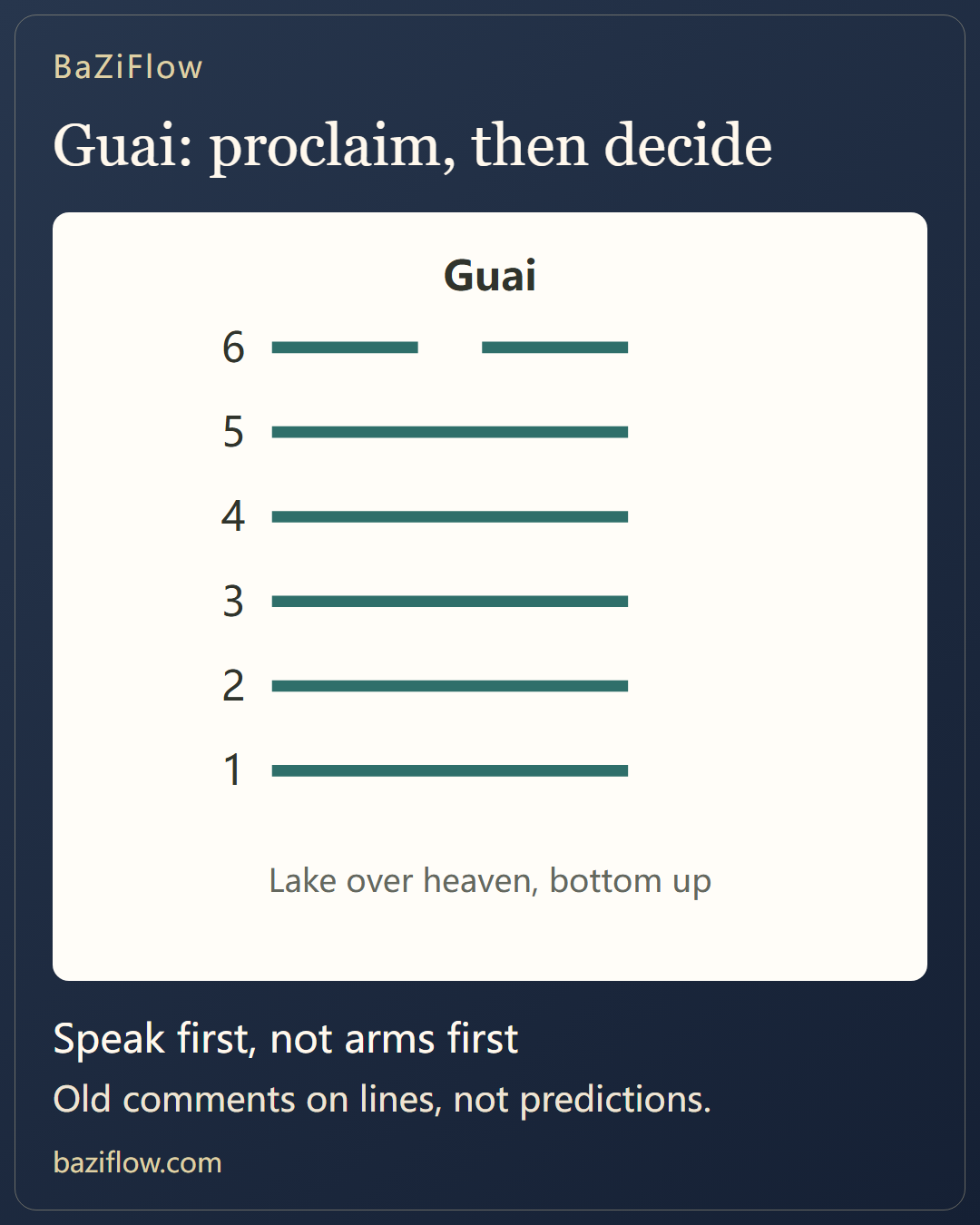
Guai (夬) is the 43rd hexagram: Dui (lake) above Qian (heaven), five yang lines and one yin. Read the spoken acts of the judgment, “deciding yet harmonious”, and the toes, cheekbone and “call” of the lines.
The short version7 min read
Guai means deciding, yet its decision begins with speaking: proclaim it in the court, call out sincerely, announce it from your own town, and do not take up arms. The six lines then show several ways a decision goes, and the last is “no call”.
- Guai stacks Dui (lake) on Qian (heaven). Only the topmost of its six lines is yin, which the Commentary calls “the soft riding on five firm lines”, and “the firm grows and reaches its end” is the yang lines filling up to the fifth place.
- Before refusing arms, the judgment puts speech first: proclaim, call out, announce. The Commentary sums the hexagram up as “strong and pleased, deciding and harmonious”.
- Toes (line 1), cheekbone (line 3) and buttocks (line 4) each give a way of going. “Resolve and resolve” occurs in lines 3 and 5. “Call” occurs in the judgment, line 2 and line 6, and line 6 says “no call”.
Read first
The Sixty-Four Hexagrams: How Upper and Lower Trigrams Form One Figure ↗
Judgment and Line Statements: Whole Hexagram or Single Line? ↗
A lake above heaven: five yang lines, one yin
The lower trigram of Guai (夬) is Qian (heaven) and the upper is Dui (lake). In the Shuo Gua Qian is “strength” and Dui is “pleasing”. Counting upward, the first five lines are all yang and only the sixth is yin. The Commentary gives the shape a name, “the soft riding on five firm lines”: one soft line sitting on five firm ones.
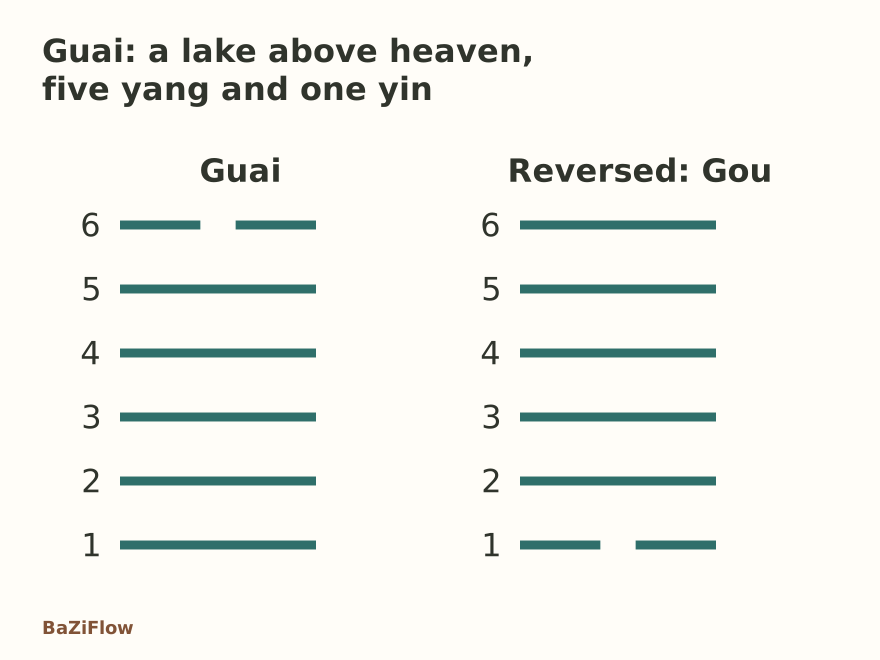
Guai and its reversed hexagram Gou: turned upside down, the single yin line at the top of Guai lands at the bottom of Gou.
Enlarge diagram · scroll sideways to read
Three words: Guai, the soft on five firm, arms
- Guai
- The Commentary defines it at once: Guai means deciding, the firm deciding the soft. Literally it is to decide, to break open.
- The soft riding on five firm
- Of the six lines only the top one is yin, and it sits on five yang lines. This is how the Commentary sums up the shape.
- Arms
- Weapons and war. The judgment says “not fitting to take up arms”, and line 2 has “weapons at nightfall”: the same word, in two places.
The judgment and the Commentary: speak first, arms not first
The judgment of Guai is a run of acts: proclaim it in the king’s court; call out sincerely, with danger; announce it from your own town; it is not fitting to take up arms; it is fitting to have somewhere to go.
Guai means deciding: the firm decides the soft. Strong and pleased, deciding and harmonious: “proclaim it in the king’s court” means the soft rides upon five firm lines. “Call out sincerely, with danger” means the peril is thereby made bright. “Announce it from your own town; not fitting to take up arms” means that what is held up is then exhausted. “Fitting to have somewhere to go” means the firm grows and reaches its end.
Enlarge diagram · scroll sideways to read
The judgment never says what the decision rests on. It lists several things that must be said aloud first, and only then rules out arms. The Commentary starts from the qualities of the trigrams: Qian below is “strong” and Dui above is “pleased”, so “strong and pleased”; the deciding is at the same time harmonious, so “deciding and harmonious”.
“Call out sincerely, with danger; the peril is thereby made bright”: calling out with sincerity, there is danger, and the Commentary says this makes the danger bright, open and aboveboard. “What is held up is then exhausted”: if one takes up arms, what one had upheld comes to its end. The last sentence, “the firm grows and reaches its end”, can be matched against the figure: the yang lines are unbroken from the first place through the fifth, and only the topmost place is still yin, so the growth has run its course.
The Great Image: a lake above heaven; bestow, and shun hoarding
The Great Image (大象) of Guai reads:
A lake above heaven: Guai. The noble person bestows emoluments on those below, and to sit on virtue is shunned.
“A lake above heaven”: the lake lies higher than heaven, so the water has gathered at the highest place. The word for deciding is written with the water radical and literally means water breaking through a bank, and a lake lifted over heaven can be set beside that sense. The noble person’s conduct is half doing, half avoiding: bestow downward, and shun sitting on virtue.
Enlarge diagram · scroll sideways to read
“Bestows emoluments on those below” is giving one’s pay to those lower down. In “to sit on virtue is shunned”, to sit on is to occupy and store up: keeping virtue piled up on oneself is what is shunned. Tradition usually reads it this way: storing up kindness and not passing it down is what is avoided.
Six lines: toes, cheekbone, buttocks, two “resolves”, one “no call”
Of the six statements of Guai, three name a part of the body: a toe, a cheekbone, a buttock.
Enlarge diagram · scroll sideways to read
Line 1 says “strong in the front toes”: the front toes are strong and he pushes ahead, “going without being able to win is a fault”, and the Small Image says “going without winning is a fault”. Line 3 says “strong in the cheekbones: ill fortune”; the character used (頄) is usually read as the cheekbone. Line 4 says “no skin on the buttocks, his walk faltering”: bare of skin, he walks haltingly. “If he leads a sheep, regret vanishes”; “he hears words but does not believe them”. The Small Image gives two comments: the place is not proper, and his hearing is not clear.
“Resolve and resolve” appears in two lines, both in yang places. In line 3: “the noble person resolves and resolves; walking alone he meets rain and is wet through and angry: no blame”. He decides, and decides again, walks alone, is caught in rain, soaked and cross, yet there is no blame, and the Small Image says “in the end no blame”. In line 5: “the wild herb, resolved and resolved; walking the middle, no blame”. Tradition usually reads the herb as a kind of weed. The Small Image’s verdict is “the middle is not yet bright”: in the middle, but not yet bright.
“Call” occurs three times. In the judgment, “call out sincerely” is the sincere call. In line 2, “an alarm cry; weapons at nightfall; do not be anxious”, the Small Image grants him the middle way. In line 6, “no call: in the end, ill fortune”, the Small Image says “in the end it cannot last”. The judgment asks for things to be said aloud first, and the topmost statement is the one where nothing is said.
Bo, Gou and Qian: neighbors of Guai
Guai has five yang lines and one yin line, the yin at the top. Its inverse hexagram Bo (剥) is exactly the opposite: five yin lines and one yang, the yang at the top. Turn Guai upside down and the yin line drops from the top to the bottom, which is Gou (姤), so Gou is the reversed hexagram (综卦) of Guai (see the figure above). The nuclear hexagram (互卦) is Qian: the four middle lines of Guai are all yang, and whether you take lines 2 to 4 or lines 3 to 5 the result is Qian, with Qian on both sides.
Enlarge diagram · scroll sideways to read
The Xu Gua writes Guai after Yi and Gou after Guai: when increase does not stop there must be a break, and after the break there must be an encounter.
Questions readers ask next
Does Guai argue for resolute removal?
In the text the course of Guai is to speak out first, and it says plainly that taking up arms is not fitting; the Commentary calls it “deciding, yet harmonious”. Among the lines some, “resolve and resolve”, bring no blame, while others, “going without being able to win” and “a faltering walk”, show a decision that goes too far or hesitates.
What do “strong in the front toes” and “no skin on the buttocks” mean?
Literally, strong toes and buttocks with no skin. One line is about pushing ahead and not winning, the other about walking haltingly, and both describe a decision going badly on the way. The body part in line 3 (頄) is usually read as the cheekbone.
What is “to sit on virtue is shunned”?
Literally, to keep virtue stored up for oneself is a taboo. It stands against the sentence before it, “bestows emoluments on those below”, and tradition usually reads it as piling up kindness without passing it down.
Was this article helpful?
Sources & references
Continue reading
Yi (益): wind over thunder, from “from above to below” to “no one adds; someone strikes” ↗
Gou: one yin line meets five yang, from “tied” and “wrapped” to “horns” ↗
The Sixty-Four Hexagrams: How Upper and Lower Trigrams Form One Figure ↗
Judgment and Line Statements: Whole Hexagram or Single Line? ↗