

Heavenly Virtue Combination: eight months, not twelve
Content version · · Sources & references
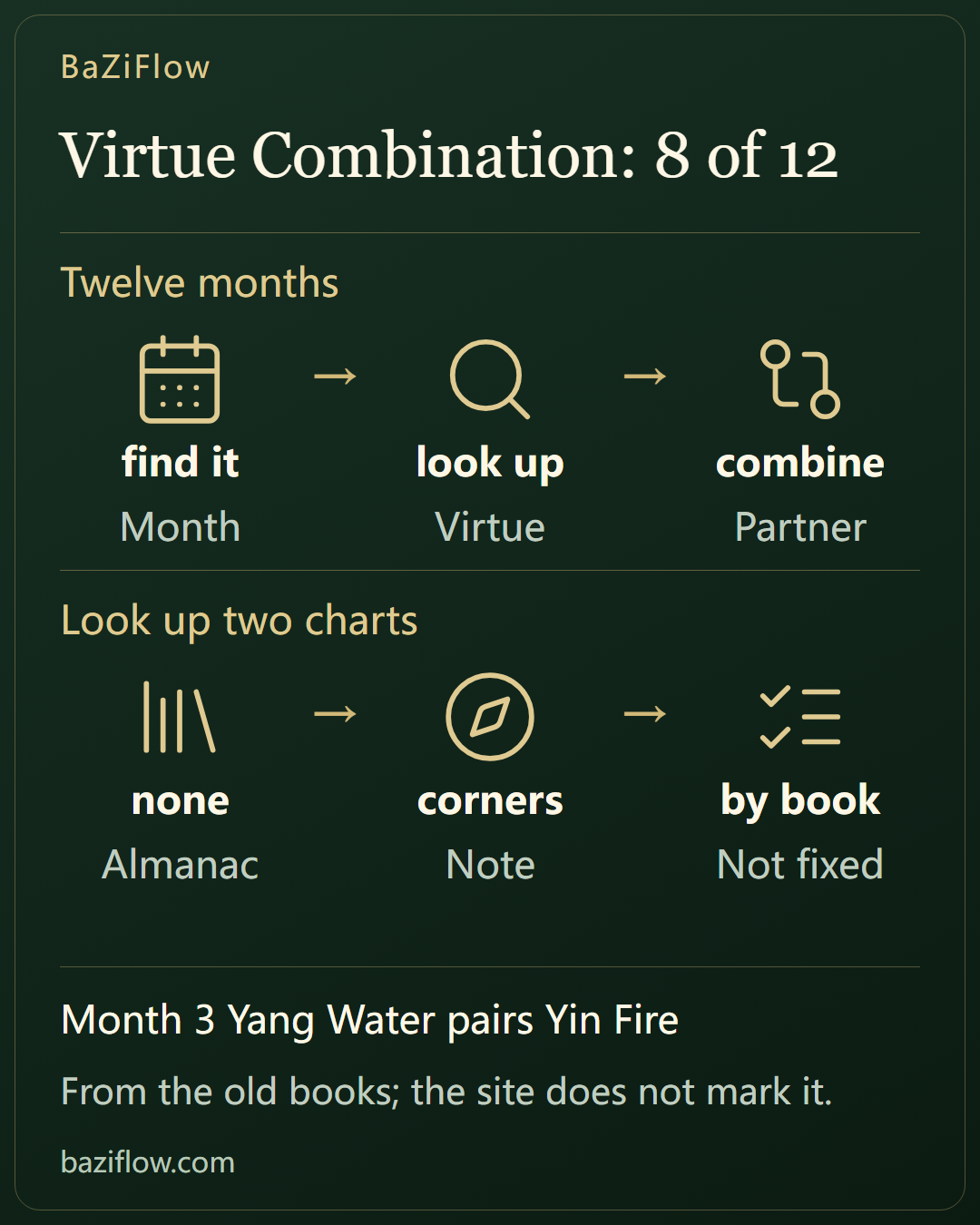
The Heavenly Virtue Combination is the Five-Combination partner of the month's virtue stem, found in eight months. The four middle months have only a direction, and the books split on them. The site does not mark it.
The short version10 min read
The Heavenly Virtue Combination has no table of its own: it is the Five-Combination partner of the month's Heavenly Virtue. Find the month's virtue first; if it is a stem, take the stem it combines with. In the four months where the virtue is a direction, the almanac records no partner.
- Only eight of the twelve months yield a partner; in months 2, 5, 8 and 11 the virtue is one of Kun, Qian, Gen or Xun, which are directions and cannot enter a Five Combination.
- Who pairs with Kun in month 2 is not settled in the books: the almanac list says none, while the editor's note and the Sanming Tonghui write Kun with Xun. This site has not fixed a reading.
- The old books use it for choosing dates, calling it a most auspicious day; where to look for it inside a birth chart is not spelled out, and the site's chart does not mark it.
Read first
Symbolic Stars in BaZi: Check the Reference and Rule Before the Meaning ↗
Put the Five Combinations on the virtue: eight characters from twelve months
In short, every month has one Heavenly Virtue (天德). When that virtue is a stem, take the stem it pairs with under the Five Combinations (五合), the five pairs Wood-Earth, Wood-Metal, Fire-Metal, Fire-Water and Earth-Water, each joining a Yang stem to a Yin stem. That partner is the Heavenly Virtue Combination (天德合). The table depends only on the month, and the character it gives is looked for among the stems of the four pillars.
This site's chart does not mark the Heavenly Virtue Combination at present. What follows rests on juan 5 of the Xieji Bianfang Shu (协纪辨方书) and juan 3 of the Sanming Tonghui (三命通会): a script laid the Five Combinations over the month list of the virtue and the result was compared with the almanac's month list one month at a time, with no difference in any of the twelve.
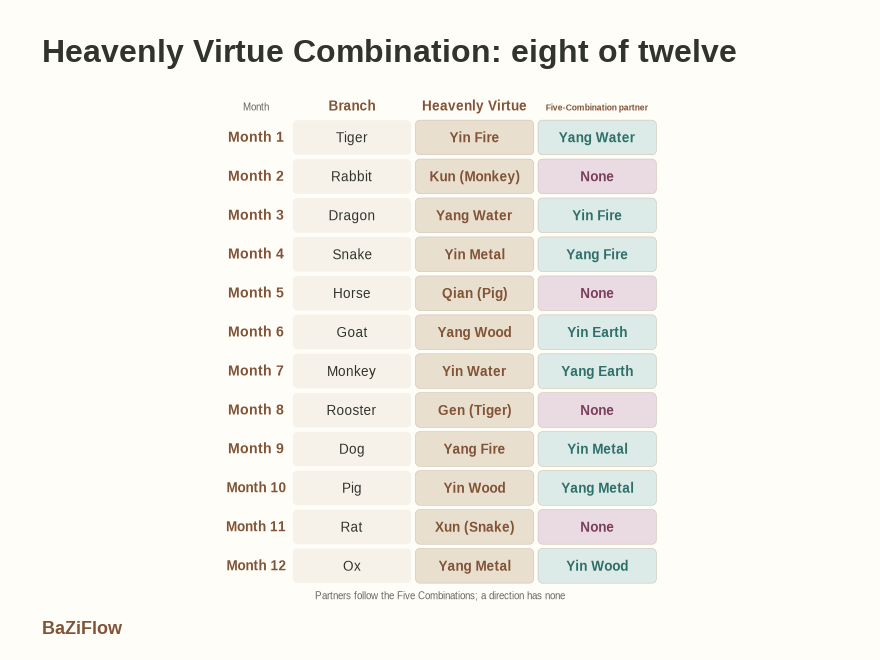
Look-up table, one row per month: the middle column is the month's Heavenly Virtue (from the Kanyu Jing month list), the right column is its Five-Combination partner. The eight months with a partner were checked against the month list in juan 5 of the Xieji Bianfang Shu; the four teal cells are directions, recorded as "no partner".
Eight months have a partner: month 1 Yang Water, month 3 Yin Fire, month 4 Yang Fire, month 6 Yin Earth, month 7 Yang Earth, month 9 Yin Metal, month 10 Yang Metal and month 12 Yin Wood. In months 2, 5, 8 and 11 the virtue is one of the four directions Kun, Qian, Gen and Xun (坤乾艮巽), which are not stems, so the Five Combinations have nothing to pair.
Turned around, the eight results do not use every stem equally often:
Enlarge diagram · scroll sideways to read
Yang Wood and Yin Water are only ever the virtue, and Yang Earth and Yin Earth are only ever the partner; the other six appear on both sides. The Earth stems are never a virtue and can enter only through the combination, which fits a remark the Xieji Bianfang Shu quotes from the Li Hai Ji (蠡海集) in the same juan: the virtue is not set on Earth stems because "the qi of heaven is not close to Earth".
Who pairs with Kun in month 2: three passages, two readings
The four middle months are the interesting ones. Inside the one Xieji Bianfang Shu, the almanac list and the editor's note already disagree:
The Heavenly Virtue Combination is Yang Water in month 1, Yin Fire in month 3, Yang Fire in month 4, Yin Earth in month 6, Yang Earth in month 7, Yin Metal in month 9, Yang Metal in month 10, Yin Wood in month 12. In the four middle months the virtue sits in the corners, hence no partner.
The almanac is blunt: in the middle months the virtue falls on a direction, so there is no partner. The editor's note on the same entry adds another reading:
Yet if the corners Kun, Qian, Gen and Xun are taken as the virtue, then the neighboring corner serves as the partner: Qian joins Gen, because Pig and Tiger combine, and Tiger and Dog combine; Kun joins Xun, because Monkey and Snake combine, and Monkey and Dragon combine. It is left unsaid because the corners have no stems, so there can be no such day; but by direction, Qian is the direction of the virtue and Gen its partner direction, Xun the direction of the virtue and Kun its partner. This too may be kept as one view.
The note says: if the virtue sits on a direction, pair it with the neighboring direction, Qian with Gen and Kun with Xun, and it supports this with branch pairs (Pig-Tiger, Tiger-Dog, Monkey-Snake, Monkey-Dragon) that combine. It also says plainly that the corners have no stems and so no day can be built from them: the pairing holds for directions only. It calls this just "one view" that may be kept. The Sanming Tonghui is briefer still, at the end of its section on the Heavenly and Monthly Virtues:
The Datong calendar has Heavenly and Monthly Virtue Combinations, the hours in which the five phases agree... Heavenly Virtue Combination: month 1 Yin Fire with Yang Water, month 2 Kun with Xun, month 3 Yang Water with Yin Fire, month 4 Yin Metal with Yang Fire; the rest follow this.
That book lists only the first four months, writes Kun with Xun for month 2, and leaves the rest to "follow this". Side by side:
Enlarge diagram · scroll sideways to read
Both readings are in circulation and this site has not fixed one. Following the note, month 5 would pair Qian with Gen, month 8 Gen with Qian and month 11 Xun with Kun; that is the note's reasoning carried forward, and the Sanming Tonghui does not write those months out.
Trying two months: Dragon and Rooster
Each month below gets one made-up chart, with month stems checked against the Five Tigers rule. The books do not say where in a chart the combination is looked for, so these examples simply use the stems and branches of the four pillars.
Enlarge diagram · scroll sideways to read
The first chart is clear: the Dragon month's virtue, Yang Water, does not appear among the four stems, but its partner Yin Fire does, twice. The second depends on how it is read. By the almanac, a Rooster month has no Heavenly Virtue Combination. The editor's note pairs Gen with Qian only as directions and says plainly that corners give no day. Taking one more step, by this site's way of writing Qian as Pig (as it does for the virtue itself), the hour branch Pig would be a hit: that step is an extension made here, not something the note says. Where such a mark belongs in a whole chart is told in where shensha belong in a reading.
What the books use it for: choosing days
In the old books the Heavenly Virtue Combination appears mainly in date selection. Juan 5 of the Xieji Bianfang Shu quotes the Tianbao Li (天宝历):
Three passages on what the Combination suits
A spirit of joined virtue
The direction it governs suits building halls and repairing city walls; the days it governs suit pardons and grace, appointing generals, offerings to mountains and rivers, and prayers for fortune.
Offerings and prayers
The old edition lists sacrifice and blessing, pardons, easing prisons and choosing generals for it, giving Heavenly Virtue, Monthly Virtue and the two Combinations each a list of their own.
A Five Combination with the prime qi
Heavenly and Monthly Virtue are the prime qi of the month's Three Harmony; their Combinations are Five Combinations with that qi, so all are most auspicious days and what they suit should be as broad. Splitting the lists so finely is "ill fitted to the name".
The editor's reasoning is plain: the prime qi is auspicious, its Five-Combination partner is auspicious too, so there is no call for narrow separate lists.
When a virtue day meets a bad day: three tiers in one juan
Date-selection books often bundle Heavenly Virtue, Monthly Virtue and the two Combinations as "the virtues" that soften certain bad days. Take the Month Break (月破, the day that clashes with the month branch). Juan 10 sorts it into three tiers:
Enlarge diagram · scroll sideways to read
The note explains why: the Month Break is both the clash of the month and the spot where the month's qi is cut off, so "a virtue spirit arriving there loses its strength and cannot bring fortune". A virtue is not an all-purpose cure, and the worse the bad day, the less it helps.
Another shensha that also takes the Five-Combination partner from a month-branch base is the Monthly Virtue Combination, which lands only on stems and works out in all twelve months. The pairs themselves are explained in stem combinations, and the month table of the virtue itself in Heavenly Virtue.
Questions readers ask next
Is the Heavenly Virtue Combination the same star as Heavenly Virtue?
It is a different character. Heavenly Virtue is the month's virtue itself; the Combination is its Five-Combination partner, so one month gives two different characters.
My month branch is Horse. Do I have a Heavenly Virtue Combination?
A Horse month is month 5 in the table and its virtue is Qian, a direction. The almanac list says the middle months have no partner; the editor's note pairs Qian with Gen but only as directions, and says outright that corners have no stems and so no day. Carrying that over to the branches of a chart (Qian as Pig, Gen as Tiger) is an extension made here, not something the book writes.
Are the Monthly Virtue Combination and the Heavenly Virtue Combination the same character?
Only in the Dragon, Goat, Dog and Ox months, where Heavenly Virtue and Monthly Virtue are the same stem and so their partners are the same too. In the other eight months they differ.
Was this article helpful?
Sources & references
Continue reading
Three Wonders (三奇): Three Stem Sets, Read in Pillar Order, and the Books That Doubt Them ↗
Monthly Virtue Combination: Four Yin Stems, Twelve Months, and No Earth or Water ↗