

Four time layers, read together
Content version · · Sources & references
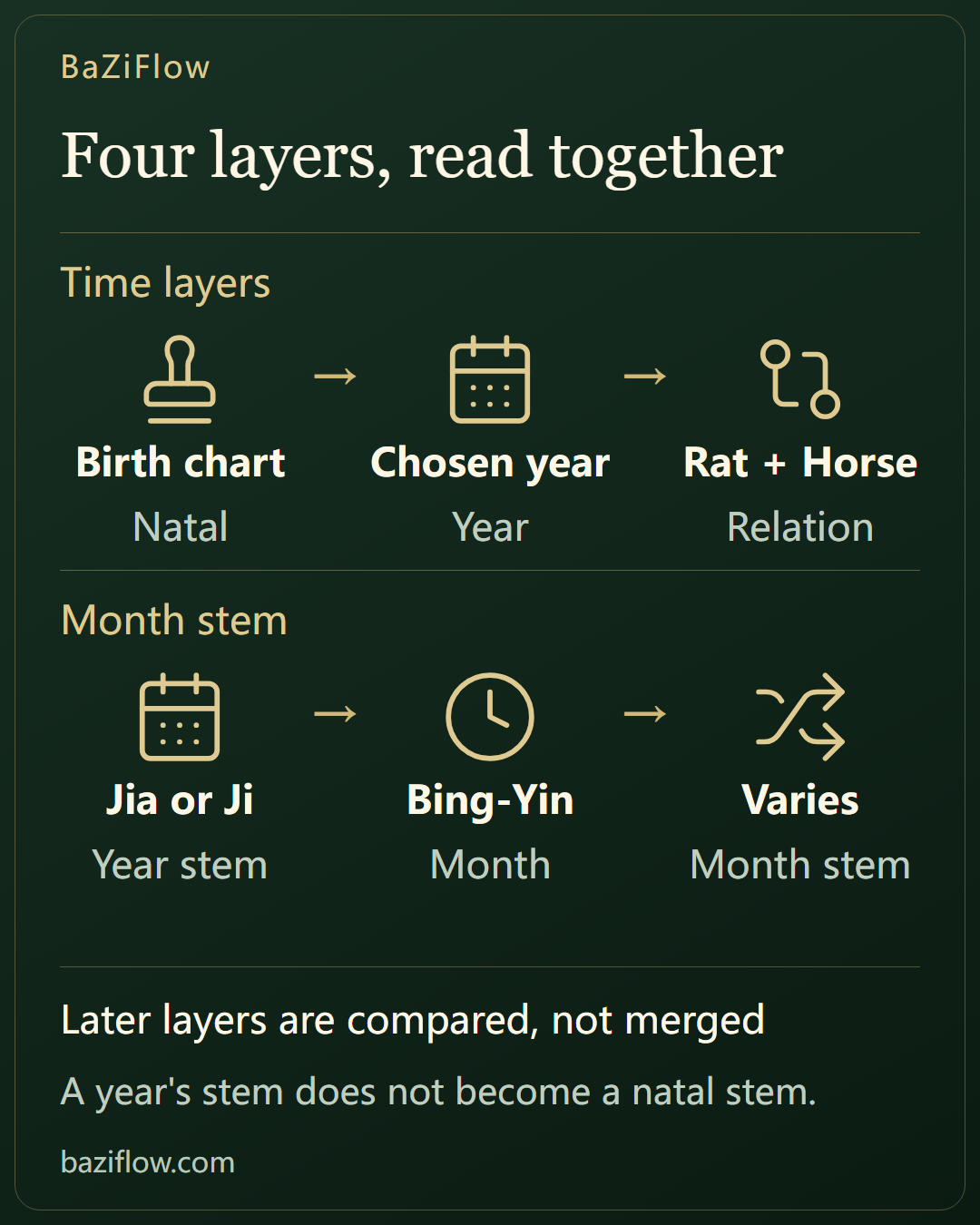
Natal chart, luck pillar, year and month are four records with their own sources. A four-layer comparison, the year-to-month stem table and a Horse-year example keep comparison conditions apart from birth facts.
The short version6 min read
Natal, luck, annual and monthly layers are four records, each with its own source and time range. Compare relationships across them, but never pour the later three into the birth pillars.
- The natal chart, luck pillar, annual and monthly layers are four records with separate sources and time ranges: compare them, but never write the later three into the birth pillars.
- A Horse year only means the natal Rat meets that year's Horse; the natal chart does not gain a Horse.
- The monthly stem depends on the year stem: a Jia or Ji year has Bing-Yin for the Tiger month, a Yi or Geng year has Wu-Yin; the Tiger month is not always Jia-Yin.
Read first
Reading a BaZi chart for the first time: the four pillars and the Day Master ↗
How luck pillars are derived: separate the sequence from its starting time ↗
A Horse year does not give the natal chart a Horse
Suppose a teaching record has a Rat as the day branch in the natal chart, and the year under discussion has a Horse as its branch. You can study the relationship between the natal Rat and the annual Horse. You cannot write that this person was born with Rat and Horse in the birth pillars. What was added is a comparison condition, not a birth fact.
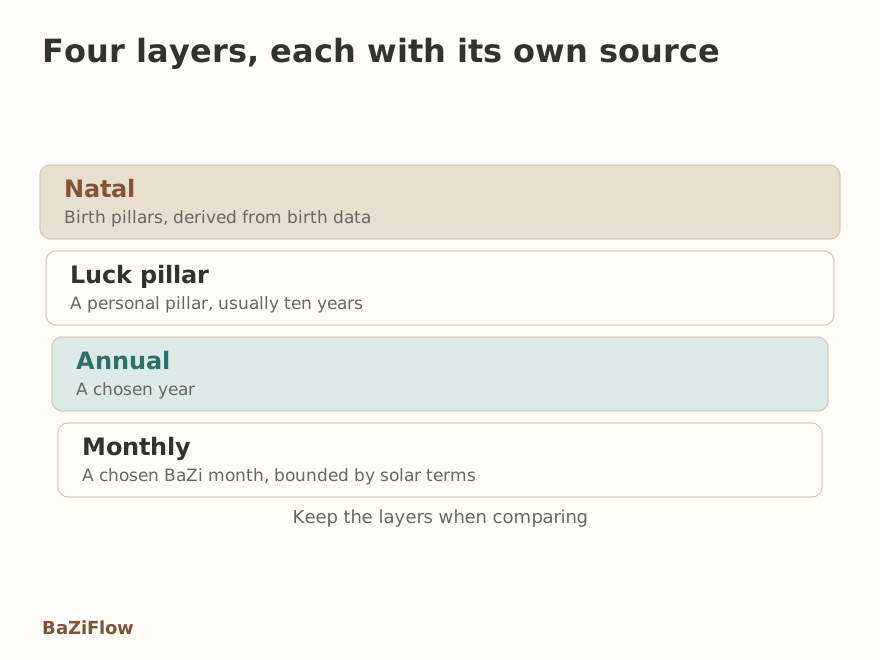
Layer sketch: four layers, each with its own source and time range. Keep the layers when comparing; do not write the later three into the birth pillars.
Enlarge diagram · scroll sideways to read
Four records, each with its own time
The luck pillar, the annual pillar and the monthly pillar are references at other time scales. Reading all four together means comparing relationships while keeping each source attached, not pouring every symbol into one bag.
Enlarge diagram · scroll sideways to read
For how the luck sequence and starting time are worked out, see how luck pillars are derived. Before comparing two timetables, line up these three definitions:
Usually ten years each
But not aligned with everyone's tenth, twentieth or thirtieth birthday; the start has to be looked up.
The year boundary
Confirm that both sides change year at the same moment.
Bounded by a solar-term moment
In a method using the twelve sectional solar terms, the boundary is a specific moment, not the Gregorian first or the lunar first.
The monthly stem depends on the year
The Tiger month does not always carry the same stem. The Hong Kong Observatory's year-stem and month-stem table shows the pattern, with each pair of year stems sharing one starting point.
Enlarge diagram · scroll sideways to read
Work through two years:
Enlarge diagram · scroll sideways to read
How the classics treat timing: return to the chart, keep stems and branches apart
Zi Ping Zhen Quan, in its chapter on luck, stresses reading the luck pillar together with the natal arrangement. It lists cases that look favorable but are affected by the natal relationships, and cases that look unfavorable but have another combination. It also separates stems from branches even when they share a broad phase, so a reader should not settle for a crude label such as "a Fire period" or "a Water period".
Enlarge diagram · scroll sideways to read
Three oversimplifications
Years and months are mere background
The natal chart is the start of the argument, not the only answer.
A year rewrites birth facts
A year is one time condition and does not rewrite birth facts.
Finer means more accurate
Finer does not mean more accurate, and does not automatically outrank the luck pillar.
This is a textual basis for reading in layers, not a guarantee about any person's fortune. Different methods order the layers differently; a method should state its emphasis and conditions, not replace actual relationships with one universal percentage table.
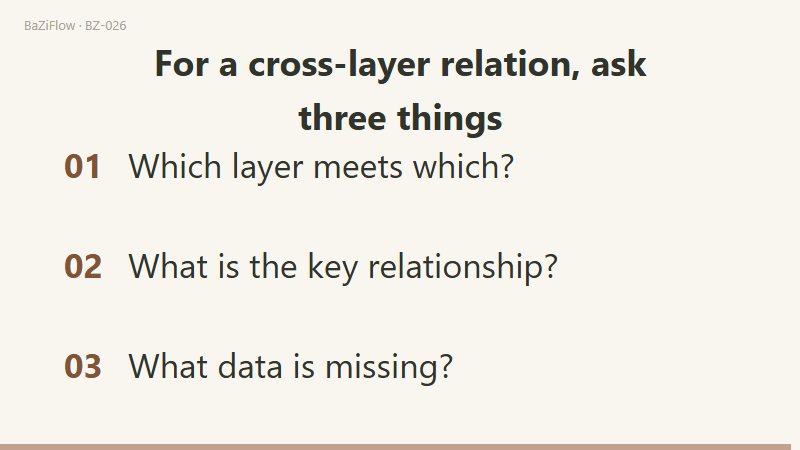
For every cross-layer relationship, name which layer meets which
Back to the Rat and the Horse: say which natal pillar holds the Rat, which year holds the Horse, and whether a luck pillar or month takes part.
Which layer meets which
Name the natal pillar that holds the stem, and the year and month it meets.
What the key relationship is
Generating, controlling, combining or clashing, and where it acts.
What data is missing
Where data is missing, hold the judgment instead of filling it in.
Enlarge diagram · scroll sideways to read
A finer time unit does not mean a more accurate prediction. A monthly pillar helps narrow the interval under discussion, but one stem cannot pin an event to a single day; the more specific the date, the more extra evidence it needs. How relationships are recognized and how their effects are judged is covered in clashes, punishments, harms and destruction.
Questions readers ask next
Does a stem that appears in a year count as already in the natal chart?
No. The year is another time layer. You can study its relationship with the natal chart, but what it adds is a comparison condition, not a birth fact.
Is the monthly stem fixed?
No. For the same Tiger month the stem depends on the year stem. Each pair of year stems shares one starting point, so a new year brings new monthly stems.
Does a finer time layer make a prediction more accurate?
No. A month helps narrow the interval under discussion, but one stem cannot place an event on one day. The more specific the date, the more extra evidence it needs, and real choices and actions are not replaced by symbols.
Was this article helpful?
Theme: Time & life stages
Part of a learning path
BaZi: from the four pillars to time layers · Step 5 of 5 available