

Traditional and modern rule choices
Content version · · Sources & references
Use a limited Mercury-in-Aquarius example to separate rulership choices, historical terminology and interpretive aims without turning two broad traditions into a single contest.
The short version6 min read
For Mercury in Aquarius, a traditional ruler table points to Saturn while a selected modern table points to Uranus. The first difference is a lookup rule, before any interpretation. Comparing that operation is clearer than treating schools as tones of voice.
- Aquarius, Pisces and Scorpio may receive different rulers under different conventions; modern writers can also retain traditional or shared rulers.
- The word “houses” in the classical domicile passage concerns sign rulership, not an automatic mapping to the twelve natal-house topics.
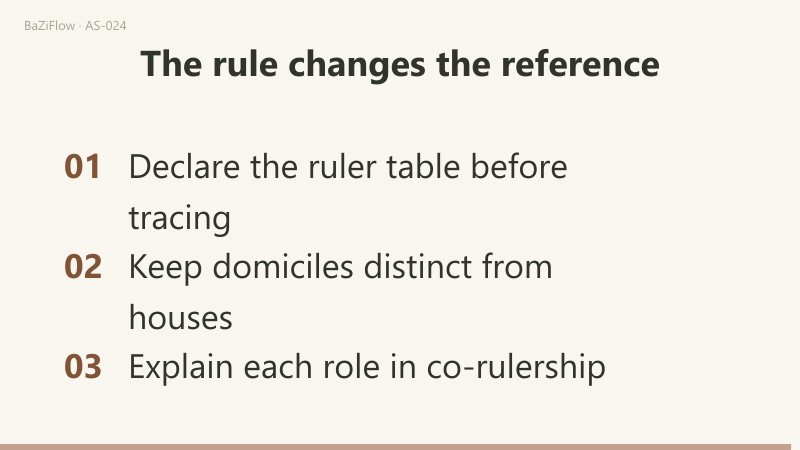
- A ruler table, an interpretive question and its required evidence are different layers. Find the changed rule before combining descriptions.
Read first
Personal, Social and Outer Planets: Use Groups as a Directory ↗
House ruler, occupant and dispositor: keep the roles distinct ↗
Rulership gives us a concrete place to start
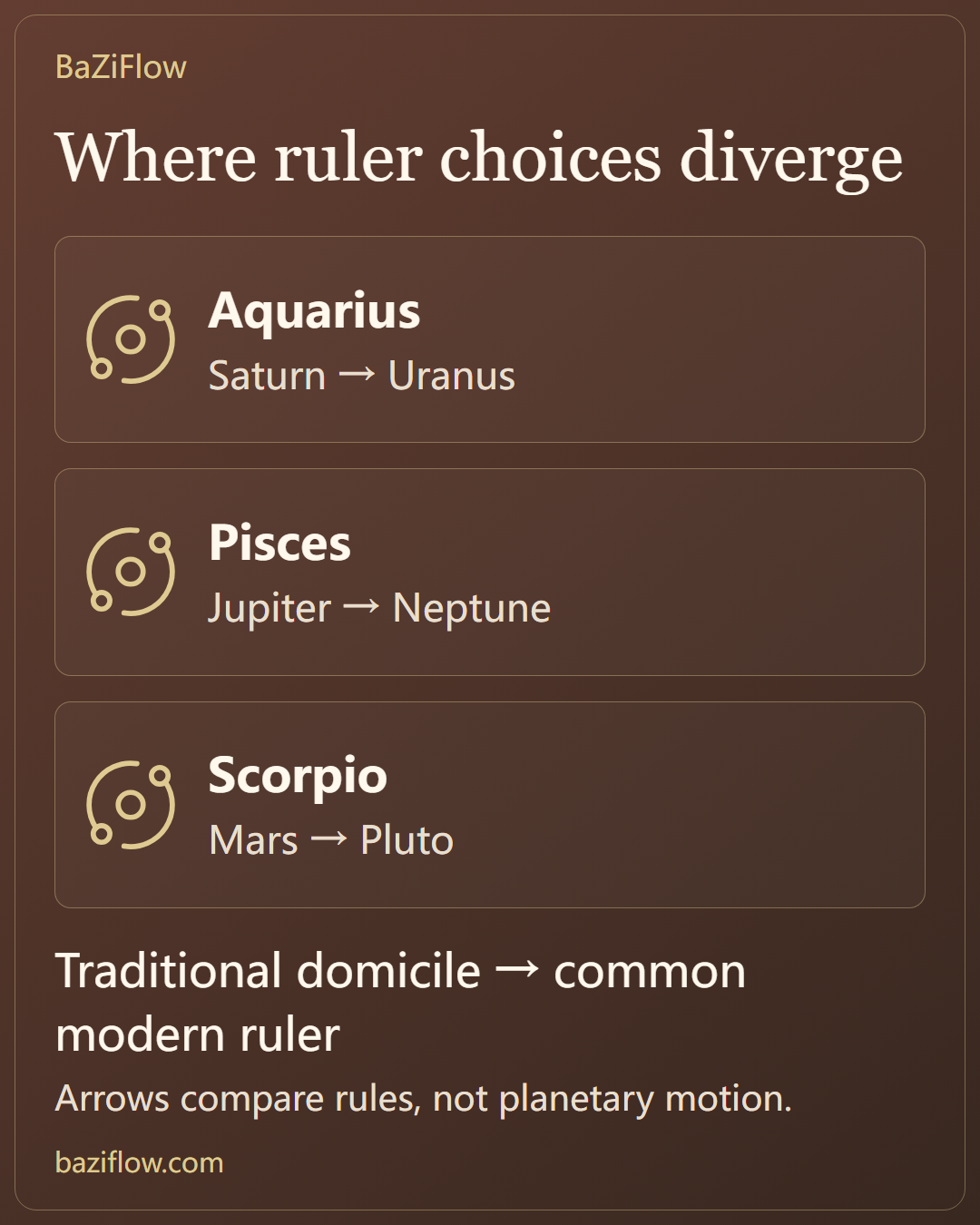
In Book I, chapter 17 of the Tetrabiblos, Ptolemy assigns Aquarius and Capricorn to Saturn, Pisces and Sagittarius to Jupiter, and Scorpio and Aries to Mars. A common modern set of associations instead gives Aquarius to Uranus, Pisces to Neptune and Scorpio to Pluto.
Joseph Crane explicitly discusses traditional rulers, modern replacements and co-rulers, while stating his own preference for the traditional scheme. His account is useful here because it makes a choice visible. It is not a vote establishing that every astrologer shares his preference or that a historical pattern has been empirically confirmed.
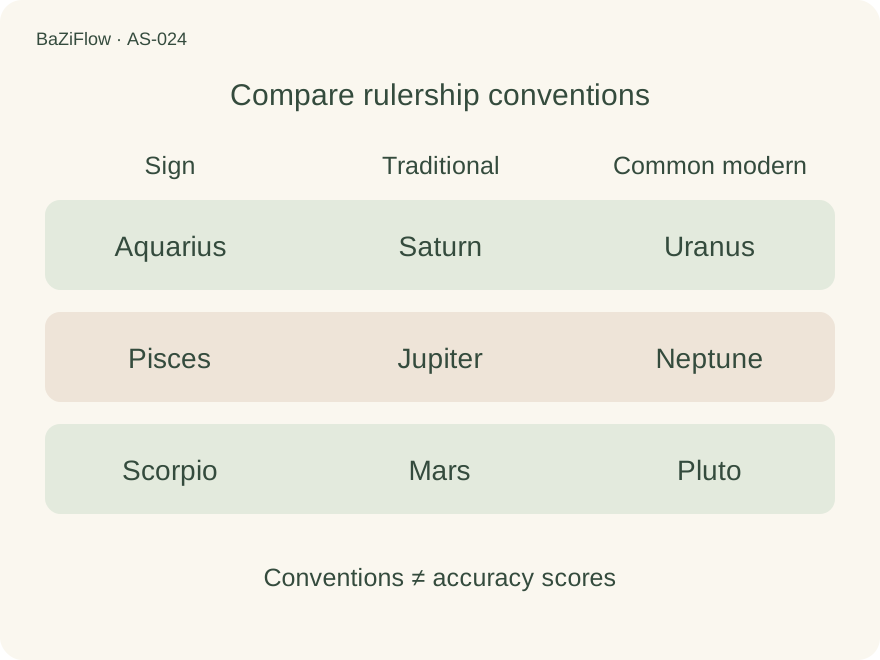
Original comparison of selected rulership conventions. Modern practice may retain traditional rulers or use co-rulership.
Merely including an outer planet in a reading does not tell you whether the writer uses it as a sign ruler. Likewise, using a traditional ruler does not specify every house, aspect or timing convention. Ask for the particular rule that affects the argument in front of you.
Read historical vocabulary in its local context
The Tetrabiblos translation's chapter on planetary “houses” discusses domiciles in zodiac signs. It is not a chapter assigning life topics to the twelve houses of a natal chart. Equating every use of that English word would introduce a new rule that the passage has not supplied.
For example, a statement linking Saturn with Aquarius does not by itself assign Saturn to the eleventh natal house. Any further sign–house correspondence needs its own explanation and source. Translation can preserve a word while changing how a modern reader expects it to function, so the surrounding argument is essential.
Ptolemy's later discussion of different systems of terms in the same book also warns against imagining a single undifferentiated ancient rulebook. Historical techniques need an author, period or specific table. Citing an old text establishes what that text says; it does not turn its physical explanations into modern scientific findings.
Domicile
- Planet–sign rulership
- Saturn–Aquarius
House
- Chart space division
- The eleventh house
Context determines what “houses” means; the meanings do not imply each other
Trace a missing step before adding a personality claim
Suppose the only supplied placement is Mercury in Aquarius. Under the traditional domicile scheme, the next dispositor to inspect is Saturn. Under the modern convention chosen for this exercise, it is Uranus. Mercury has not changed position; the lookup rule has changed the next object of inquiry.
| Declared route | Next item to inspect | What the input still lacks |
|---|---|---|
| Traditional Aquarius rulership | Saturn | Saturn's position and relevant condition |
| Uranus as Aquarius ruler | Uranus | Uranus's position and relevant connections |
The missing information matters. “Saturn” cannot become a complete portrait of a cautious person, nor can “Uranus” become proof of unusual inventiveness. Those would be extra inferences built from generic associations, not conclusions supplied by this limited chart record.
A co-rulership approach can be documented too, but it needs to state what each ruler contributes and how competing indications are handled. Choosing whichever ruler best matches a story after hearing it is a different procedure. It cannot then be presented as an independent result of a rule fixed in advance.
Traditional rulership
Selected modern rule
Find where a study note changes its rule
A study group has one supplied placement: Venus in Scorpio. One reader writes “inspect Mars next,” another writes “inspect Pluto next.” Before comparing the resulting descriptions, stop at that first fork. Under traditional domicile rulership Scorpio leads to Mars; under the modern rulership convention selected by the second reader it leads to Pluto. The disagreement has not changed the supplied Venus position.
Neither note yet contains the position of its next planet. A description assembled from the name Mars or Pluto alone would add information that the record does not provide. Hearing the person's story and then selecting whichever branch sounds more convincing would also change the exercise: the rule would no longer have been fixed in advance.
This gives us a practical way to compare books. Mark the first changed lookup, identify the source for each choice, and keep the missing data visible. There is no need to blend the two unfinished routes into a personality sentence. The Mercury example above applies the same test to a different sign, so the point does not depend on this one case.
Psychological emphasis is one approach, not the entire modern category
The Centre for Psychological Astrology describes its aim in terms of exchange between astrology and depth, humanistic and transpersonal psychology. That institutional description helps identify an interpretive orientation. It neither defines all modern astrology nor demonstrates the validity of an assessment instrument.
A psychologically oriented discussion may ask how a symbol is experienced; a technical comparison may first ask which condition or topic a rule assigns. To read them together, retain the question each is asking. Do not reduce the difference to kind versus harsh language, or assume that a positive tone provides stronger evidence.
Question
Which dispositor?
- Needed input
- Sign and ruler table
- Scope of answer
- Next planet to inspect
How is a symbol experienced?
- Needed input
- A person’s specific account
- Scope of answer
- The experience reported
Compare the first changed operation
For either example (Mercury in Aquarius, or the study group’s Venus in Scorpio), the original placement, each selected ruler, the missing planetary position and any later claim belong in separate fields. When comparing two sources, identify the step at which they diverge. If you later combine methods, describe the order and the handling of conflicts rather than dissolving them into a broad statement such as “stable yet rebellious.”
The point is not to choose a school from a single example. It is to make the reading reproducible enough that another reader can see what has actually changed. For a worked application of the traditional lookup, see sign, house and ruler together. The planet groups article separately distinguishes astrological categories from astronomical classifications.
Retain one input
Both notes can begin with Mercury in Aquarius.
Locate the first fork
The traditional table leads to Saturn; the selected modern table leads to Uranus.
Continue each route
Supply each position separately and state the order and conflict rules if combining them.
Questions readers ask next
Should Aquarius lead to Saturn or to Uranus?
Follow the declared rulership convention. Ptolemy’s domicile allocation uses Saturn; a common modern association uses Uranus, while some approaches retain both. State the chosen method before examining the ruler’s actual position.
Does including outer planets imply modern sign rulership?
No. Interpreting Uranus as a planet and assigning it rulership of Aquarius are separate choices. A writer may include outer planets while retaining a traditional ruler table, so one inclusion cannot identify the whole method.
Does psychological astrology define all modern practice?
No. It is one interpretive orientation within modern practice. The CPA’s institutional description identifies its educational aims, not every modern method or the validity of a psychological assessment instrument.
Was this article helpful?