

Synastry and midpoint composites
Content version · · Sources & references
Audit a square in synastry and a conjunction in a midpoint composite using the same four invented longitudes. Learn which labels and settings make the comparison meaningful.
The short version6 min read
Synastry keeps two sets of natal positions; a midpoint composite calculates new positions from matching bodies. Four identical inputs can yield a cross-chart square and a composite conjunction without contradiction. The objects being compared have changed.
- A synastry aspect links positions belonging to two people; a composite position is derived and does not belong directly to either person.
- The short-arc midpoint of 350° and 110° is 50°. The numerical mean, 230°, sits on the other arc, so circular averaging requires a convention.
- Swapping display rings preserves a specified angular pair but can change the house reference. Composite houses involve a separate construction method.
Read first
Conjunction, Opposition and Square: Learn to Measure the Angle Before Judging Good or Bad ↗
Preserve people in one method, identify derived points in the other
Synastry retains the two sets of natal positions. Its cross-aspect labels must preserve ownership: A Moon–B Sun is not interchangeable with A Sun–B Moon as a statement about which bodies belong to whom, even when particular examples happen to give equal angles. Dropping those labels makes later interpretation impossible to audit.
A midpoint composite instead pairs like with like to construct a new set: Sun with Sun, Moon with Moon and so on. The resulting composite Moon is neither person's natal Moon. Calling the construction a chart of the relationship is an interpretive convention; it does not create a third person's birth data or supply a record of what either participant actually feels.
TimePassages documents these as separate chart types. A software menu can make the switch look like a change of display, but the underlying operation changes. This article concerns a midpoint composite specifically. Do not assume that every product carrying a general “relationship chart” label uses this operation.
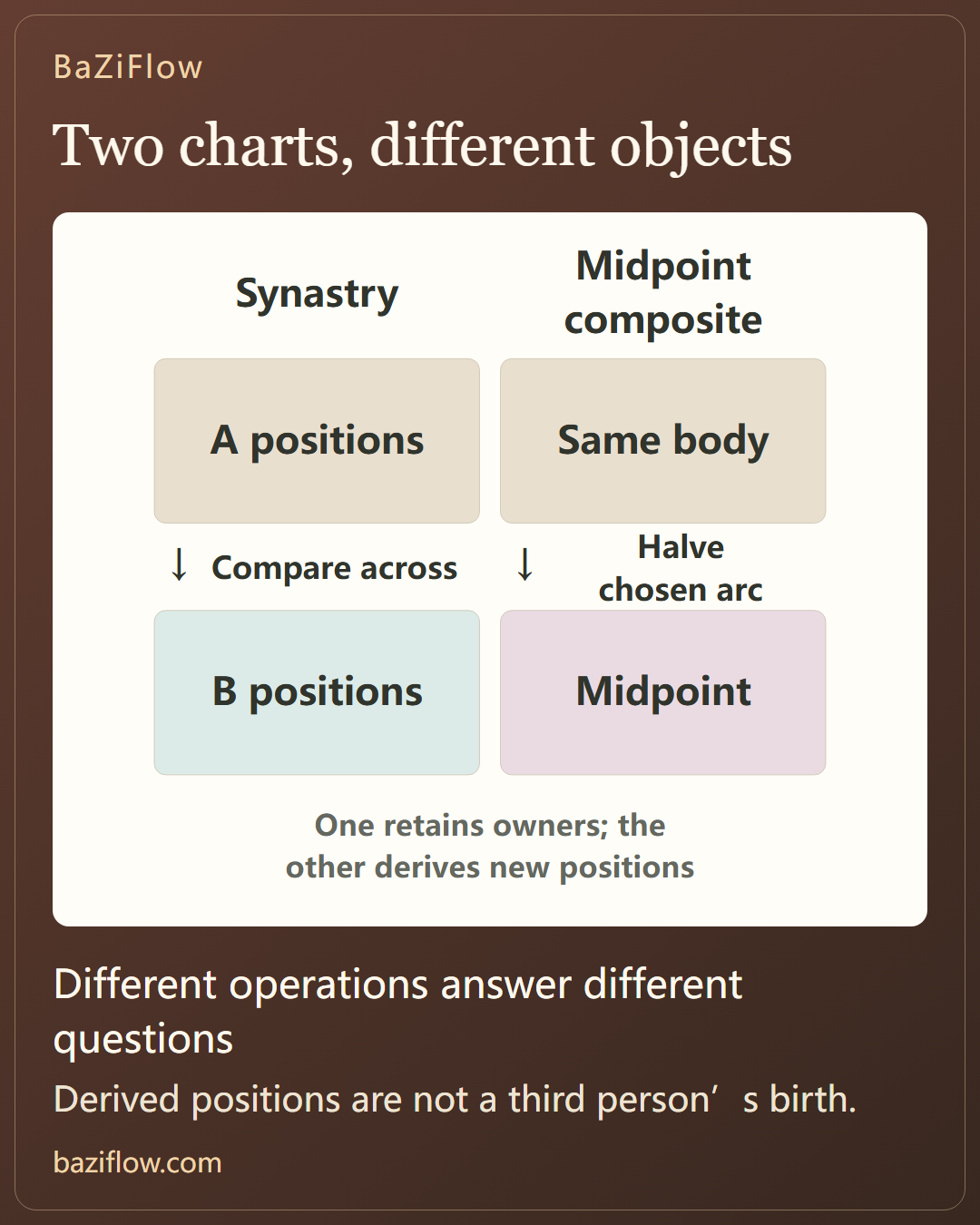
Synastry
Midpoint composite
One retains owners; the other derives new positions
Start with the apparent contradiction
One report lists a square between A's Moon and B's Sun. Another lists a conjunction between the composite Sun and Moon. Before deciding which report is wrong, inspect the nouns. The first claim compares two people's natal positions; the second compares two points calculated from corresponding positions in their charts.
Here is a small invented dataset that produces both results. A has Sun 350° and Moon 20°. B has Sun 110° and Moon 80°. No dates, houses or other planets are supplied. In the cross-chart comparison, A's Moon at 20° lies 90° from B's Sun at 110°. The square is an exact result for that pair.
For the composite Sun, take the midpoint of the shorter arc from 350° through zero to 110°. The arc is 120° long, so travelling 60° from 350° reaches 50°. The midpoint of the two Moons, 20° and 80°, is also 50°. The computed Sun and Moon therefore coincide. That does not cancel the cross-chart square; it answers another mathematical question.
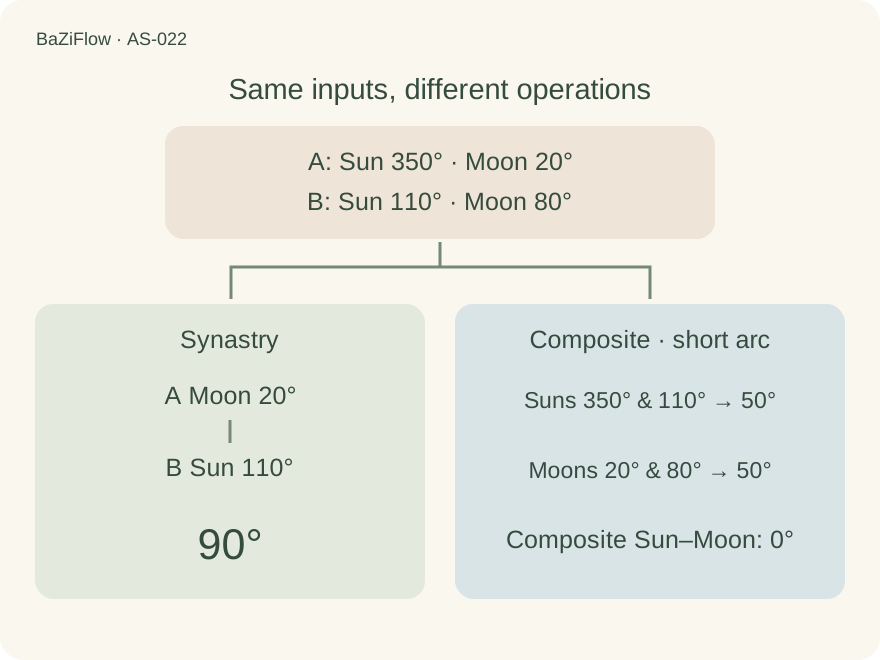
Original partial-data exercise. These are invented longitudes, not a pair of complete birth charts.
| Comparison | Positions | Separation |
|---|---|---|
| A Moon / B Sun | 20° / 110° | 90° |
| Composite Sun / Moon | 50° / 50° | 0° |
Circular arithmetic needs an explicit choice
The ordinary numerical mean of 350 and 110 is 230. Why did our example produce 50? The former lies halfway along the longer arc; the latter lies halfway along the shorter one. Both points are equally distant from the endpoints, and they are opposite each other. A calculation on a circle needs to say which midpoint convention it uses.
There is an especially revealing boundary case. With endpoints at 0° and 180°, neither connecting semicircle is shorter. Their arc midpoints are 90° and 270°. A “choose the short arc” instruction alone does not resolve the tie. Check the implementation's rule rather than choosing whichever answer fits a preferred reading.
Astrodienst also documents alternative treatment of certain composite Mercury and Venus positions. Consequently, a half-circle discrepancy can be a method difference rather than a rounding error. Record the convention before writing a long comparison of interpretations. A computed composite is not required to reproduce a real sky at a single date, so it should not be treated as an ordinary birth chart with a missing birthday.
Midpoint 410° · 410
350° ↔ 470°
- First 60° · 350–410
- Next 60° · 410–470
Unwrapped: 470°=110° and 410°=50°
Swapping the people tests different things from changing the method
For fixed longitudes, exchanging the inner and outer display rings does not alter the angular separation of a specified pair. A Moon at 20° and B Sun at 110° remain 90° apart. House overlays require an additional label: whose planet is being located in whose house framework?
In the TimePassages bi-wheel described by its manual, the displayed houses belong to the inner-chart person. Reverse the order and the reference framework changes. This is why “Moon in the seventh” is incomplete as a cross-chart statement. It has omitted the owner of the Moon and the owner of the houses. Other products should be checked against their own display documentation.
Composite houses introduce a different setting question. Astrodienst describes both midpoint house cusps and a method using a midpoint MC with a reference place. Agreement on composite planetary longitudes therefore does not establish agreement on every angle and cusp. Uncertain birth times also remain uncertain inputs; averaging them cannot manufacture reliable angles.
Operation
Swap rings
- Pair angle
- Fixed pair unchanged
- House frame
- TimePassages uses inner person
Change composite houses
- Pair angle
- Midpoint planets can stay
- House frame
- Cusps may change
Keep collaboration evidence outside the diagram
Imagine two people producing a short audio guide for a local exhibition. One has recording equipment but limited evening availability; the other can arrange interviews but has never edited audio. Neither the cross-chart square nor the composite conjunction tells you how many hours they can contribute or whether they consent to the proposed division of work.
A useful discussion might ask who will obtain recording permission, who will edit and how unfinished work will be handed over. Those answers can be recorded next to, rather than inside, the symbolic reading. If the collaboration improves after the roles are clarified, preserve the role clarification as a possible explanation instead of crediting a chart label by default.
When comparing readings, keep three records distinct: the supplied positions, the interpretation offered and the participants' own confirmed account. Two techniques applied to the same partnership are not two independent observations of its success. For more practice with ownership, read two subjects in relationship readings. The aspect guide explains why an angle alone does not settle a favourable or unfavourable verdict.
Name each object
Keep A, B or composite attached to each body.
Recalculate one relation
Check the supplied cross-angle or the chosen midpoint.
Test the discussion against the task
Ask each person to confirm time, responsibilities and a handover plan.
Questions readers ask next
How can a synastry square and composite conjunction both be correct?
They compare different objects. A Moon at 20° and B Sun at 110° are 90° apart, while the two solar and two lunar short-arc midpoints each land at 50°. Their composite separation is zero.
Which midpoint applies when the positions are exactly opposite?
For 0° and 180°, the arc midpoints are 90° and 270°. Neither semicircle is shorter, so a short-arc preference alone cannot choose one. Keep the software’s explicit tie convention rather than choosing by interpretation.
Does reversing the inner and outer chart change an aspect?
Not for the same two longitudes. Their angular separation stays fixed, although the person supplying the house framework may change. TimePassages uses the inner person’s houses; other products need their own documented convention.
Was this article helpful?