

Cook Ding: skill and nourishing life
Content version · · Sources & references
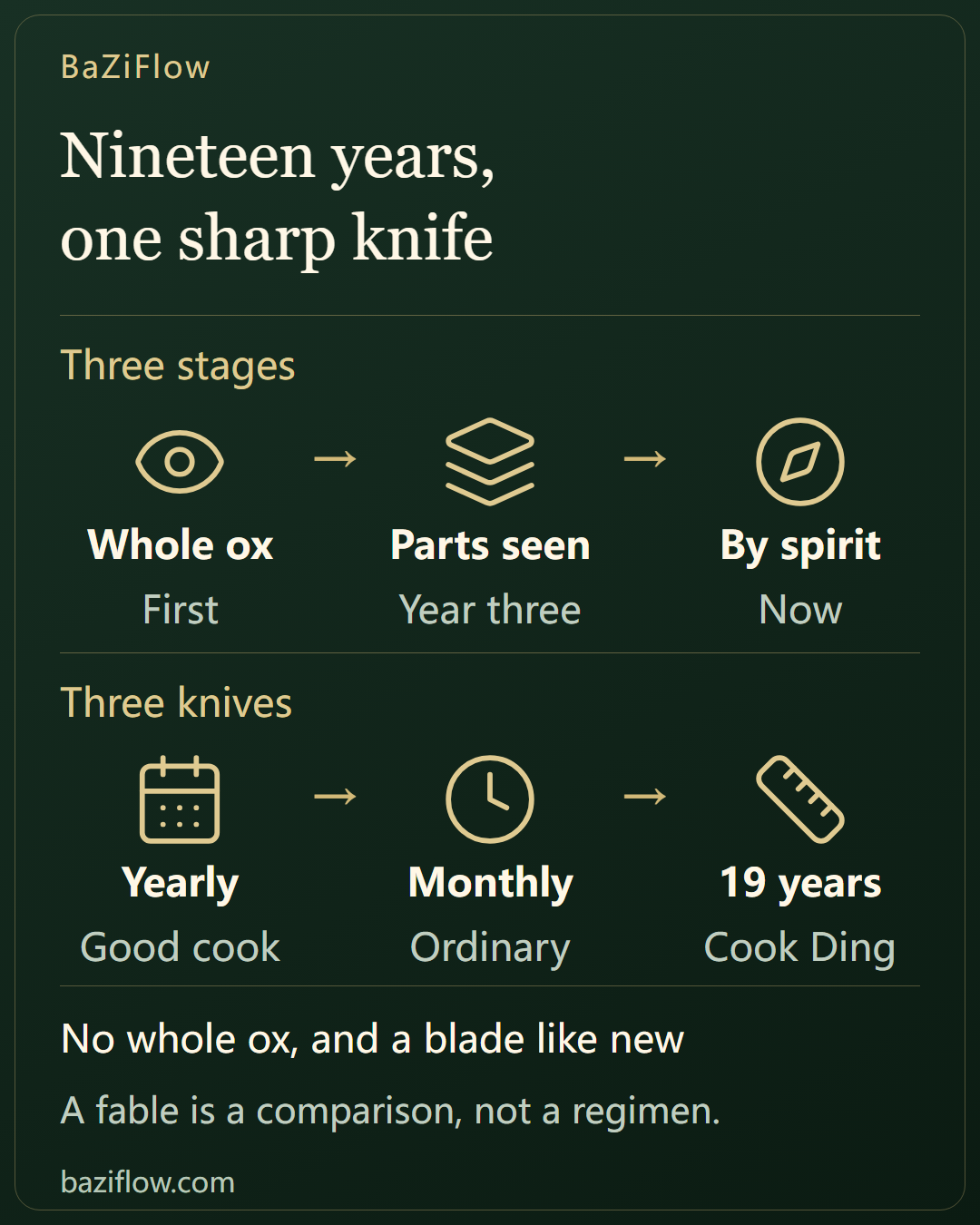
Cook Ding carving an ox comes from the Zhuangzi chapter on nourishing life. A stage table, three knives compared, four steps at a hard place and a three-layer reading separate the text, tradition and modern borrowing.
The short version8 min read
Cook Ding carving an ox is a fable in the Zhuangzi chapter on nourishing life: a cook’s knife has served nineteen years and still looks fresh from the whetstone, and Lord Wenhui, hearing him, says he has learned how to nourish life.
- The fable sits between an opening statement, which says life has limits and knowing has none, and three short tales; the lord’s closing remark brings the topic back to nourishing life.
- Ding names three stages: all he saw was ox, then no whole ox, now meeting it with the spirit. What guides the blade is the animal’s own grain and the gaps in the joints.
- His knife lasts nineteen years where a good cook changes one yearly and an ordinary cook monthly, yet at every tangle of bone and sinew he still turns wary and hardly moves the blade.
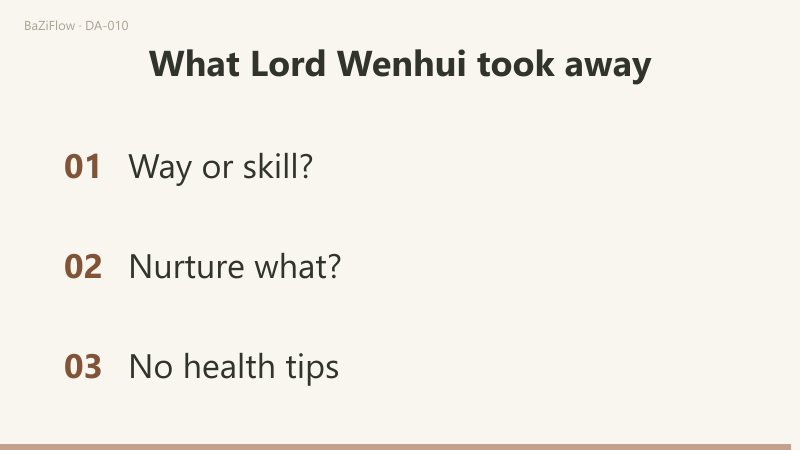
Read first
The Zhuangzi: Inner, Outer and Miscellaneous Chapters, Mapped ↗
One fable inside the chapter on nourishing life
Cook Ding’s story runs a few hundred characters and sits in the third Inner chapter of the Zhuangzi, “Yang Sheng Zhu” (养生主), a title that can be read as the key to nourishing life or as the master of the life being nourished. A cook carves an ox for Lord Wenhui (文惠君) with every motion keeping time. The lord listens to his explanation and says he has learned how to nourish life. Everything below starts from that remark and the passages around it.
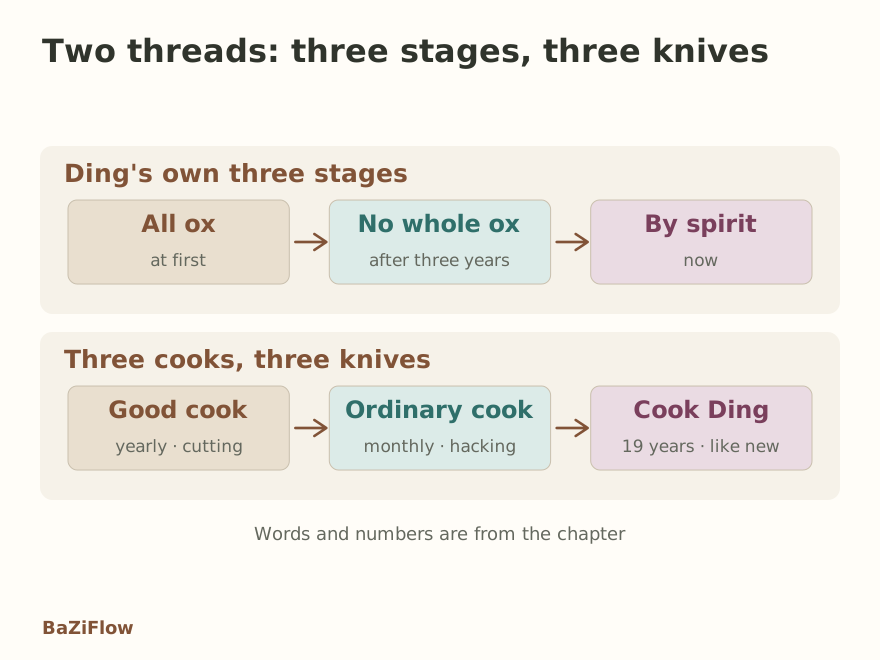
Sketch of the two threads. Both rows come from the chapter, and the numbers are Ding’s own.
The figure gathers the story’s two threads: Ding’s account of three stages, and the contrast between three kinds of cook and their knives. A statement for the whole chapter comes before the story and three shorter tales follow it, so the chapter reads as one piece about keeping life whole.
Enlarge diagram · scroll sideways to read
My life has a shore, yet knowing has none. To follow the shoreless with what has a shore is perilous, and to go on knowing after seeing this is simply perilous. Do good without coming near fame; do wrong without coming near punishment. Take the midline as your constant, and you can protect your person, keep your life whole, nourish your parents and see out your years.
Three things are said here. Life ends, knowledge does not, and chasing the second with the first is dangerous. Then comes the advice to follow the “midline” (督). Readers take the word differently: as the middle, the empty space between things, or the line down the center of the back that later medicine calls the governing channel. The commentators do not agree, and the fable never says which one it has in mind.
At first an ox, later no whole ox
Before describing his skill, Ding says: “What I love is the Way (道), which has advanced beyond technique.” Then he dates his own change with three points in time.
Enlarge diagram · scroll sideways to read
After three years the ox is no longer one block to him but a set of structures he can tell apart. Now, in his words, “the senses stop and the spirit moves where it wants.” Traditional commentary reads this as the senses stepping back while a settled familiarity with the animal’s structure takes over, so that he is no longer scanning with his eyes for each spot.
Three phrases that carry the passage
- The natural grain (天理)
- In “relying on the natural grain”, the term means the pattern and structure the ox already has, so that the blade follows how the animal is made. It is a different matter from the later philosophical Principle of Heaven, which carries moral weight, and mixing the two shifts the sentence.
- The way things already are (固然)
- Following “what is so already” means taking the animal as it is: the first character means already or originally, the second means so.
- Gaps and hollows (郤, 窾)
- Ding strikes the large gaps and leads the blade through the large hollows. These are the spaces between bones and joints, where the blade advances while avoiding the hard places.
Nothing in these lines says that more practice always means more skill. The text records a change in how the ox looks to him, from something in the way to something with openings in it.
Three knives: a thin blade in a seam
Ding offers the age of his knife as evidence. He sorts cooks into kinds by how quickly their knives wear out, and the text gives a reason for each.
Enlarge diagram · scroll sideways to read
The two reasons are single characters: “cut” (割) for the good cook and “hack” or “snap” (折) for the ordinary one. Traditional commentary takes the first as cutting along the flesh and the second as chopping at bone, which wears a blade faster. The text itself gives only the two words.
Joints have gaps, and the edge of a blade has no thickness. Put what has no thickness into a gap and there is wide, easy room, more than enough for the blade to roam. That is why after nineteen years the edge is as if it had just left the whetstone.
Put the words together. A joint has an opening. The edge has “no thickness”, a way of saying it is thin enough to slip through. A blade that thin meets no resistance in the opening and “roams” with room to spare. The whetstone is the stone on which the cook sharpens his knife.
Where bone and sinew tangle: wary and slow
If Ding were merely skilled, the story could stop at the blade that stays new. He goes on with a “however”: every time he reaches a place where bone and sinew gather, he still takes care.
Even so, whenever I come to a tangle, I see that it is hard to work. I grow wary and take care. My gaze comes to rest, my movement slows, and I move the knife very slightly. Then it parts with a crack, like earth falling to the ground.
Enlarge diagram · scroll sideways to read
The word for the tangle (族) is read by traditional commentary as a place where things gather and knot. The other words are plain in sense: wary, gaze at rest, movement slow. A modern reader could call this attention, but that is today’s word; the text’s own words are wariness, stillness and slowness.
Stands holding the knife
After the cut he does not hurry off; he stands with the knife in his hand.
Looks all around
He takes in the work he has just done and the place around him.
Content
Commentators read the phrase as a settled satisfaction; as a later idiom it has drifted toward self-satisfaction, so the meaning has moved.
Tends the knife and stores it
He puts the blade in good order and puts it away. Care for the tool goes on after the work is done.
What the lord understood
The last line belongs to Lord Wenhui, and he does not say what he learned. That makes it the place where readings differ most.
Enlarge diagram · scroll sideways to read
The first column is what the words themselves give. The second is the more common traditional reading: take the ox’s grain as the guide, do not collide with what resists, do not spend yourself where it is pointless, with the knife standing for a life and the ox for the affairs of the world. The third is today’s borrowing. “Craftsmanship” and “focus” are modern terms, and “nourishing life” now usually means health care, which is not what the chapter title meant.
The same chapter carries three more tales, and reading them alongside widens what “nourishing life” covers.
Three more pieces from the chapter
From Heaven, not from man
Gongwen Xuan (公文轩) meets the Right Master (右师), an official with one foot, and asks whether it came from Heaven or from man. The answer is “from Heaven, not from man”; how the clause on the human form that follows should be read is disputed in the tradition.
Not wishing to be caged
A pheasant in the marsh takes a peck every ten steps and a drink every hundred, and does not wish to be kept in a cage. There its spirit would run high, yet it would not be well.
Content with the time
When Lao Dan (老聃) dies, Qin Shi (秦失) comes to mourn, wails three times and leaves. Coming was a matter of the time, he says, and going a matter of the turn; for one at ease with both, grief and joy cannot enter.
Read together, the four pieces are commonly taken to make nourishing life a matter of living at ease within limits: the limits of knowing, of the body and of time. For the place of this chapter in the whole book, see how the Zhuangzi is arranged. For the different uses of non-action in the two books, see wu wei and Laozi and Zhuangzi compared.
Questions readers ask next
Is Cook Ding teaching a way to stay healthy?
The lord says he has learned how to nourish life, but the text never says what he took from the story. The chapter’s opening lists protecting oneself, keeping life whole, nourishing parents and living out one’s years; tradition often reads the fable as acting along the grain of things and wasting less. Diet, exercise and cures appear nowhere in it; Ding speaks about a craft, and it serves as a comparison.
How does the Chinese idiom about a blade with “room to spare” relate to the original?
The phrase comes from the line about a blade that has ample room as it roams through the joints. In the fable the room is literal space between the bones. Later writers used it for handling any difficult affair with ease, which stretches the original picture.
If Ding’s interest has moved beyond skill, is skill unimportant?
He says what he loves is the Way, which has advanced beyond technique; he does not dismiss technique. The details he gives are technical: three years of practice, thousands of oxen, the choice of gaps. At the hardest places he slows down. What “the Way” means here, the story leaves undefined.
Was this article helpful?
Part of a learning path
Sources & references
Continue reading
The Zhuangzi: Inner, Outer and Miscellaneous Chapters, Mapped ↗
Equalizing Things: How Different Perspectives Meet, and the Limits of Judging ↗
Laozi Editions: Chapter Order and Wording in the Received Text, Silk and Bamboo ↗