

Water in the Spring: Yang Wood Monkey and Yin Wood Rooster
Content version · · Sources & references
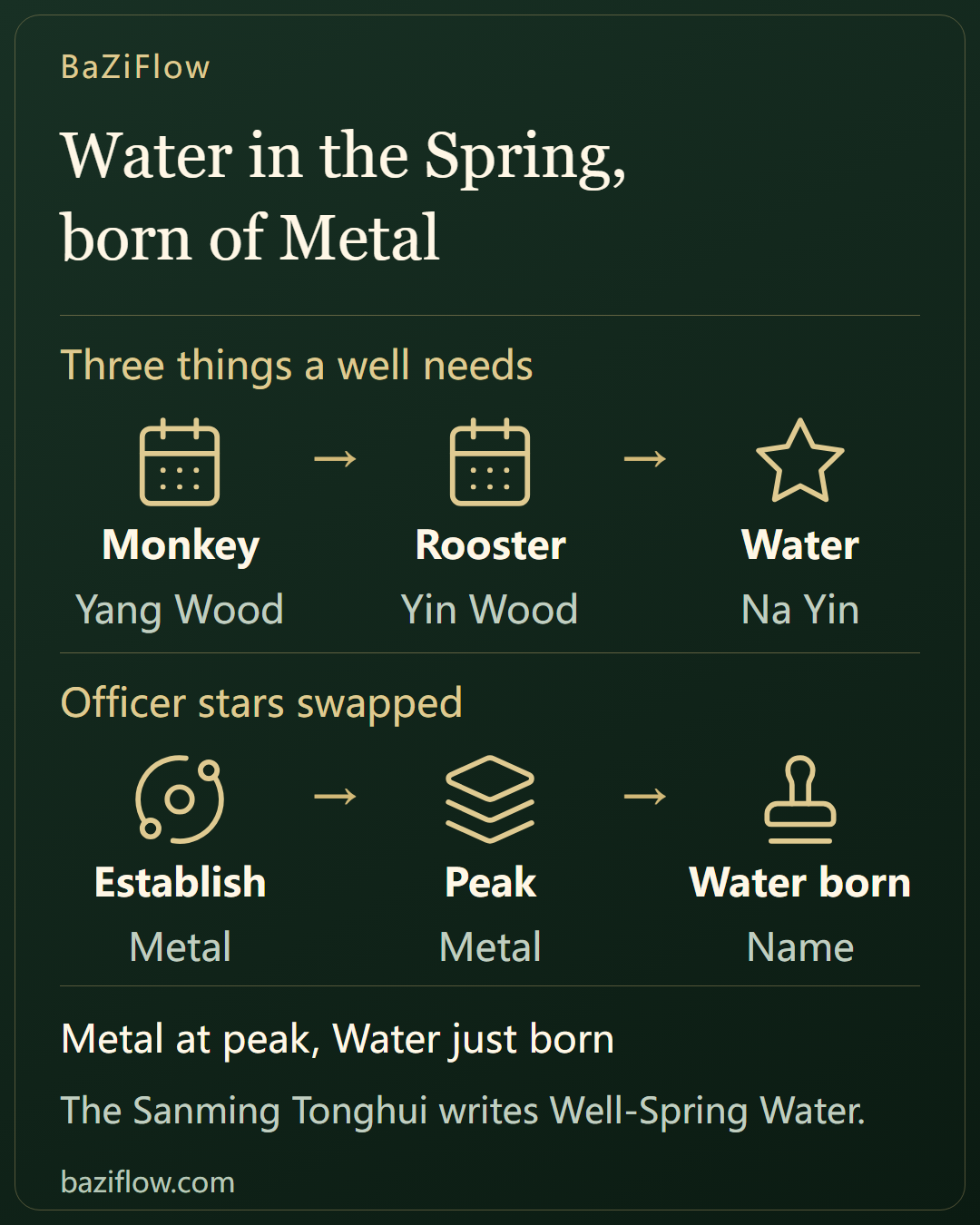
Yang Wood Monkey and Yin Wood Rooster share Water in the Spring, which the Sanming Tonghui writes Well-Spring Water: Metal birthing Water, a well as picture, two patterns, and the digit-sum method that counts Water out.
The short version10 min read
Water in the Spring is the eleventh Na Yin name, shared by Yang Wood Monkey and Yin Wood Rooster and written Well-Spring Water in the Sanming Tonghui. The pillars are Wood on Metal, Water lives only in the name, and the book's image is Metal at its peak with Water born from it.
- Stems are Wood, branches Metal. Metal is at Establishment on the Monkey and Peak on the Rooster, the column the calendar specialists borrow for the name; the pillar notes of juan 1 call the pillars "self-born" and "self-defeated", Water's own Growth and Bath.
- The book itself calls this account "strained" and says it "sheds light on" the survey's image, so the two layers should be cited separately.
- Add the four stem and branch numbers and keep the last digit: Yang Wood Monkey and Yin Wood Rooster give 30, digit 0, which maps to Water. The method agrees with the site's Na Yin table on all thirty pairs.
Read first
What is Na Yin in BaZi? Why Yang Wood Rat Gold in the Sea does not replace Yang Wood ↗
One pair, two names
The eleventh Na Yin name is Water in the Spring (泉中水), shared by Yang Wood Monkey (甲申) and Yin Wood Rooster (乙酉) in the sixty-cycle. The pair has a second name: the Sanming Tonghui (三命通会) writes Well-Spring Water (井泉水) in juan 1. Look at the two pillars first. The stems are Wood and the branches are Metal, so Wood sits on Metal; Water appears only in the Na Yin column, with one hidden Yang Water inside the Monkey.
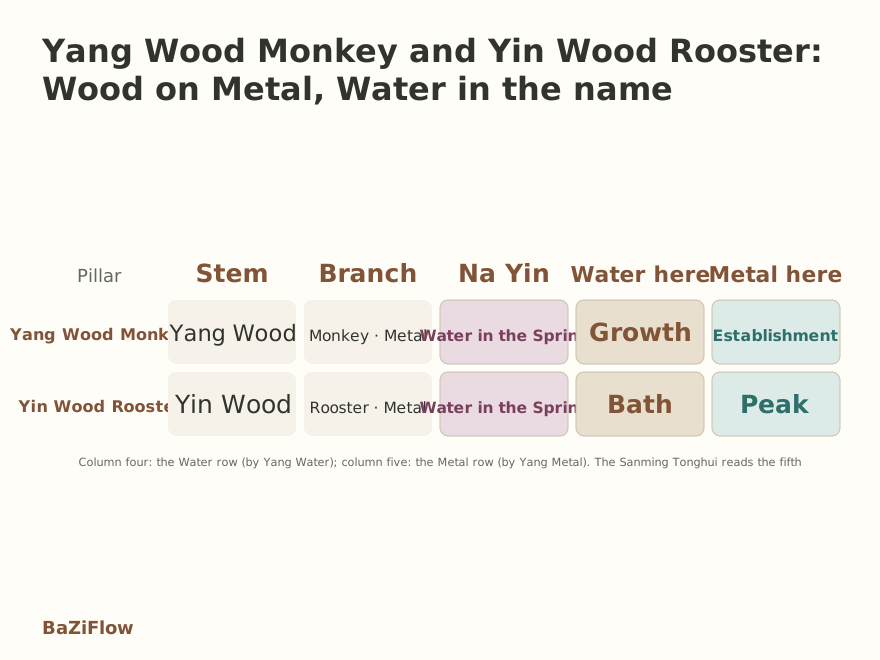
Column four reads the Water row (by Yang Water), column five the Metal row (by Yang Metal) of the site's stage table; the calendar specialists name the pair from column five, the pillar commentary of juan 1 from column four.
Column four looks up the Water row of the twelve life stages (counted by Yang Water): Water is at Growth on the Monkey and at Bath on the Rooster. Column five looks up the Metal row (counted by Yang Metal): on the Monkey Metal stands at Establishment, and on the Rooster at Peak. Both columns use one table, different rows.
"Child and mother in one place": Metal strong, Water born
The survey in juan 1 of the Sanming Tonghui first offers a still picture:
Yang Wood Monkey and Yin Wood Rooster: the breath is calm and still, child and mother share one position, the water comes out and is never used up, is drawn and never runs dry. So it is called Well-Spring Water.
The line does not say who "child and mother" are. In the order of production, Metal is mother to Water, and the Monkey and Rooster are Metal's places, so "Metal and Water in one place" is a natural reading; the sentence itself does not spell it out. The calendar specialists' paragraph is more concrete:
Yang Wood Monkey and Yin Wood Rooster: Metal takes Establishment at the Monkey and Peak at the Rooster. With Metal already thriving, water takes its birth from it, but its force is not yet great. So it is called Well-Spring Water.
From Establishment at the Monkey to Peak at the Rooster Metal is at full strength; Water is born out of that strong Metal, which gives it a source, yet "its force is not yet great": a spring just out of the ground, nothing like a river or a sea. What is borrowed here is the mother's position, not the water's own. The other Water names there use other yardsticks (the Rat and Ox, Fire's position, direction), and after the run the book adds a remark of its own:
Strained as these accounts are, they shed light on one another and on what came before.
"Strained" (凿, literally "bored through") is the book's own word for a stretched argument; it admits the explanation is forced and still says it matches the earlier image. Cite the two layers separately, each with its own source.
Water's own column is used too. The same juan's notes on each of the sixty pillars (释六十甲子性质吉凶) call Yang Wood Monkey "self-born water" and Yin Wood Rooster "self-defeated water": Water at Growth on the Monkey and at Bath, also called Defeat, on the Rooster, which "leans on the mother" and needs many Metals. The name borrows Metal's column; the pillar notes go back to Water's.
Enlarge diagram · scroll sideways to read
A well needs three things: Metal, Wood, Earth
The entry opens by turning this water into a well:
Well-Spring Water: a cold spring, clear and keen, whose nourishment never fails; eight households dug it to drink from together, and ten thousand people lived off it.
It then says what the well needs, in three things, each with a picture or a consequence:
Enlarge diagram · scroll sideways to read
The ranking of Metals is the book's too: Sandstone Metal fits best and Hairpin and Bracelet Metal comes next; White Wax "clashes with Hairpin, so it does not suit" (on the table the Dragon against the Dog and the Snake against the Pig are indeed the two clashing pairs); "meeting Sword Edge as well, the Monkey and Rooster are too strong, for fear of flood"; Gold in the Sea is "of no use", save that its Yin Wood Ox, a mountain, lets "a spring come out below".
Officers swapped, water around a flower bank: two patterns you can lay out on four pillars
The entry ends with two patterns:
If Yang Wood Monkey meets Yin Wood Rooster and Yin Wood Rooster meets Yang Wood Monkey, the officer stars are exchanged, the most auspicious. If two waters stand in the year and hour and two woods in the month and day, it is called water winding round a flower bank, a noble pattern.
Take "officer stars exchanged" first. The "officer star" means the ten gods' Direct Officer: for any stem, the single stem of opposite polarity that checks it. The officer of Yang Wood is Yin Metal, and that of Yin Wood is Yang Metal. The Monkey of Yang Wood Monkey hides Yang Metal, which is the officer of Yin Wood, and the Rooster of Yin Wood Rooster hides Yin Metal, the officer of Yang Wood. On this article's reading, each pillar keeps the other's officer star in its branch, which is what "exchanged" means; the entry itself does not spell it out:
Enlarge diagram · scroll sideways to read
Now "water winding round a flower bank": two waters in the year and hour pillars, two woods in the month and day pillars, water outside and wood inside, like water circling an embankment in bloom. The book argues only from position, not from particular Na Yin names. The Long Flowing Water entry uses the same pattern name for a different layout.
Enlarge diagram · scroll sideways to read
Water counted out: another way to get the name
A Na Yin name can be counted as well as read. Juan 1 of the Xiejibianfang (协纪辨方书), quoting the Ruigui tang xialu, gives a method: every stem and branch has a number, add the four numbers of the two pillars, keep the last digit, and look up the element.
Yang Wood Monkey and Yin Wood Rooster: the count is thirty; ten belongs to Earth, and Water takes Earth as its tone, so it is called Water.
The numbers are: Yang Wood and Yin Earth 9, Yin Wood and Yang Metal 8, Yang Fire and Yin Metal 7, Yin Fire and Yang Water 6, Yang Earth and Yin Water 5; Rat and Horse 9, Ox and Goat 8, Tiger and Monkey 7, Rabbit and Rooster 6, Dragon and Dog 5, Snake and Pig 4. The last digit gives the Na Yin element: 1 and 6 Fire, 2 and 7 Earth, 3 and 8 Wood, 4 and 9 Metal, 5 and 0 Water.
Enlarge diagram · scroll sideways to read
The same method gives the right answer elsewhere: Yang Wood Rat and Yin Wood Ox make 34, digit 4, Metal (Gold in the Sea); Yang Earth Rat and Yin Earth Ox make 31, digit 1, Fire (Thunderbolt Fire). All thirty pairs, counted this way, match the site's Na Yin table.
An evening Start of Spring, then one after midnight
The Yang Wood Monkey year is 2004 and the Yin Wood Rooster year is 2005; the same pair comes round every sixty years: 1944 and 1945, 2064 and 2065. Beijing time puts the Start of Spring (立春) at 19:56 on 4 February 2004, at 01:43 in 2005 and at 07:27 in 2006.
Enlarge diagram · scroll sideways to read
One Start of Spring falls in the evening and the next just after midnight, which is easy to get wrong: someone born on the afternoon of 4 February 2004 still has the year pillar Yin Water Goat, Willow Wood; someone born at 1 a.m. on 4 February 2005 still has Yang Wood Monkey.
Evening or small hours
Start of Spring: 19:56 on 4 February 2004, 01:43 in 2005; check the clock first.
Two names, one pair
Well-Spring Water is the Sanming Tonghui's name, Water in the Spring the Ziwei doushu quanshu song's.
Whose strength
Metal's Establishment and Peak name the pair; "self-born" and "self-defeated" read Water's row.
The previous pair is Willow Wood and the next is Earth on the Roof. The whole stage table is in the twelve life stages and void branches, and how the Direct Officer is found is in what the ten gods are.
Questions readers ask next
Why does this site say Water in the Spring when the Sanming Tonghui says Well-Spring Water?
The same pair is written two ways: the Na Yin song in juan 2 of the Ziwei doushu quanshu has Water in the Spring, while the survey, the calendar specialists' paragraph and the entry in the Sanming Tonghui have Well-Spring Water. The look-up goes by the pillars Yang Wood Monkey and Yin Wood Rooster, not by the wording; cite each book in its own spelling.
Does "its force is not yet great" mean this water is weak?
It means "just come out": Metal is in full strength, the water is only born from it, so there is a source but the volume has not grown, and the comparison is with rivers and seas. It describes the stage the water is in. Water is at Growth on the Monkey and Bath on the Rooster, the first two cells of the twelve stages.
The stems are Wood, the branches are Metal and the Na Yin is Water. Is that a contradiction?
Each layer is looked up on its own: the stems Yang Wood and Yin Wood are Wood, the branches Monkey and Rooster are Metal, the Monkey also hides Yang Metal, Yang Water and Yang Earth, and the Na Yin of the whole pillar is read by name. The layers need not agree, and before counting elements one writes down which layer is being counted.
Was this article helpful?
Sources & references
Continue reading
Willow Wood (杨柳木): Why Yang Water Horse and Yin Water Goat Carry This Na Yin Name ↗
Earth on the Roof: Why Yang Fire Dog and Yin Fire Pig Carry This Name, "Finished Earth" ↗
Five Elements cycles: learn the relationships, not just the order ↗