

Strong and Weak Day Masters: A Conditional Relationship
Content version · · Sources & references
Strength describes the Day Master within a traditional chart framework, not personal toughness or health. Work through reference changes and incomplete evidence before accepting a final label.
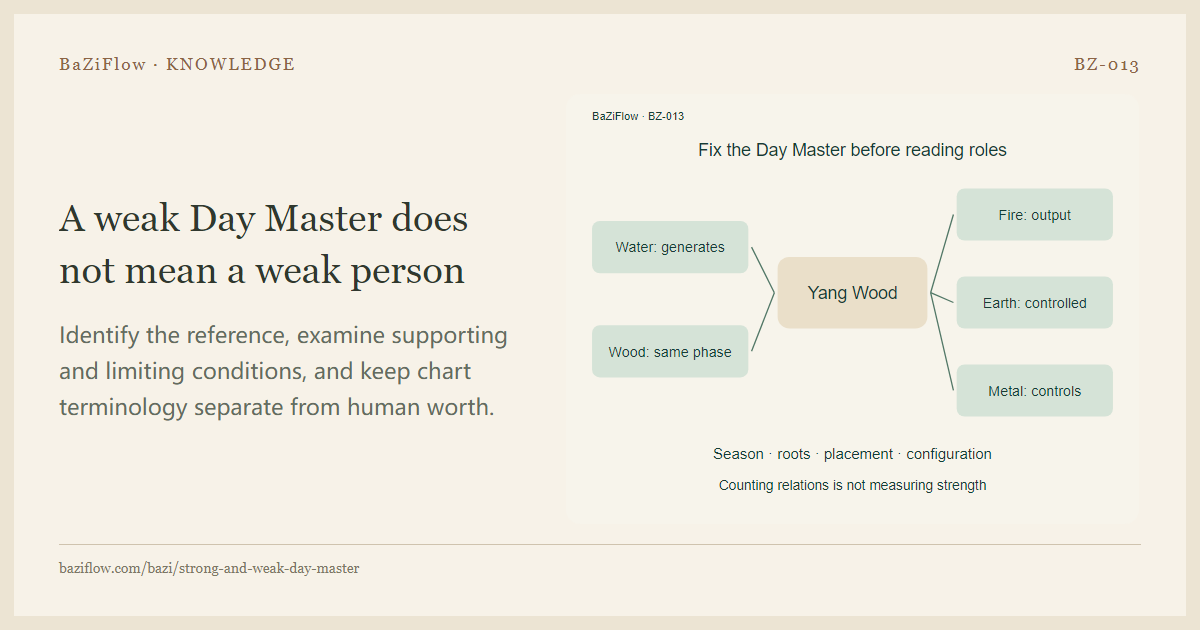
Identify the reference, examine supporting and limiting conditions, and keep chart terminology separate from human worth.
Read first
Five Elements cycles: learn the relationships, not just the order ↗
First remove the everyday meaning
“Weak Day Master” can sound like a judgment about a person. In Zi Ping terminology it is ordinarily a statement about the Day Stem's position within a configuration of support, output and control. The Day Master is a reference point in the chart, not a summary of the person's body, willpower or worth.
Consequently, the label does not establish poor health, low confidence or limited achievement. “Strong” does not establish the opposite. Translating a technical classification into a modern health or personality assessment changes the claim and demands evidence that the original chart terminology does not provide.
Even within the traditional framework, identifying strength is a conditional interpretation rather than an award. A reader should be able to ask what supports the label, what works against it, and what missing information might change it.
A phase changes roles when the reference changes
Use Yang Wood as a provisional Day Master. Water generates Wood; other Wood belongs to the same phase. Wood generates Fire, controls Earth and is controlled by Metal. Those directions produce a relationship map, but not a strength score. The map has no complete chart placements, season or roots attached to it.
| Phase viewed from Yang Wood | Direction | Further question |
|---|---|---|
| Water | Generates the reference | Is effective support established? |
| Wood | Same-phase support direction | What season, roots and placement apply? |
| Fire | Generated output | Under what conditions does output operate? |
| Earth | Controlled by the reference | What capacity and configuration are involved? |
| Metal | Controls the reference | How is that control situated? |
Now change the Day Master to Water. Metal moves from incoming control to incoming generation. This small change proves why phases cannot be permanently divided into a “helpful team” and a “harmful team” for every chart. The Ten Gods introduction develops the reference-based names used for such relationships.
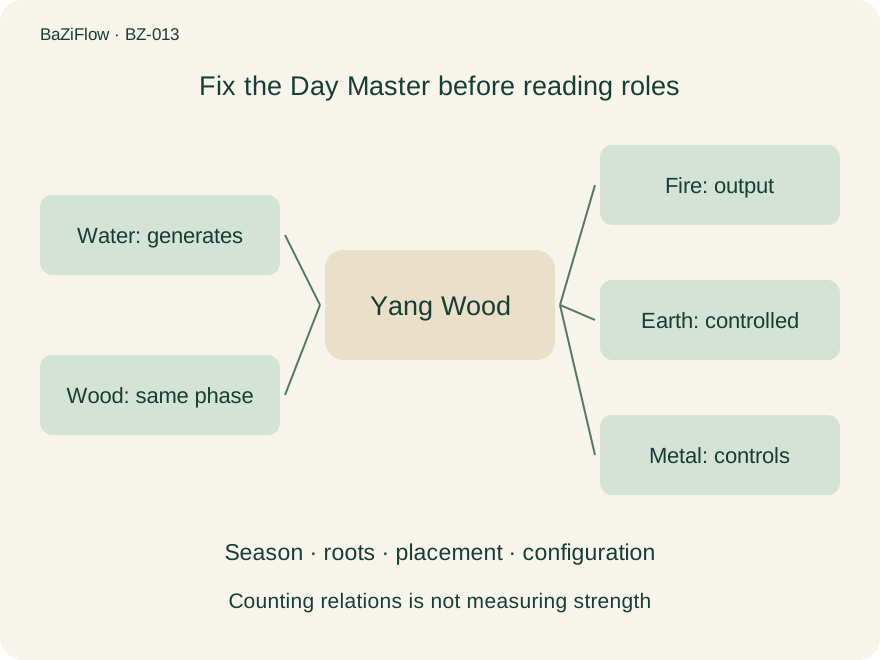
Original BaZiFlow relationship diagram for a Yang Wood Day Master; not a score for health, character or achievement.
What would make you revise the conclusion?
Consider two evidence cards. Card A says “Yang Wood, seasonal support, a corresponding root.” Card B says “Yang Wood, less seasonal support, no confirmed corresponding root.” A contains more stated support than B, but neither card provides the entire configuration. Comparing their evidence is justified; assigning them complete strength verdicts or numerical life rankings is not.
Add effective support elsewhere to Card B and the interpretation may need revision. Add significant output or control to Card A and that also needs examination. Revising in response to relevant information is not inconsistency. It is what a conditional conclusion should do. The cards deliberately contain no birth dates or people: the exercise tests reasoning about missing information.
Seasonal support, rooting and emergence must also remain distinct. One concerns season, another the relationship to support in branches, and another the correspondence between hidden and visible stems. Renaming one fact three times must not turn it into three independent points of evidence. See roots, emergence and seasonal support for the separate checks.
Classical cautions and different frameworks
The strength discussion and accompanying traditional commentary in Di Tian Sui consider weakness inside apparent strength and strength inside apparent weakness. San Ming Tong Hui, volume 2, similarly warns against equating every vigorous seasonal state with good fortune and every diminished state with bad fortune. These are cautions within a traditional interpretive literature, not experimental validation of the literature's predictions.
Common support-and-restraint readings examine assistance relative to output and control. Pattern, following-pattern and transformation discussions introduce other conditions. A special framework should be named and its requirements checked; it should not be invoked merely because an ordinary reading became inconvenient. Different schools also weigh conditions differently, so the stated method matters when comparing conclusions.
A software score adds yet another layer. The program may sum its chosen weights with perfect arithmetic while the weights remain debatable. Decimal places express computational precision, not automatically interpretive reliability. If structurally different inputs repeatedly receive nearly identical scores, saturation or repeated rules deserve investigation before similarity is accepted as a property of the charts.
A label should leave an inspectable argument
An explanation should identify its Day Master, the distinguishing support evidence, the output and control evidence, and the unresolved conditions. A reusable sentence such as “strong, so restrain” or “weak, so support” does not show that the present configuration was actually read. It also cannot independently justify a fixed career, relationship style or behaviour prescription.
Read the label as the end of a bounded argument, not the beginning of a judgment about a person's value. The next discussion, favourable, useful and unfavourable factors, asks how further interpretive choices relate to that evidence rather than treating strength as a universal permission slip.