

Why two BaZi charts disagree around midnight
Content version · · Sources & references
A Rat-hour label does not settle the day boundary. Compare the selected day pillar, hour-stem rule and time conversion separately before treating two charts as contradictory.
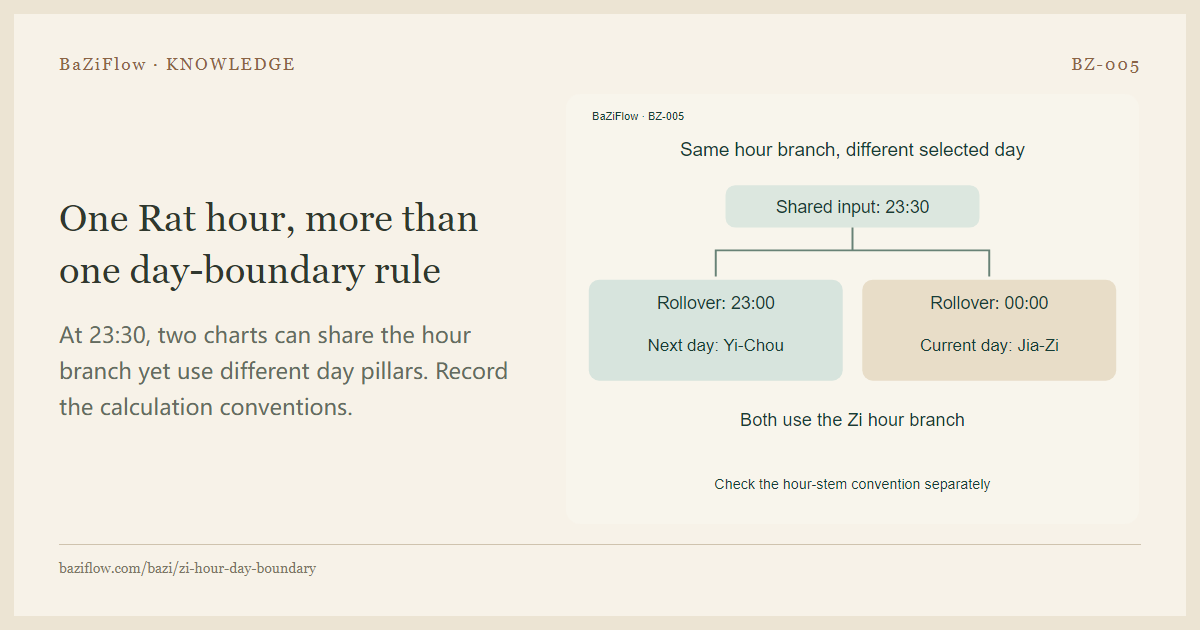
At 23:30, two charts can share the hour branch yet use different day pillars. Record the calculation conventions.
Read first
Reading a BaZi chart for the first time: the four pillars and the Day Master ↗
True solar time, time zones and daylight saving: what is the difference? ↗
A midnight setting is an incomplete specification
Imagine you are documenting a calculator for someone else to reproduce. Its settings say “change the day at midnight.” Is that enough to derive the Hour Pillar for a birth at 23:30? No: you still need to know which day's stem supplies the late-night hour stem. A rule for the day label and a rule for the hour stem can use different references.
The distinction is visible in the consulted transcription of Mingli Tanyuan. Its example keeps Xin-You as the late-night Day Pillar while using the following Yang Water day to obtain Geng-Zi as the Hour Pillar. After midnight, the Day Pillar becomes Ren-Xu and the hour remains Geng-Zi. This is evidence for a stated convention, not a claim that every school uses it. The transcription contains a suspect clock numeral, so its dated example is not reproduced here as a verified historical birth calculation.
The practical lesson is to write two settings: when the Day Pillar advances, and which day supplies the hour stem during the late Rat hour. A familiar school name or a single “early/late Rat hour” switch may conceal those details. Without documentation, leave the second setting unknown.
Build a small test sheet before comparing interpretations
Use adjacent teaching days Jia-Zi and Yi-Chou. They do not identify a real birthday. Keep one time basis throughout, with no additional solar-time correction. A changes the Day Pillar at 23:00; B changes it at 00:00. First record only the fields that these conditions determine.
| Shared clock reading | A: day change at 23:00 | B: day change at 00:00 |
|---|---|---|
| First date, 22:30 | Jia-Zi day; Pig hour branch | Jia-Zi day; Pig hour branch |
| First date, 23:30 | Yi-Chou day; Rat hour branch | Jia-Zi day; Rat hour branch |
| Following date, 00:30 | Yi-Chou day; Rat hour branch | Yi-Chou day; Rat hour branch |
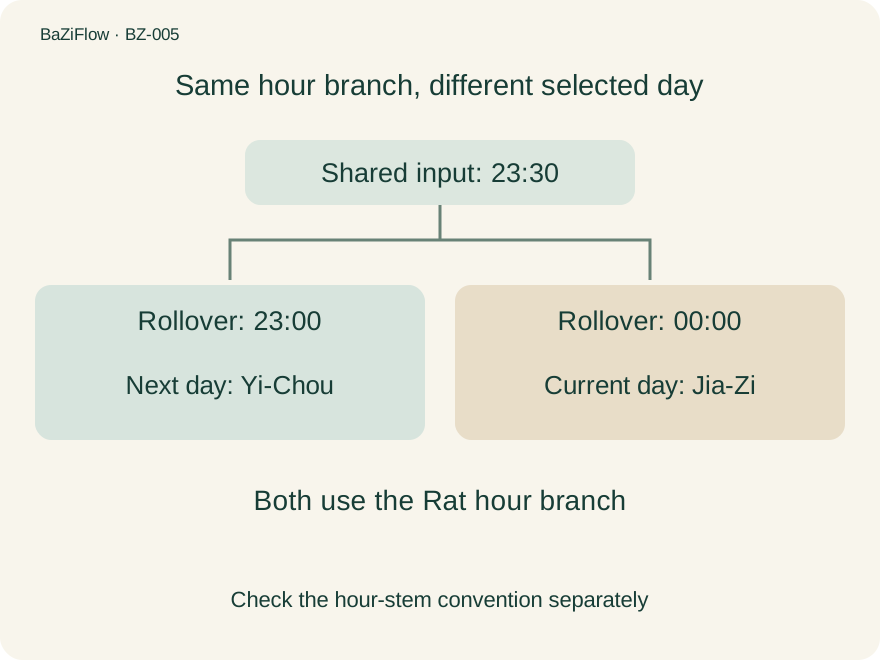
Original BaZiFlow rule diagram. Jia-Zi and Yi-Chou label adjacent teaching days, not a verified birth date.
The Hong Kong Observatory's correspondence table places the Rat hour between 23:00 and 01:00. That supports the shared hour branch in the middle row. It does not, on its own, settle the day-rollover convention. Notice also that this exercise table deliberately leaves the hour stem blank: filling it now would smuggle in a rule that the exercise has not specified.
Add the condition “derive the hour stem from the selected day stem.” The Observatory's hour table then yields Jia-Zi for a Yang Wood day and Bing-Zi for a Yin Wood day. At 23:30, A therefore gives Bing-Zi and B gives Jia-Zi under this added condition. Remove the condition, and B's hour stem becomes unresolved again. The historical late-night treatment above shows why that qualification matters.
Diagnose a disagreement by its pattern
Suppose two outputs have the same Zi branch but different day stems. Check their day-change settings and the timestamps actually passed to the calculation. If they have the same Day Pillar but different hour stems, ask about the late-night reference day. These observations narrow the investigation; they do not establish that the implementations are correct.
If even the hour branches differ, look further upstream. One report may have used 23:30 and another 22:50 after a time conversion. The forty-minute difference can cross the Hai/Zi boundary before either day-rollover rule is considered. Calling this only a “midnight dispute” would miss the differing inputs.
This is why the original recorded time and the calculation time belong in separate fields. Record location, the historical time-zone interpretation, any daylight-saving adjustment, and any mean or apparent solar-time correction. Hong Kong Standard Time is UTC+8 according to the Observatory; that local reference does not specify other regions or every historical offset.
Keep the experiment separate from choosing a chart
After reproducing the fields, you may still have an unresolved birth-time record or a method choice. A timestamp recalled as “around midnight” does not become precise because a calculator prints minutes and seconds. Preserve conditional alternatives with their assumptions instead of adjusting a minute until the interpretation feels preferable.
A changed day stem changes the reference for the Ten Gods. A changed hour stem alone is a narrower difference. Use the four-pillar structure to describe exactly which fields are stable. Save the software version alongside the original timestamp, converted timestamp and the two rules above. Another reader can then repeat the calculation without needing to agree with an interpretation first.
Sources & references
Continue reading
Zodiac Animals and Branches: What a Year Label Leaves Out ↗
What are the Ten Gods? Start from the Day Master's relationships ↗