

Where transformations originate
Content version · · Sources & references
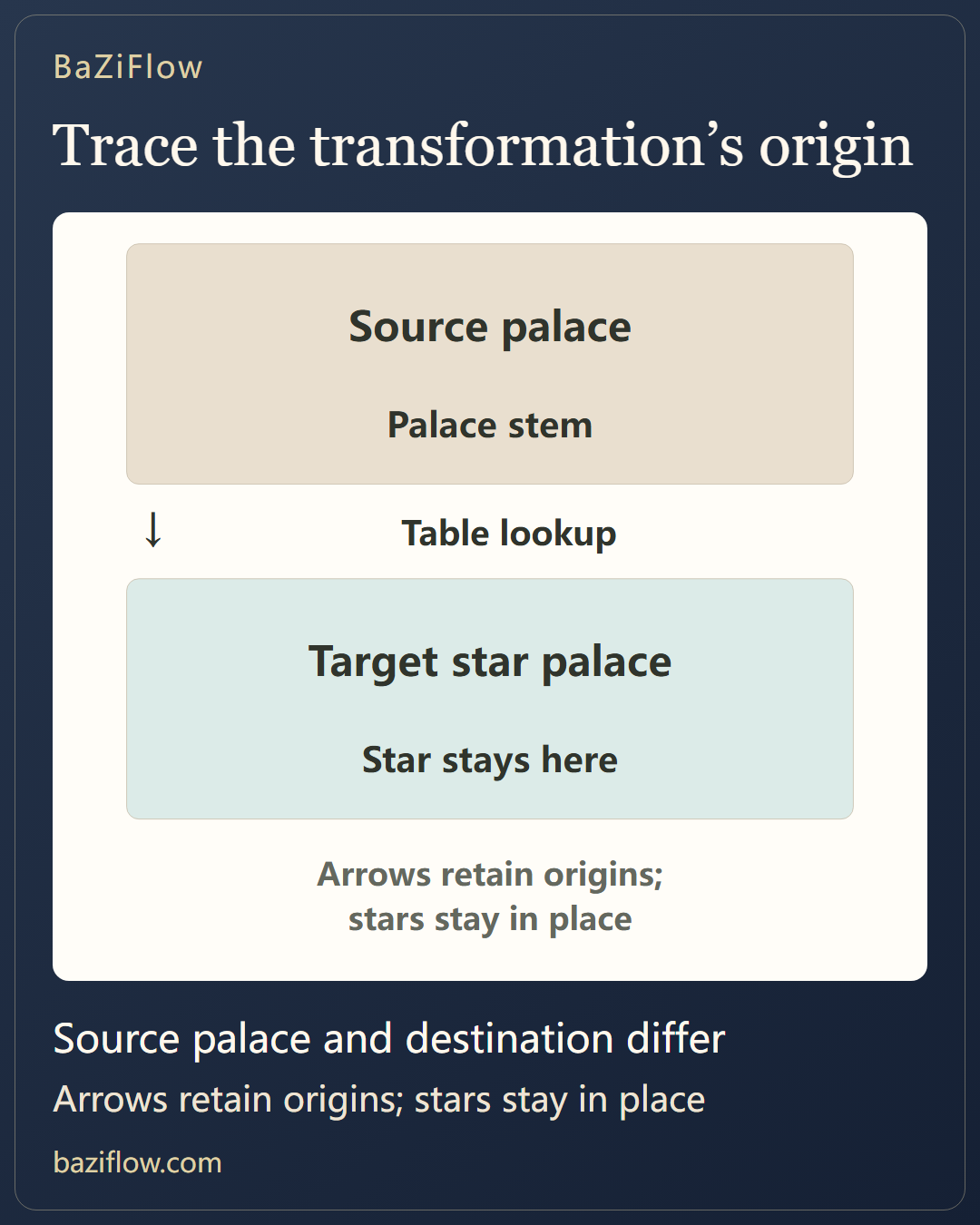
Track two transformation sources to one star without losing their origins. A Yang Wood birth-year stem and a Yang Fire palace stem illustrate why an arrow is not merely a label on its destination.
The short version6 min read
Birth-year transformations select star labels from the natal year stem. Palace-stem transformations also retain the palace that supplies the stem and the palace containing the target star. Both can annotate Lian Zhen, yet they remain different records with different origins.
- The natal layer uses the birth-year stem; a palace-stem relation additionally needs the source palace that supplied its input.
- The cited table gives Lian Zhen Lu from Yang Wood and Ji from Yang Fire; different origins remain two records rather than a cancelling sum.
- A to B means A supplies the stem and the selected star is at B; a mark at B does not establish B as the source.
Read first
One destination can receive two different records
Consider a deliberately limited model. The birth-year stem is Yang Wood. A separate palace, called A, has the stem Yang Fire. Lian Zhen is placed in a destination called B. These are teaching labels for tracing a relationship, not a complete chart calculated from a birth date.
Using the cited iztro table, Yang Wood assigns Lu to Lian Zhen; Yang Fire assigns Ji to Lian Zhen. Both lookups therefore mention the same star, but they have different origins. Keeping only “Lian Zhen has Lu and Ji” would discard the feature this example is meant to teach.
| Origin of the lookup | Stem used | Recorded result |
|---|---|---|
| Birth-year layer | Yang Wood | Natal Lu on Lian Zhen in B |
| Palace A | Yang Fire | Ji from A to Lian Zhen in B |
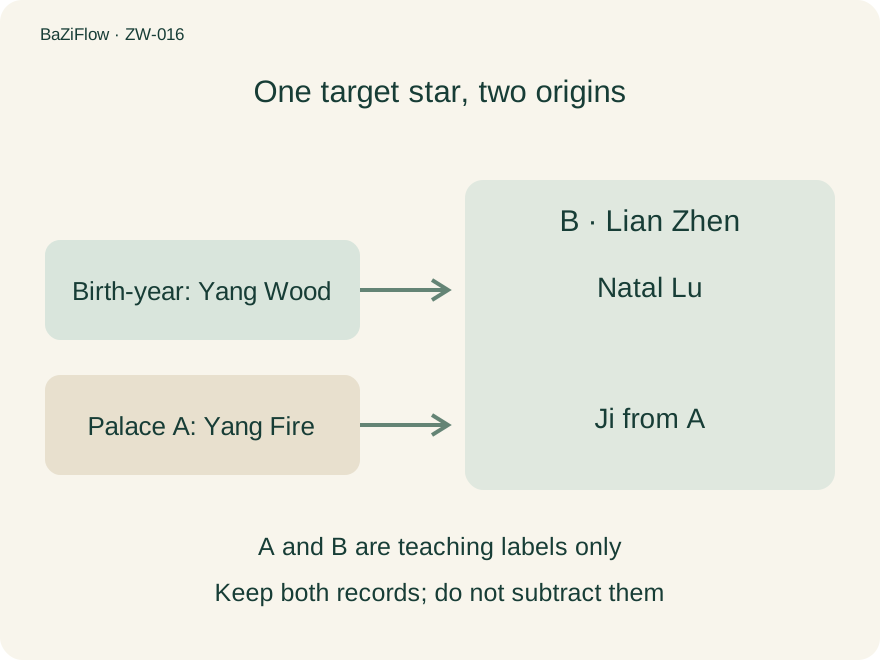
Original BaZiFlow source comparison using the Yang Wood and Yang Fire rows of the cited iztro table; no personal palace topics are assigned.
No palace topic has been assigned to either letter. B is not automatically Wealth or Spouse, and A is not automatically Life. Nor does this limited model establish that arbitrary stems and placements may be combined into a valid natal chart. Full placement rules would still have to be satisfied.
Natal Yang Wood
B: Lian Zhen Lu
A: Yang Fire
B: Lian Zhen Ji
An arrow carries information that a badge does not
A birth-year transformation begins with the natal year stem and attaches the selected transformation to the selected star. A palace-stem calculation begins with the stem of a particular palace. It therefore preserves an additional origin: the palace from which the relation is being read.
The iztro explanation describes a palace A whose stem produces a transformation on a star in palace B. Its palace documentation separately provides checks for natal transformations within a palace and checks for transformations from one palace to another. These are different questions even when their visible labels use the same four names.
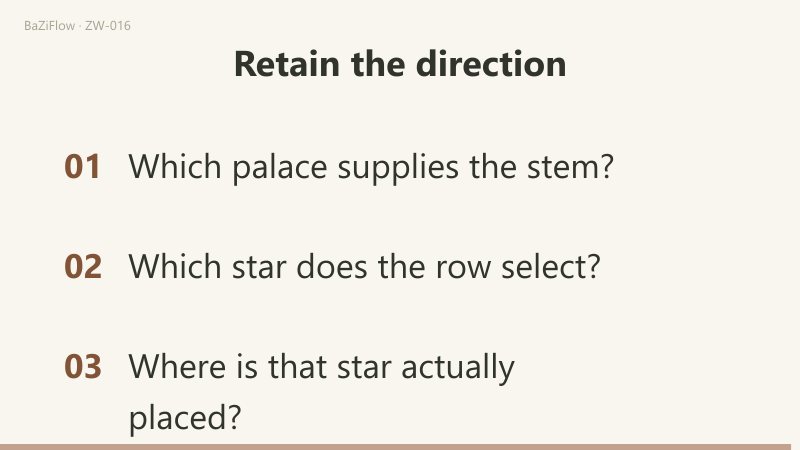
When reading an arrow, first identify the source palace and its stem. Then verify the table entry and the target star's actual position. Starting only at the arrowhead can mistakenly turn an incoming relation into something generated by the receiving palace itself. If the basic natal lookup is new, review birth-year transformations before adding the palace origin.
Arrows retain origins; stars stay in place
Why Lu and Ji do not simply cancel
In the model, two lookups remain two records. There is no table instruction saying to assign Lu a value of plus one, Ji a value of minus one, and delete both when the total is zero. That arithmetic would replace source information with an invented score.
A particular interpretive method may discuss how different transformation sources interact. Such a discussion needs to name its method and conditions. It should not erase the inputs it is interpreting. Likewise, retaining only whichever label feels more important would prevent another reader from reconstructing the original observation.
The star has not been duplicated or moved by the lookup. Lian Zhen remains the target star at B in this teaching model. What differs is the relationship under which its annotation was obtained. This distinction is useful whenever a chart display places several marks near one name: proximity on the screen does not make their origins identical.
Natal Yang Wood
- Source
- Natal Yang Wood
- Target
- B: Lian Zhen Lu
A: Yang Fire
- Source
- A: Yang Fire
- Target
- B: Lian Zhen Ji
Compare the input relation before comparing the interpretation
Two readings that both mention Ji on Lian Zhen may be discussing different things: one could use a palace stem and another an annual stem. Put their table version, originating stem, source palace if applicable, target star and target palace side by side. Differences in those fields should be resolved before treating the prose as a disagreement about one shared fact.
Some traditions explain palace relations through words such as attachment, dependence or concern. Those are symbolic interpretations within a method. An arrow from A to B does not independently establish that one real person dislikes or depends on another. Real relationships require information from the people involved.
As a reconstruction exercise, hide the diagram and redraw only the palace-stem relation from the table above. You should recover A to B with Yang Fire as the source stem. Then add the separate Yang Wood birth-year record without making Yang Wood the stem of A. If both origins survive the exercise, you have retained the distinction that a flattened list of transformation labels would lose.
Try reversing A to B. The model supplies Yang Fire at A; the Yang Fire row selects Lian Zhen with Ji; Lian Zhen is at B. These facts establish the stated direction. To ask whether B also sends Ji to A, obtain B’s stem, find its Ji star and check whether that star is at A. None of those inputs is supplied here. The reverse relation is unverified, rather than established or disproved.
An arrow is therefore not a freely reversible line between two palaces. The source stem determines the table row, and the selected star’s position determines the destination. If a separate reverse relation does exist in a full chart, preserve its own lookup evidence instead of adding a second arrowhead to the original line.
A to B
- A supplies Yang Fire
- Lian Zhen at B
B to A
- B stem missing
- Target unchecked
A diagram legend is part of the evidence
Applications and books may distinguish annotation types by colour, line style or position. Do not assume that red always means natal or that a dashed arrow always means annual. Read the legend belonging to that specific diagram.
Without the legend, record the visible mark as unresolved. A cropped image may provide enough information to identify a star while withholding the origin of its annotation. It is better to retain a precise partial observation than to name the wrong layer and build a long interpretation on it.
A return to the originating palace can introduce the topic of self-transformations and school terminology. Even there, an arrow shape is not a universal dictionary. Establish the author's definition before translating the mark into a technical category.
Natal label
Identify year stem
Palace arrow
Retain source palace
Cycle label
Name the time layer
Questions readers ask next
What extra field does a palace-stem transformation need?
It needs the palace supplying the stem. The natal lookup starts from the year stem; the palace lookup starts from a specific palace’s stem. Source palace, selected star and destination together preserve the directional relation.
Do Lu and Ji on Lian Zhen automatically cancel?
No cancellation is defined by the cited table. Natal Yang Wood gives Lian Zhen Lu, while Palace A’s Yang Fire gives Lian Zhen Ji. Keep both inputs. Any interpretation of their interaction requires a separately stated method rather than deleting the records first.
Can an A-to-B transformation be read as B to A?
No. A supplies the lookup stem and B contains the selected star. Reversing the relation requires B’s stem, the star that it selects and that star’s location. The original arrow does not establish this separate reverse lookup.
Was this article helpful?