

Roots, exposed stems and seasonal support in BaZi
Content version · · Sources & references
Three often-confused conditions describe different parts of a Four Pillars chart. Learn what each statement actually establishes.
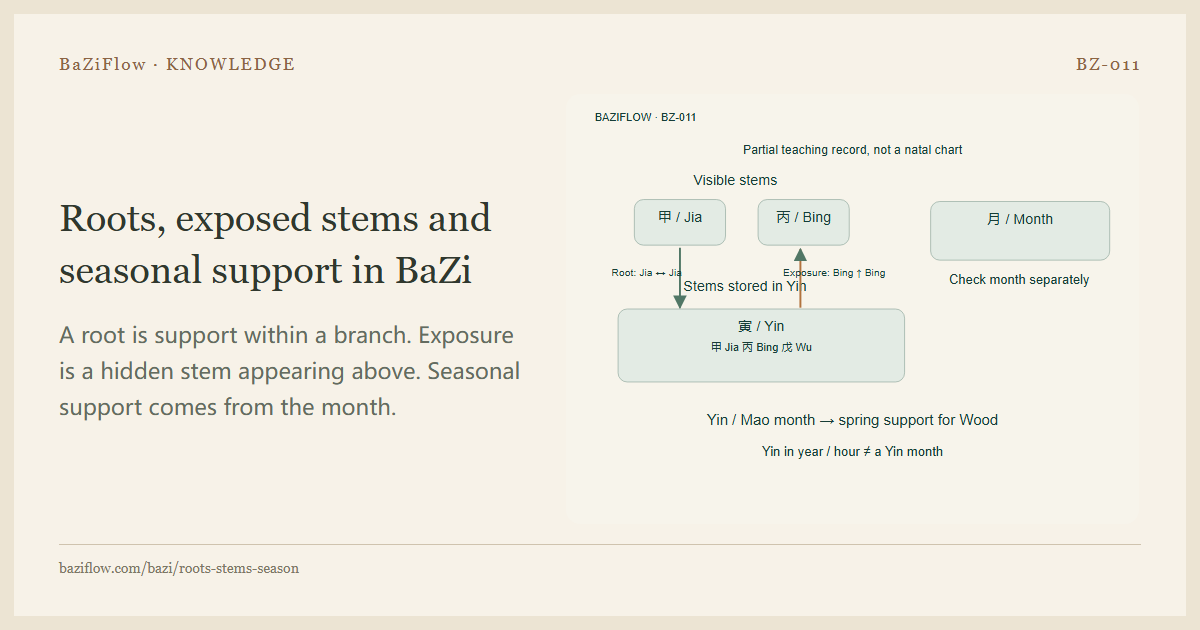
A root is support within a branch. Exposure is a hidden stem appearing above. Seasonal support comes from the month.
Three translations that can hide the evidence
“Rooted”, “exposed” and “in season” are sometimes all paraphrased as “strong”. Keep the Chinese terms tong gen, tou gan and de ling beside your English notes until their different questions become familiar. Rooting asks about support within a branch; exposure asks whether a hidden stem also appears in the visible row; seasonal support asks about the month. None gives a complete strength judgement.
Build a record with three independent fields
Write the visible stem first, then the exact contents of the branch you are consulting, then the month branch if known. Yin stores Jia, Bing and Wu; Mao stores Yi; Zi stores Gui. These are different inventories, not interchangeable examples of “support”. Jia with Yin has an exact root correspondence. Jia with Mao can have same-element root support under a common convention, but Mao does not store Jia. Zi's Gui Water can generate Wood; it is not a Wood root.
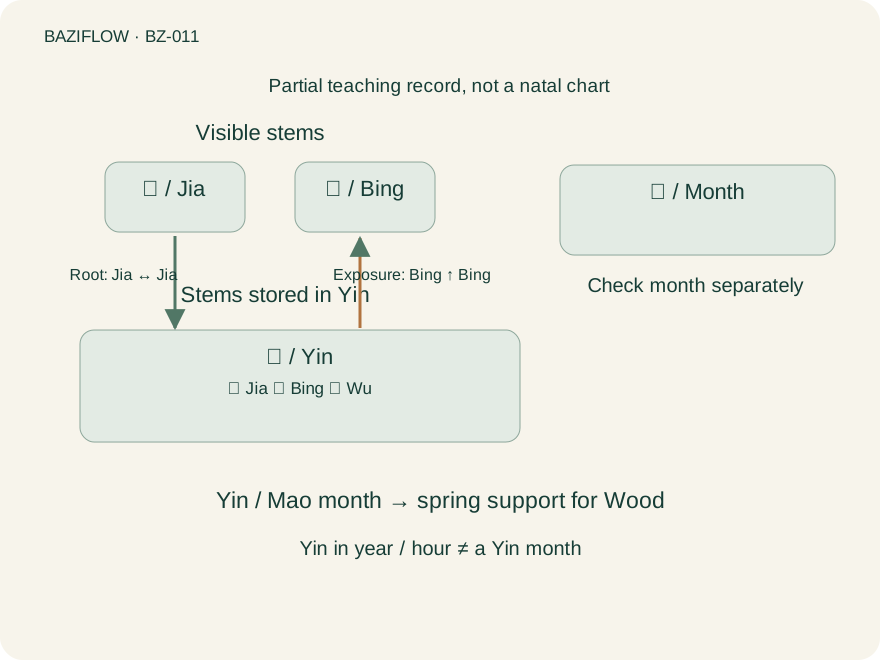
A partial teaching record, not a complete natal chart or a strength score.
Read upward for exposure, sideways for season
If Yin is present and visible Bing is recorded, the Bing hidden in Yin is exposed. Replace the visible Bing with Ding and that exact correspondence disappears: Yin does not store Ding. A broader same-element usage should be identified as such. Also label whether the visible stem is natal or arrives in a later period; a later Bing must not be copied into the natal inventory.
For season, consult the month rather than whichever branch looks helpful. Wood has spring support in Yin and Mao months, but Yin in the hour position says nothing by itself about the birth season. BaZi months use solar-term boundaries, not the first day of a Gregorian or lunar month. Schools can differ on root weights and finer seasonal categories, so include the convention in the record.
Try an evidence-editing exercise
Edit these three statements. “Jia has a root because the hour branch is Yin” can be retained as a structural observation under the stated inventory. “Bing is in its ruling season because it appears above a Yin month” combines exposure with a seasonal claim it has not established. “A spring-born Jia must be strong” skips the rest of the chart. Correct the second by recording exposure only, and the third by recording spring support while leaving overall strength open.
Now remove the month field from your worksheet. The root and exposure correspondences may remain, while the seasonal conclusion becomes unknown. That is the point of separate fields: missing data should remove only the conclusion that depends on it. These fragments are not calculated personal charts and cannot determine useful elements or life outcomes.
From a worksheet to a whole-chart argument
Zi Ping Zhen Quan's discussion of being in season without being strong, or out of season without being weak, is a historical warning against one-factor verdicts. It documents an internal method of the tradition, not scientific verification of prediction. Only after the observations are fixed should a reader discuss support, output, control and combinations under a named approach.
For a contrasting way to organise evidence, continue to BaZi and Zi Wei reading methods. A palace–star system can teach the same discipline of separating observation from interpretation without its stars becoming equivalents of roots.