

Death God: the Establishment spot of a group
Content version · · Sources & references
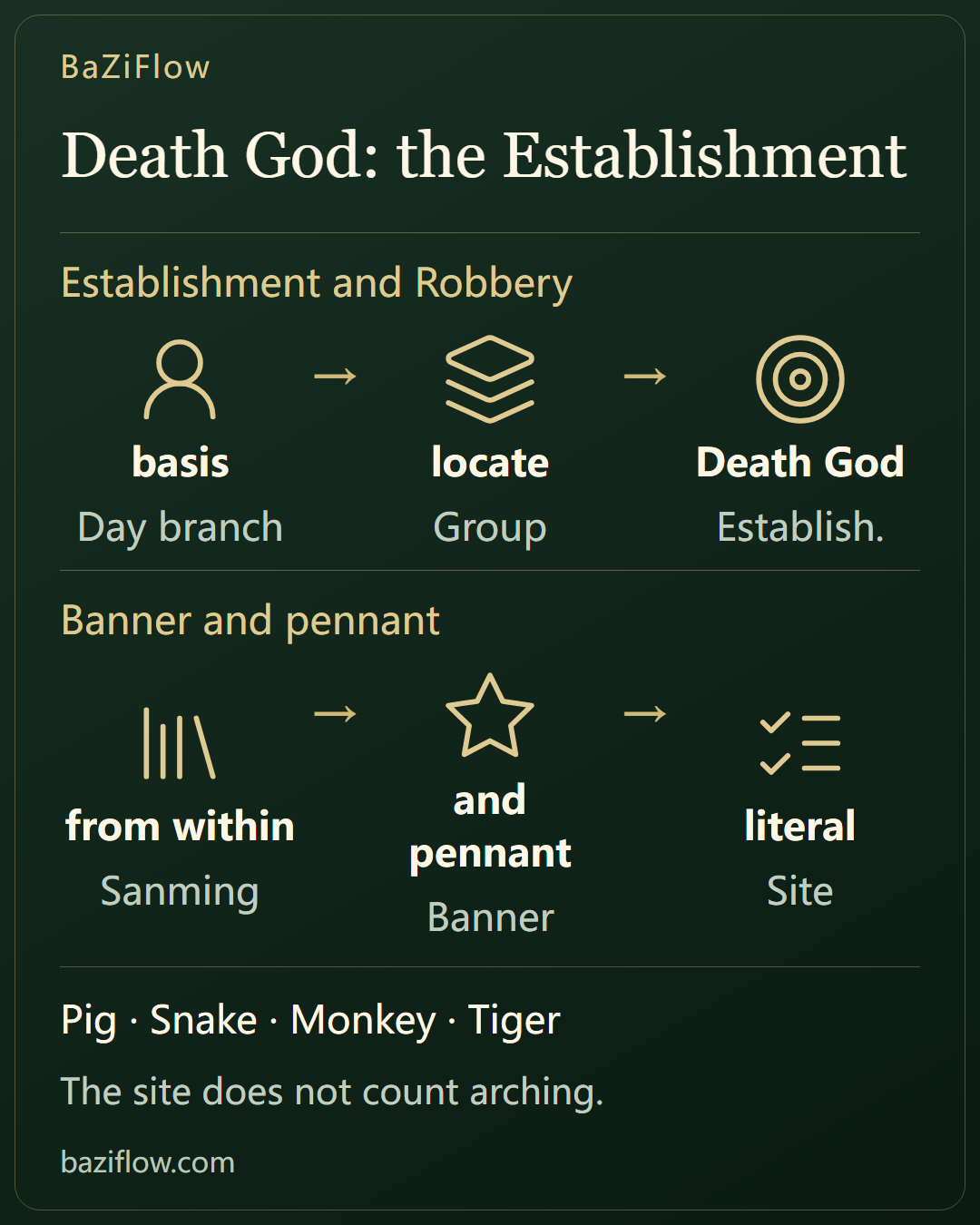
The Death God starts from the day branch and takes the Establishment spot of its Three Harmony group, just before Peak: Tiger, Monkey, Snake or Pig. A table, the banner-and-pennant case and two sample charts.
The short version8 min read
The basis of the Death God is the day branch: it takes the Establishment spot of the Three Harmony group the day branch is in, the stage just before Peak, always one of Tiger, Monkey, Snake and Pig, and it clashes the Robbery Sha of the same group.
- Monkey-Rat-Dragon gives Pig, Tiger-Horse-Dog gives Snake, Snake-Rooster-Ox gives Monkey, Pig-Rabbit-Goat gives Tiger. In each group the Death God and the Robbery Sha clash each other, the two branches simply swapping places.
- The Sanming Tonghui names it "loss from within" and points to the hidden stem, in the landing branch, that the group's element produces and so drains; the old verses read it as a heavy calamity and as something that a Nobleman can turn.
- The book calls the Robbery Sha the banner and the Death God the pennant, and allows them to be "arched" into place between two pillars; the site counts only branches that literally stand in the chart.
Read first
Symbolic Stars in BaZi: Check the Reference and Rule Before the Meaning ↗
The Establishment spot of the group
The Death God (亡神) comes from the same groups as the Robbery Sha and also takes two steps. First see which Three Harmony (三合) group the day branch belongs to; then take the branch in that group that holds Establishment.
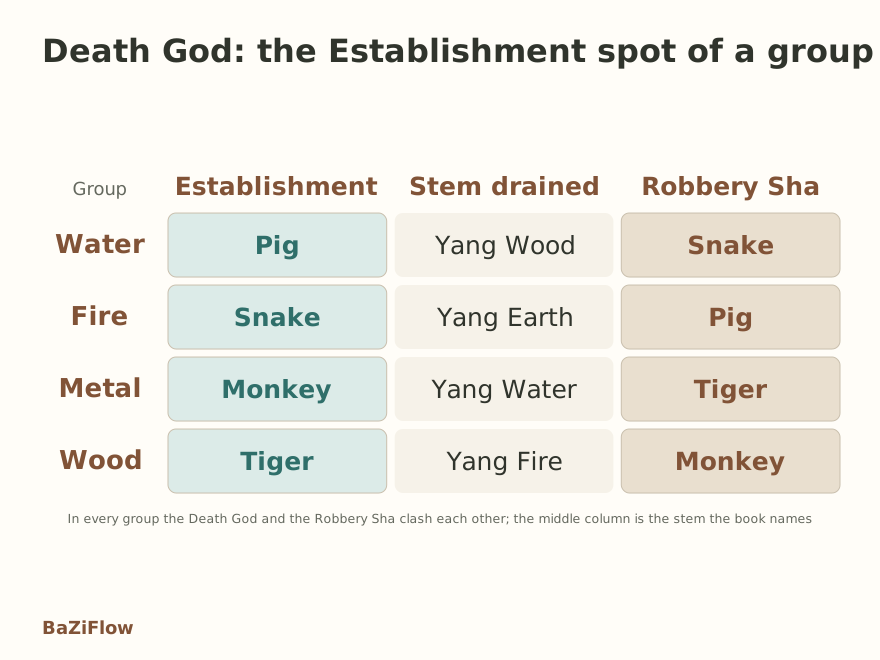
Table: the Establishment spots are checked against the twelve-stage table, the Death God and Robbery Sha spots come from the site engine, and the middle column is the stem the Sanming Tonghui names, checked against the engine's hidden-stem table.
In the twelve life stages Establishment sits right before Peak, the point where each element reaches its working prime. The four groups give Pig for Water, Snake for Fire, Monkey for Metal and Tiger for Wood, so Tiger, Monkey, Snake or Pig. Each lies outside the three branches of its own group, so, as with the Robbery Sha, the day pillar's own branch cannot be hit.
Robbed from outside, lost from within
The Sanming Tonghui (三命通会) files these two shas in a single section of juan 3 and sets them apart by what their names mean:
Loss means to lose; losing something from within is what is called the Death God's loss.
"Robbery" is being taken from outside, "loss" is leaking away from inside. The landing spots move accordingly: the Robbery Sha at Severance, the Death God at Establishment. The book again goes group by group through the hidden stems, but this time the stem it names is not one that controls the element; it is one that the group's element produces, and so drains:
Water produces Wood; for Monkey, Rat and Dragon, Pig is the Death God, because the Wood inside the Pig drains Water.
Water produces Wood, Pig hides Yang Wood, and that Wood draws the energy of Water out, so Pig is the Death God of the Water group. The other three are written the same way: Fire produces Earth and the Earth inside the Snake drains Fire; Metal produces Water and the Water inside the Monkey drains Metal; Wood produces Fire and the Fire inside the Tiger drains Wood.
Enlarge diagram · scroll sideways to read
In every group this pair of spots turns out to be a clash: Snake and Pig for Water, Pig and Snake for Fire, Tiger and Monkey for Metal, Monkey and Tiger for Wood. So the same branch is the Robbery Sha of one group and the Death God of the group across from it.
Banner and pennant: "arching" in the book
Juan 6, where it speaks about chart patterns, sets the two shas side by side and gives them a name from the army camp:
Among the Symbolic Stars, the Robbery Sha is called the banner and the Death God the pennant; only when the two meet do they make banner and pennant.
The book then gives a chart: Yang Metal Dragon (庚辰), Yang Fire Dog (丙戌), Yang Metal Horse (庚午) and Yang Fire Rat (丙子). It says the Robbery Sha of this chart is at Snake and the Death God at Pig: the Dragon and Horse of Yang Metal Dragon and Yang Metal Horse hold Snake between them, which is called "arching" Snake and makes a wrapped banner; the Dog and Rat of Yang Fire Dog and Yang Fire Rat hold Pig between them, arching Pig and making a wrapped pennant. With both flags present, the chart has "banner and pennant".
Enlarge diagram · scroll sideways to read
The Snake and Pig in this example fit the Water group: the year branch Dragon and the hour branch Rat are both in Monkey-Rat-Dragon. The site starts from the day branch Horse, which is in the Tiger-Horse-Dog Fire group, so its spots are Pig (Robbery Sha) and Snake (Death God), exactly swapped. More important, the site counts only branches that literally stand in the four pillars and does not count arching, and Dragon, Dog, Horse and Rat contain neither a Snake nor a Pig, so the site marks no Robbery Sha and no Death God on this chart. The start and the rule both differ, and a literal look-up cannot be used to confirm the book's arching.
Two sample charts where both appear
The first chart has a day branch of Ox, in the Snake-Rooster-Ox Metal group: Death God at Monkey, Robbery Sha at Tiger. The second has a day branch of Pig, in the Pig-Rabbit-Goat Wood group: Death God at Tiger, Robbery Sha at Monkey.
Enlarge diagram · scroll sideways to read
In both charts a Death God and a Robbery Sha turn up together and clash each other: Monkey against Tiger in chart A, Tiger against Monkey in chart B. The site marks each on the pillar where it stands.
One of the sixteen kinds is called "Establishment"
The Sanming Tonghui splits the Death God into "sixteen kinds", each with an alias and its own conditions, and one of them is named after exactly the spot this article is about.
When the Death God enters the Establishment spot but falls into a void branch, that is auspicious instead.
Two things have to hold at once: the landing spot is Establishment, and it falls into emptiness; only then does the book say "auspicious instead", and more conditions follow. So the spot is just a first step. For one and the same landing spot the book sorts out sixteen readings by void branches, Noblemen, flourishing or decline, and the like.
The same section collects several old verses, and they do not agree:
Enlarge diagram · scroll sideways to read
The alias "Seven Sha" comes from the same section: the book calls the Death God "also named Guan Fu (官符) and the Seven Sha". It is an alias inside the Symbolic Star list, a different table from the Ten God Seven Killings. The site has a single line for this spot: "a position of inner drain and lost ground; resources slip away where you are not looking, so the point is to hold your boundaries". That line grows out of the sense of "lost from within", and the table cannot tell what slips away or when.
Its partner in the same group is the Robbery Sha; further down the series, the one that counts from the year branch instead is the Mourning Gate. For how heavily any Symbolic Star weighs in a whole chart, see weighing Symbolic Stars inside a reading.
Questions readers ask next
Is the Death God the same as the Seven Killings among the Ten Gods?
No. The book does say the Death God is "also called the Seven Sha", but that is an alias in the Symbolic Star list. The Ten God Seven Killings is a relation between the Day Master and another stem and is looked up on stems. The two only share a name.
Does the name "Death God" mean I will lose something?
The name borrows the image of losing from within. The site's line reads "a position of inner drain and lost ground; the point is to hold your boundaries". A position cannot say what is lost or when; it only says where to be careful.
Why can the book's example not be reproduced with the site's method?
The landing spots in the book's chart are Snake and Pig, which fits the Water group, and they are reached by "arching". The site starts from the Horse day branch, goes into the Fire group, and gets Pig and Snake, the same two swapped, and no Snake or Pig stands literally in the chart. The start and the rule both differ.
Was this article helpful?
Sources & references
Continue reading
Calamity Sha (灾煞): One Spot After the Robbery Sha, Opposite the General Star ↗
Mourning Gate (丧门): Two Places Ahead of the Year Branch, the Third of the Twelve ↗