

The eight trigrams: structure and images
Content version · · Sources & references
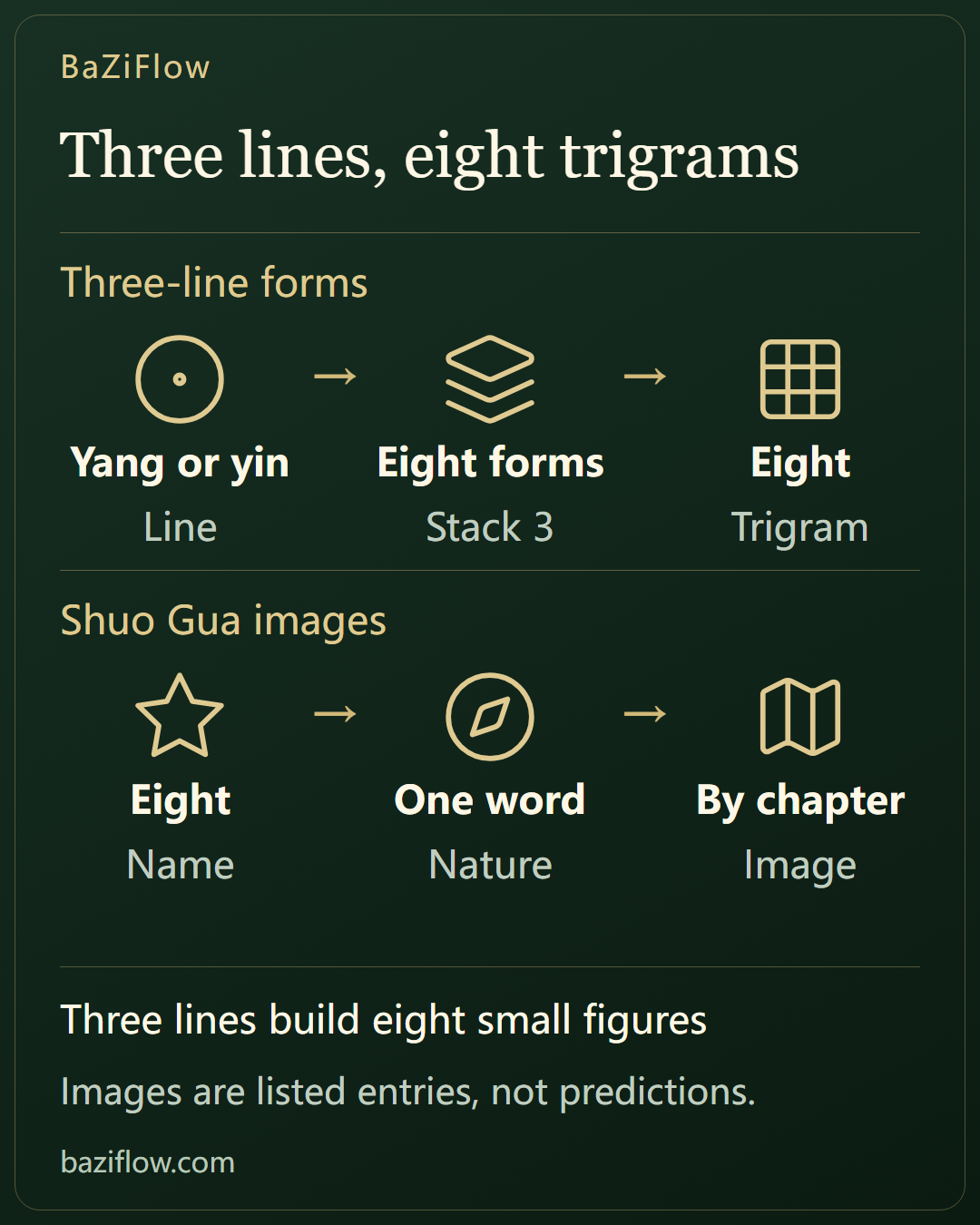
The eight trigrams are the small figures built from three lines. An eight-row table, a 1-3-3-1 grouping and Shuo Gua chapter 7 separate structure, names, natures and images, and show which chapter each entry comes from.
The short version9 min read
Each trigram is built from three lines, each either yang or yin, which gives 2 × 2 × 2 = 8 figures. The Shuo Gua then attaches a nature and a set of images to each one.
- Every one of three positions takes yang or yin, so only eight combinations exist, and lines are counted from the bottom; read upside down, Zhen and Gen swap places, as do Xun and Dui.
- Chapter 7 of the Shuo Gua gives each trigram a one-word nature (strength, yielding, moving, entering, sinking, clinging, stopping, delight) with no word for fortune or misfortune in the set.
- Qian can be heaven, a horse, a head or a father; those entries sit in separate chapters, so a citation names the chapter first and only then the use.
Read first
Yin and Yang Lines: Two Strokes, Six Places, Read from the Bottom ↗
Three lines, and why there are exactly eight figures
A line in a figure of the Zhou Yi (周易) takes one of two forms: a yang line is one unbroken stroke, and a yin line is a stroke broken in the middle. Stack three lines from the bottom up and you have one of the eight trigrams.
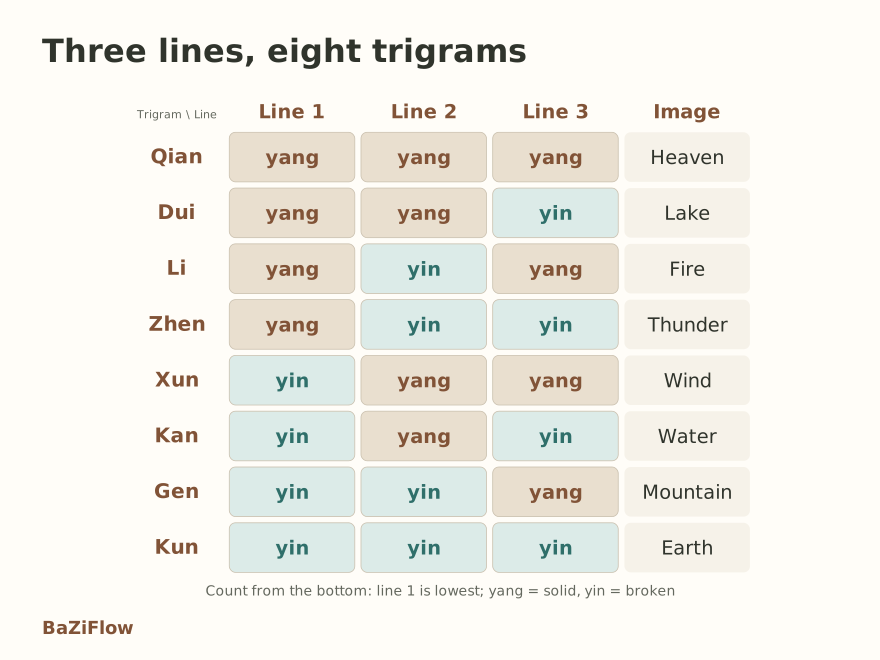
The eight trigrams at a glance: count from the bottom, solid is yang, broken is yin. A structure table, not a reading.
Each position offers a choice between yang and yin, and there are three positions, so the count is 2 × 2 × 2 = 8. The names are Qian (乾), Kun (坤), Zhen (震), Xun (巽), Kan (坎), Li (离), Gen (艮) and Dui (兑). The table lists every one of them: there is no ninth, and each appears exactly once. How a single line is drawn is covered in yin and yang lines.
Enlarge diagram · scroll sideways to read
Seen from another side, identifying any trigram takes just three yang-or-yin questions. Ask about line 1 and eight candidates become four; ask about line 2 and two remain; ask about line 3 and one is left.
The eight small figures: names and three-line forms
Reading a trigram needs one rule: count from the bottom. The lowest line is line 1, the next is line 2 and the top one is line 3. Turn the order upside down and Zhen becomes Gen and Xun becomes Dui, while Qian, Kun, Kan and Li read the same either way, so the bottom end still has to be marked.
Enlarge diagram · scroll sideways to read
Both figures have one yang line and two yin lines. They differ only in where the yang line stands: at line 1 it is Zhen, at line 3 it is Gen. Move the yang line and the name moves with it.
Sorted by the number of yin lines, the eight fall into groups of 1, 3, 3 and 1:
Enlarge diagram · scroll sideways to read
Choose which of the three positions carry a yin line: none can be done 1 way, one position 3 ways, two positions 3 ways and all three 1 way, which totals 8. Inside a group, the trigrams differ only in whether the odd line sits at line 1, 2 or 3.
To read one trigram, work like this:
Start at the lowest line
Line 1 is at the bottom; count upward to line 3 and never read from the top down.
Write solid as yang, broken as yin
A solid line at the bottom with two broken lines above it is written yang-yin-yin.
Look it up in the first table
Yang-yin-yin is Zhen; the reversed order, yin-yin-yang, is Gen.
Shuo Gua, chapter 7: eight words for eight natures
The three-line form is structure; the meaning behind each name has to come from text. The Shuo Gua (说卦, “Discussion of the Trigrams”), one of the Commentaries on the Changes (易传), gives a whole chapter to a one-word nature for each trigram.
Qian is strength. Kun is yielding. Zhen is moving. Xun is entering. Kan is sinking. Li is clinging. Gen is stopping. Dui is delight.
None of the eight words is a verdict of good or bad. Chapter 3 already sets heaven and earth, mountain and lake, thunder and wind, water and fire side by side, and chapter 11 then names the image trigram by trigram: Qian is heaven, Kun is earth, Zhen is thunder, and so on. The table combines both:
Enlarge diagram · scroll sideways to read
The “Usual sense” column is a common gloss, not wording from the Shuo Gua. Qian, all yang, is strength and Kun, all yin, is yielding, a pair that fits the line pattern well. For the other six, the text does not spell out how a word is read from the lines.
One trigram, several images, each from a different chapter
The Shuo Gua does not keep its images in one place; they are spread over several chapters:
- Chapter 3: heaven and earth, mountain and lake, thunder and wind, water and fire, set as four pairs
- Chapter 8: animals
- Chapter 9: body parts
- Chapter 10: the family
- Chapter 11: more images, trigram by trigram
Qian shows the spread:
Enlarge diagram · scroll sideways to read
The four entries stand side by side and do not follow from one another. Qian is heaven, and also a horse, a head and a father; which applies depends on the chapter in use, not on which seems more correct. The animals and body parts of all eight are:
Lists in chapters 8 and 9
Animals
Qian horse, Kun ox, Zhen dragon, Xun chicken, Kan pig, Li pheasant, Gen dog, Dui sheep
Body parts
Qian head, Kun belly, Zhen foot, Xun thigh, Kan ear, Li eye, Gen hand, Dui mouth
Chapter 10 treats the family. Qian is heaven and is called father; Kun is earth and is called mother. The other six are sorted by a “first seeking, second seeking, third seeking” into eldest, middle and youngest: Zhen and Xun are the eldest son and daughter, Kan and Li the middle ones, Gen and Dui the youngest.
Enlarge diagram · scroll sideways to read
The text itself gives only the words for first, second and third seeking, plus the genders. Set beside the three-line forms they can be checked: Zhen, Kan and Gen have one yang line and are male; Xun, Li and Dui have one yin line and are female; and the odd line sits at line 1, 2 or 3, matching eldest, middle and youngest. That is a reading of the diagram, not a rule the text states.
Two passages on arrangement, and where the trigrams lead
Two passages of the Shuo Gua deal with how the eight are placed. Chapter 3 sets them in four pairs; chapter 5 runs through them in the order Zhen, Xun, Li, Kun, Dui, Qian, Kan, Gen and says where each one stands.
Enlarge diagram · scroll sideways to read
Compare the pairs of chapter 3 with the table in the first section: Qian and Kun, Zhen and Xun, Kan and Li, Gen and Dui. In every pair all three lines are opposite. Chapter 5 adds directions as it goes, for example “all things come forth in Zhen, and Zhen is the east” and “Li is brightness; all things see one another; it is the trigram of the south”.
Later diagrams arrange the eight in two well-known orientations, called the Prior Heaven (先天) and Later Heaven (后天) arrangements. Neither the names nor the diagrams appear in the Shuo Gua, so they are left aside here.
Three lines are not yet a complete figure. Chapter 9 of the Great Commentary (Xi Ci, 系辞), upper part, says as much when it describes how a figure is obtained:
Eighteen changes complete a hexagram; the eight trigrams are a minor completion.
A full figure takes eighteen changes, and a three-line trigram counts only as a minor completion. What comes next is how two trigrams stack into six lines.
Learn the three-line forms first
Return to yin and yang lines and practise reading lines from the bottom up.
See how two trigrams stack into six lines
Continue with hexagrams to meet the upper and lower trigram.
Then learn what each of the six positions means
What the first line through the top line each contribute is in line positions.
Questions readers ask next
How do trigrams relate to the sixty-four hexagrams?
A trigram has three lines and a hexagram has six. A hexagram can be read as two trigrams placed one above the other, and that is where 8 × 8 = 64 comes from. How the stacking works and how each result is named belongs to the article on hexagram structure.
Qian is heaven, a father and a horse. Which one is correct?
All three are entries in the Shuo Gua, in different chapters: chapter 11 gives heaven, chapter 10 calls it father and chapter 8 gives horse. They are parallel categories rather than rival answers, so whoever uses one should say which chapter it comes from.
What are the Prior Heaven and Later Heaven arrangements?
They are names that later Yijing scholarship gave to two arrangements of the eight trigrams around a circle. Both the names and the diagrams come from later times; later diagrams often draw on what chapters 3 and 5 of the Shuo Gua say, but the Shuo Gua itself contains neither diagram.
Was this article helpful?
Part of a learning path
Sources & references
Continue reading
Yin and Yang Lines: Two Strokes, Six Places, Read from the Bottom ↗
The Sixty-Four Hexagrams: How Upper and Lower Trigrams Form One Figure ↗
Trigram imagery: why a round clay bowl has two possible routes ↗