

Read retrograde motion
Content version · · Sources & references
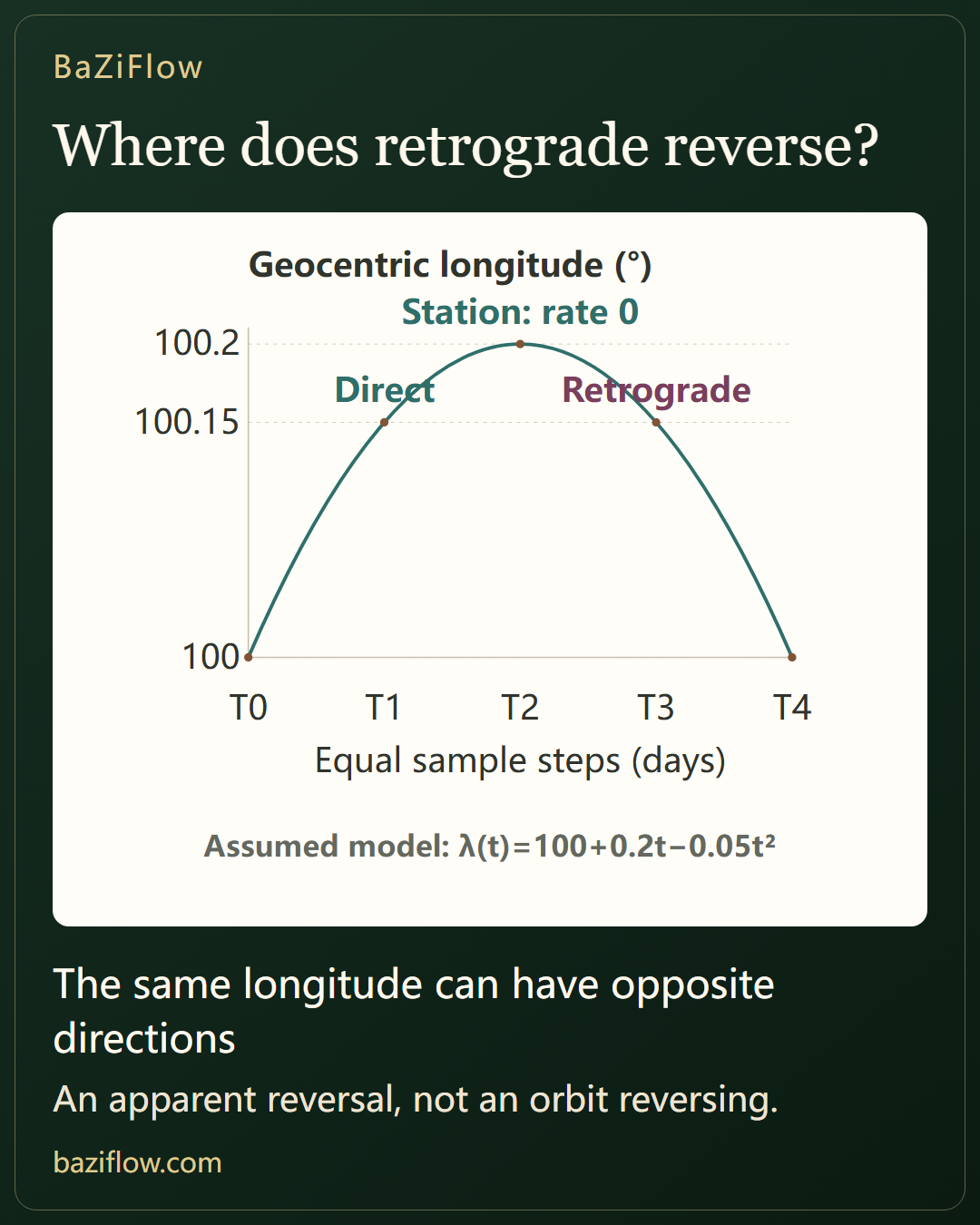
Use an invented position-and-speed series to read direct motion, a station and retrograde motion. Separate a coordinate change from orbital reversal, chart layers and causal claims.
The short version6 min read
R marks a direction of change in a specified coordinate. Longitude says where the object is; longitude rate says how it passes that location. Keep them separate to recognize a reversal, a station or a wraparound error.
- In the geocentric longitude setting used here, a negative rate denotes retrograde motion, not a reversal of the orbit around the Sun.
- Two samples at 100.15° can have opposite rates; a position alone cannot distinguish direct from retrograde motion.
- Check circular wraparound and rounding, then attach the rate to the correct object and natal or transit instant.
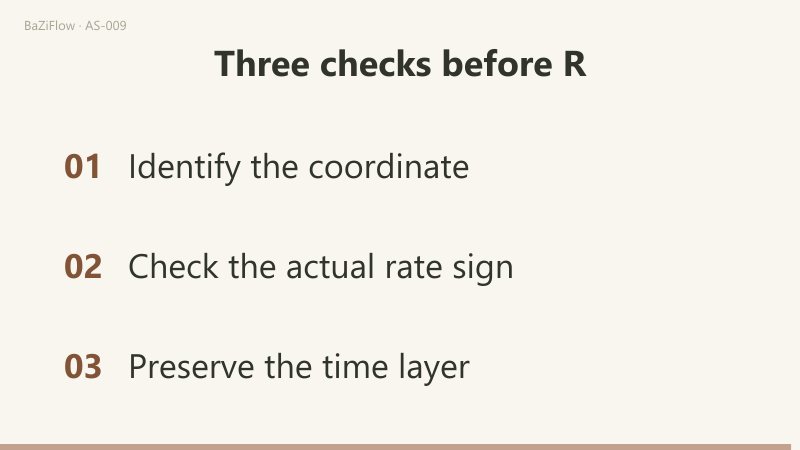
Read first
Four Chart Components: Read the Object, Position and Relationship ↗
The observer moves too
Retrograde motion in a familiar geocentric astrology chart concerns an apparent reversal in longitude. Earth, the observing platform, is moving as well. A planet's direction against the background can reverse temporarily without the planet reversing its orbit around the Sun. OpenStax discusses the heliocentric account of this phenomenon as part of the history of astronomy.
The R on a chart is therefore a coordinate statement, not a declaration that a planet physically turned around in space. It is also not a personality diagnosis. Before reading it, identify the object, instant and coordinate convention. A heliocentric output or a different coordinate system cannot be compared by blindly carrying over the same label rule.
In the usual geocentric ecliptic-longitude setting used here, a negative longitude rate indicates retrograde motion and a positive rate direct motion. The statement is deliberately narrow. It tells us how one coordinate changes; it does not specify a person's experience during that change.
0°/day · 0
Decreasing ↔ Increasing
- Retrograde · -0.1
- Station · 0
- Direct · 0.1
Example rates in degrees/day; sign describes geocentric longitude change
One longitude, two directions
Suppose two saved rows both show 100.15 degrees. One row reports +0.10 degrees per day, the other −0.10. The locations agree, but the direction does not. Reading only the position column would discard the information that distinguishes them.
The following series is invented. Successive samples are one day apart, and speed is stipulated to vary linearly between samples. This assumption lets the average rate over each day reproduce the next position. None of the numbers belongs to a named planet or a birth record.
| Sample | Longitude | Rate in degrees per day |
|---|---|---|
| T 0 | 100.00° | +0.20 |
| T 1 | 100.15° | +0.10 |
| T 2 | 100.20° | 0.00 |
| T 3 | 100.15° | −0.10 |
| T 4 | 100.00° | −0.20 |
The average rate in the first interval is (0.20 + 0.10) / 2 = 0.15 degrees per day, adding 0.15 degrees. The next adds 0.05. The last two subtract 0.05 and 0.15 respectively, returning to 100.00. The zero at T 2 is part of the constructed example, rather than an inference from a rounded display. Real ephemeris rates need not follow this linear rule.
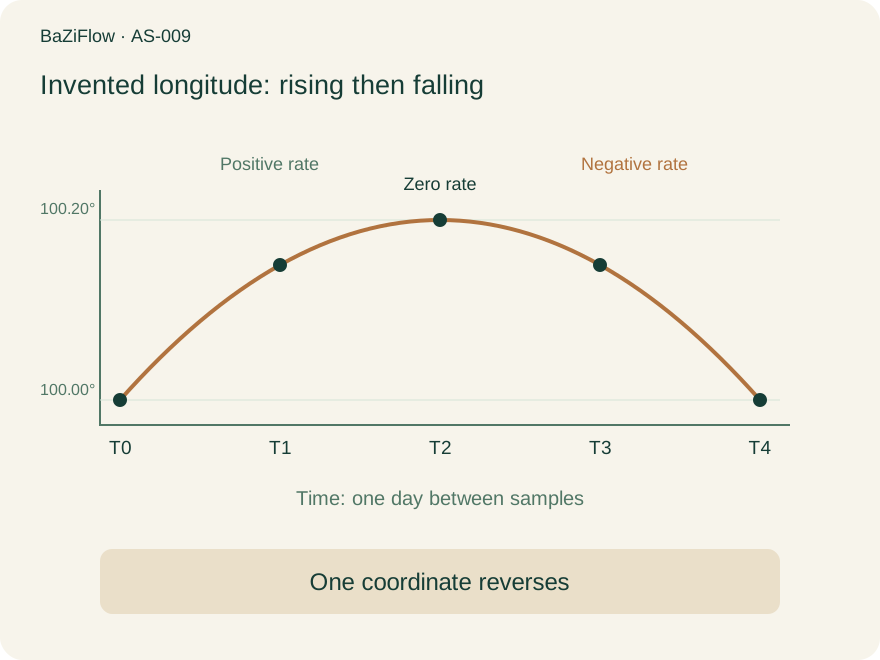
Original BaZiFlow teaching diagram; positions and speeds are invented, not an ephemeris for a real planet.
Notice that T 1 and T 3 share the same position but have opposite rates. A location alone cannot tell you the direction of motion. This is why Swiss Ephemeris, when the speed flag (SEFLG_SPEED) is set, returns longitude and longitude speed as separate quantities, with the latter expressed in degrees per day. Keep both when inspecting a questionable retrograde flag.
Two traps in reading a station
First, a zero longitude rate is not the absence of all physical motion. It refers to one component in the stated coordinate system. Second, a displayed 0.00 may be a small positive or negative rate rounded to two decimal places. It is not automatically the exact instant of a station. Inspect adequate precision and neighbouring times before making that claim.
There is another trap at the circle's join. A move from 359.9 to 0.1 degrees looks like minus 359.8 if ordinary subtraction is used. Unwrapped over this short interval, it is a forward move of 0.2 degrees. A sign change in a poorly processed difference must not be reported as a real reversal. Circular aspect calculations provide a related wraparound exercise.
Nor can two widely separated samples establish that motion stayed in one direction throughout the interval. Reversals can occur between them. Use a trustworthy rate field or a sufficiently resolved series, check errors returned by the calculation, and preserve the convention used. Extra decimal places do not compensate for a wrong frame or an unchecked failure.
Raw subtraction
Unwrap the short step
Keep natal and current motion in different records
A natal retrograde flag describes the object's state at the natal instant. A current retrograde flag describes the instant being queried. A later station does not erase the natal flag, and natal direct motion does not prevent a later retrograde interval. A useful note says which object, whose chart and which time layer it belongs to.
To investigate a transit in relation to a natal chart, additional positions and relationships are needed. Retrograde status alone is not a complete reading. A shared interval can cover many people; that shared condition cannot by itself distinguish one person's history from another's. Houses, aspects and relevant circumstances are separate information, not hidden inside the letter R.
These distinctions also guard against copied interpretations. If the same sentence about delays or inwardness is applied to everyone with the flag, the writing has not shown why it belongs to the current chart. A responsible account should state what evidence adds specificity and where it has none.
Natal
- Birth instant
- Keep its rate
Transit
- Query instant
- Recheck rate
An astronomical fact is not a causal verdict
Authors attach different symbolic interpretations to retrograde motion, including reviewing or revisiting matters. The sign of a velocity does not prove those interpretations. It certainly cannot, on its own, identify the cause of a device failure or a difficult conversation. Such an explanation needs evidence beyond the ephemeris.
If recording everyday observations, retain uneventful and successful cases as well as frustrating ones. Selecting only problems after noticing a retrograde date gives a distorted record. A proposed causal claim needs defined comparisons and counterexamples; more accurate positions do not remove that requirement.
The useful first achievement is modest: identify the motion correctly and bind it to the right time and subject. From there, transits and the natal chart examines how current positions can be related to a natal framework without treating a common sky condition as a complete personal explanation.
Identify the measurement
Record the object, geocentric longitude, rate unit and observation instant.
Check a short interval
Compare the continuous position series with its rate and handle wraparound and rounding.
Separate interpretation
Keep symbolic conventions, observed circumstances and calculated facts distinct.
Questions readers ask next
Does a displayed rate of 0.00 establish an exact station?
No. Small positive or negative values can round to 0.00. Check sufficient precision and neighbouring instants. Even an exact zero in longitude rate does not mean that all physical motion has stopped.
Why is a move from 359.9° to 0.1° not necessarily retrograde?
In this short forward-step example, unwrap 0.1° as 360.1°. The difference is then +0.2°. The raw −359.8° comes from the coordinate join and must not be mistaken for a reversal.
Does a current direct station erase a natal retrograde flag?
No. The natal record describes the birth instant; the current record describes a different instant. Both can be correct when the object, coordinate convention and time layer remain explicit.
Was this article helpful?
Sources & references
Continue reading
Aspect Angles and Orbs: Calculate One Line from Two Positions ↗
One sky, different natal targets: how transits are compared ↗