

Month Blade: the Blade that lands on the month
Content version · · Sources & references
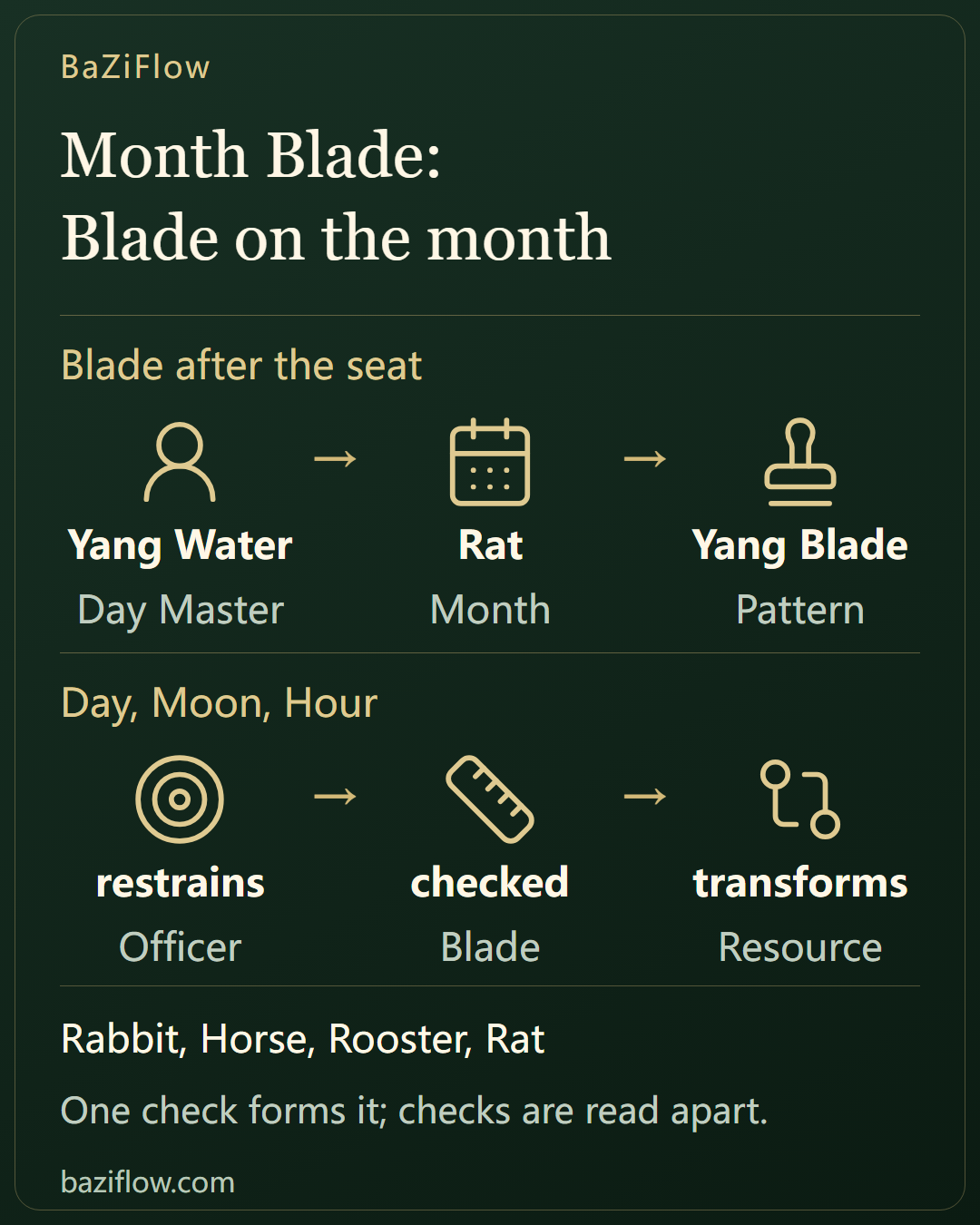
The Month Blade pattern is the Yang Blade on the month branch; the site files it as the Yang Blade pattern for yang Day Masters whose month is at Peak. The old books add Day and Hour Blades and how Officer checks them.
The short version9 min read
The Month Blade pattern is the Yang Blade landing on the month branch, which the site names the Yang Blade pattern; one check forms it, and the reading depends on how Officer, Killings and Resource cooperate.
- The Blade always stands one step after the emolument seat. A Month Blade is that step landing on the month branch, and the site does this only for the five yang stems.
- The old books place a Blade in the day, the month or the hour; the site's pattern check looks at the month only, and a Blade on the day or hour pillar has to be found in the spirit star table.
- Reading a Blade pattern comes down to what restrains it or transforms it: Officer and Killings restrain, Resource transforms, and three kinds of stars can pull that path apart.
Read first
BaZi patterns explained: how formation, disruption and assistance work ↗
The Blade always stands one step after the seat, and the Month Blade is that step on the month
The Yang Blade is the stage after the emolument seat of a yang stem in the Twelve Stages, which is the Peak stage. When it falls on the month branch it is called the Month Blade (月刃), and the site files such a chart as the Yang Blade pattern.
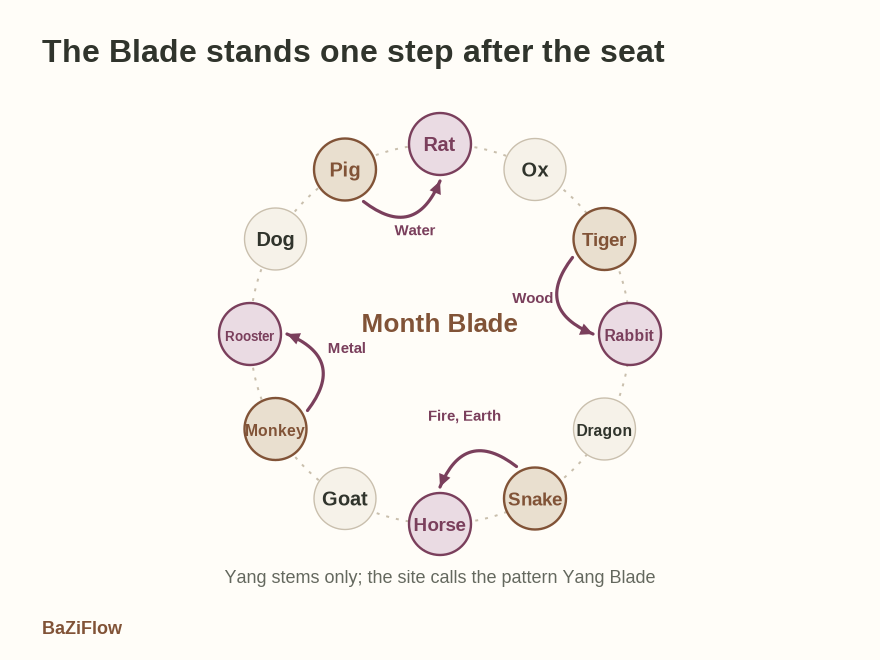
Seat and Blade on one ring: Tiger, Snake, Monkey and Pig hold the emolument seats, Rabbit, Horse, Rooster and Rat the Blade months, with the yang stems named beside each arrow; data from the site's Twelve Stages table.
The figure is a ring of the twelve branches. Tiger, Snake, Monkey and Pig are the seats, and the next branch in each case, Rabbit, Horse, Rooster and Rat, is the Blade: Yang Wood has its seat at Tiger and its Blade at Rabbit; the two Fire and Earth yang stems share the Snake seat and the Horse Blade; Yang Metal sits at Monkey and has the Blade at Rooster; Yang Water sits at Pig and has it at Rat. The Horse month is shared by Yang Fire and Yang Earth, so five yang stems occupy only four branches.
Day, Moon and Hour Blades: the site reads only the month
Juan 11 has a headline-style line that lines up the three places:
A Day Blade, Month Blade or Hour Blade meeting Officer, Killings or Glory Spirit: fame covering the age.
"Glory Spirit" (荣神) is another name for Resource. The three differ only in which pillar the Blade falls on, and the site's pattern check takes the month branch alone:
Enlarge diagram · scroll sideways to read
Two example charts from the commentary make this concrete. In the chart Yang Fire Dog, Yin Water Snake, Yang Earth Horse, Yin Fire Snake (丙戌 癸巳 戊午 丁巳) the day branch is the Horse, the Blade of Yang Earth, so the book treats it as a Day Blade and says Resource transforms it; the site reads only the month, where the Snake is the seat of Yang Earth, and names it Build Emolument. In the chart Yang Water Rat, Yin Water Rabbit, Yang Wood Dog, Yin Fire Rabbit (壬子 癸卯 甲戌 丁卯) from juan 7 the original says "Blade in the month command": a Yang Wood day in a Rabbit month, and the site also names it Yang Blade, with the hour branch another Rabbit. The two agree here.
What forms it: a yang Day Master and a month at Peak, nothing more
The Yang Blade check comes third in the site's chain: the strict single-element pattern and the Build Emolument check have both been run first and missed. Its conditions are two: the Day Master is one of the five yang stems, and the month is exactly its Peak. The description reads: a Yang Blade Day Master is strong and favors Officer or Seven Killings restraining the blade; Wealth stems are disfavored because they stir up the blade. No breaking check was written for it, and the quality field is fixed at pure.
Enlarge diagram · scroll sideways to read
In the table the main stem is a Rob Wealth for every Day Master except Yang Earth, which means the character of the same element and the other polarity. For Yang Earth in a Horse month the main stem is Yin Fire, a Direct Resource, and that matters in the fifth section. Yin stems have no such pattern on the site. Take the chart Yang Metal Tiger, Yang Earth Tiger, Yin Wood Pig, Yang Earth Tiger (庚寅 戊寅 乙亥 戊寅), a Yin Wood Day Master in a Tiger month, which is a yin Peak: the site goes back to the ordinary month-command check, the Earth stem shows, and the pattern is Direct Wealth.
Look at the Day Master
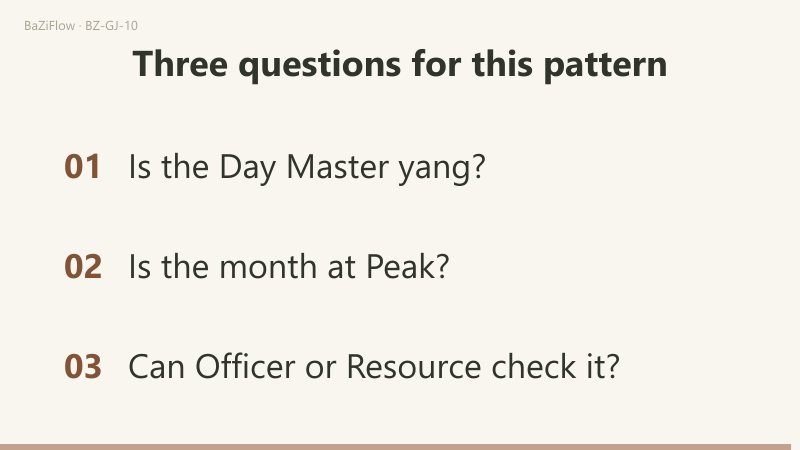
Is it one of the five yang stems? The five yin stems never enter this pattern.
Look at the month
Does the month branch fall on the Peak of that stem? Only four branches qualify: Rabbit, Horse, Rooster and Rat, as the ring above shows.
Check the first two gates
The strict single-element pattern and Build Emolument are judged first; only if both miss does the Yang Blade check run.
Now take a Yang Blade chart, Yang Metal Tiger, Yang Earth Rat, Yang Water Horse, Yin Fire Goat (庚寅 戊子 壬午 丁未), a Yang Water day in a Rat month. Yang Earth (Seven Killings) stands on the month stem and Yin Fire (Direct Wealth) on the hour stem, so the favoring cue (Officer or Killings) and the disfavoring cue (Wealth) both appear in the description; the site lists them and does not weigh which is heavier.
What counts as holding the Blade: Officer checks, Resource transforms, three things undo it
Under the "three-blade pattern" the commentary writes the whole reading at once: Officer, Killings and Resource must check and transform one another; Officer and Killings without Resource, or Killings without Officer, are all acceptable, and Resource transforming Killings is better still, with only entanglements to fear. There are three entanglements: Officer must not meet Hurting Officer, Resource must not meet Wealth, and Killings must not be pressed down by Eating God or Hurting Officer.
Enlarge diagram · scroll sideways to read
Juan 5, in "On the Yang Blade", quotes a line from a classic that says the Blade and Killings make each other:
Killings without the Blade do not show; the Blade without Killings has no majesty.
This turns checking around: Killings need the Blade to show, and the Blade needs Killings to have force. The site has not put this mutual support into its judgment.
Three readings that disagree, written down here
Three disagreements in reading
The site says yes, the book asks if that holds across the board
Juan 5 first says a Yang Blade pattern generally dislikes Wealth territory and fears being clashed, then lists cases: a Blade at the Horse fears Wealth at the Rat, a Blade at the Rat fears the Horse, a Blade at the Rooster fears the Rabbit. What it fears is Wealth that clashes the Blade, and it then asks "can it be said to fear Wealth across the board?"
The book says to leave the Blade label off
Juan 11: for a Yang Earth day in a Horse month do not read a Blade; where Fire is plentiful in the hour and the year it turns into Resource. The commentary says Blade and Resource share a palace and Resource gains strength with Fire, but if the Yin Earth stem shows it is still judged a Blade. The site names every Yang Earth day in a Horse month a Yang Blade pattern, such as Yin Fire Snake, Yang Fire Horse, Yang Earth Monkey, Yang Earth Horse (丁巳 丙午 戊申 戊午).
The site: five yang stems only
Juan 5 says Yin Wood meeting Fire also counts as a Blade, reading Hurting Officer as the cause, a path that runs through the stems. The site's Yang Blade pattern looks only at the month branch and the five yang stems.
Back at the site's two sentences, "favors Officer or Killings restraining the blade" runs the same way as the book's checking, while "Wealth stirs up the blade" is a short form of the longer passage above. To see how the neighboring pattern is judged, read Build Emolument; the Blade stands one step beyond the seat that article describes.
Once a pattern is named, the cooperation around it still has to be read; the general account is in what a pattern is: formed, broken and rescued. The order in which the strict single-element patterns are tried before a Blade can be checked in the Flaming Upward pattern article.
Questions readers ask next
Are Month Blade and Yang Blade the same pattern?
They cover the same chart but are named differently. Month Blade stresses that the Blade falls on the month branch; the pattern type the engine actually outputs is Yang Blade. The site's term table lists a Month Blade translation, but the judgment does not output it as a separate type.
A yin Day Master has its Peak in the month. Is that a Month Blade?
Not on this site. The check applies to the five yang stems only, so a Yin Wood Day Master in a Tiger month goes back to the ordinary month-command pattern. The books have a separate line, a yin stem meeting Fire counts as a Blade, but that works through the stems and the site has no such item.
Does a Yang Blade pattern always fear Wealth?
The site's note says Wealth stirs up the blade, which is a simplified cue. The book first says Wealth territory is generally unwelcome, and then asks whether that can be said across the board, because Wealth that feeds Officer is the Useful God there. It is not a verdict.
Was this article helpful?
Sources & references
Continue reading
Build Emolument (建禄格): When the Month Sits on the Day Master's Seat ↗
Bend and Straighten (曲直格): Wood in Full Strength, and Where the Books Differ ↗