

Blood Blade: three sources, one checkable step
Content version · · Sources & references
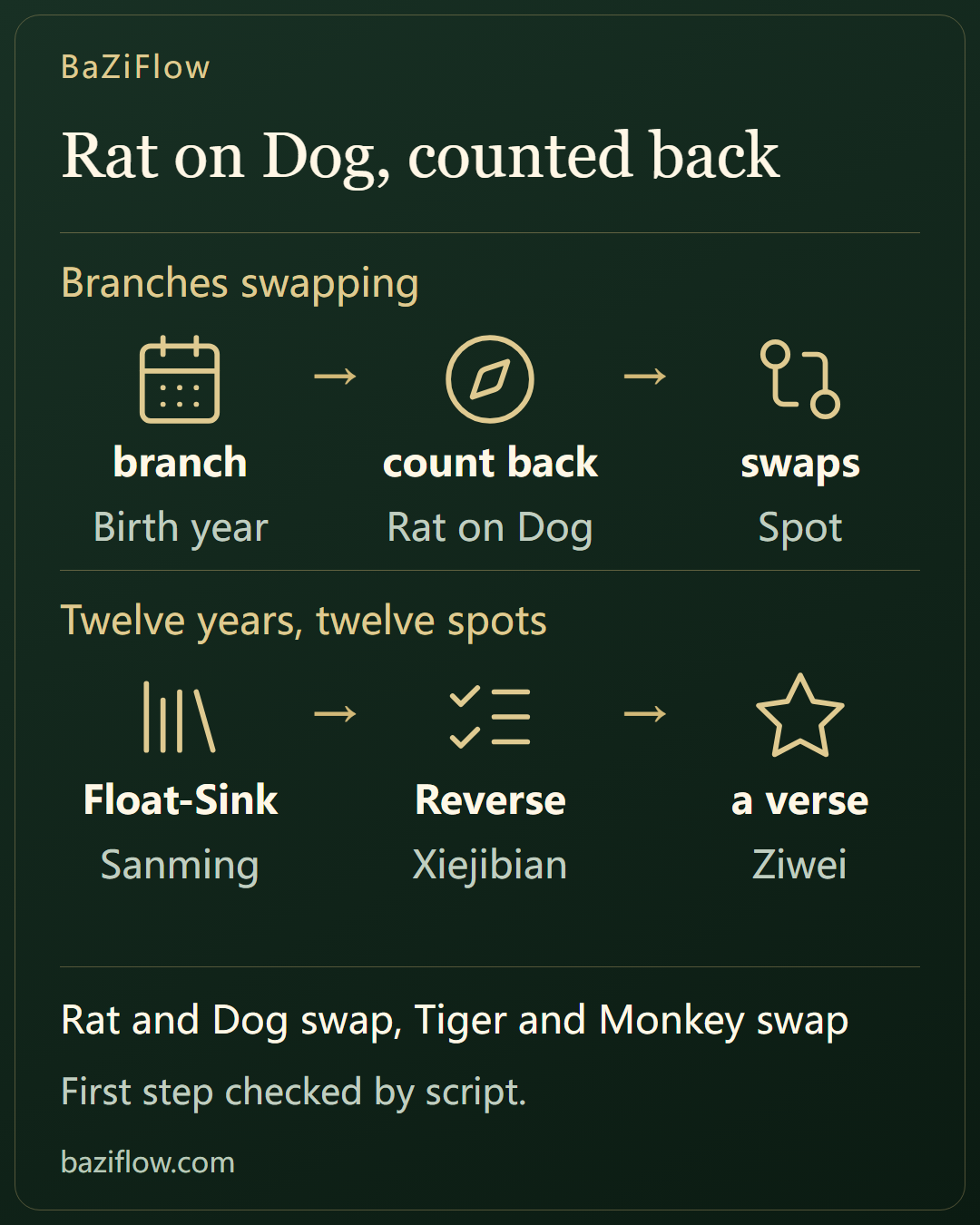
Old books use Blood Blade (血刃) for three unrelated things: a birth-year count in the Sanming Tonghui, an almanac star the Xiejibianfang rejects, and a Ziwei verse phrase. Step one is checked by script.
The short version6 min read
In the old books Blood Blade names three unrelated things: a count from the birth year in the Sanming Tonghui, an almanac star the Xiejibianfang dismisses as baseless, and a phrase in a Ziwei verse. The site engine has no table for it, so only the step the text states clearly is written out here.
- Juan 3 of the Sanming Tonghui notes "same as Blood Blade" under the Float-and-Sink star. Its first step puts Rat on Dog and counts back to the birth year: the twelve landing spots swap in pairs, and only Snake and Pig land on themselves.
- The second step, "count from the year palace to see which palace it lies in", does not say where to start or how the twelve palaces are ordered, so the passage cannot be completed from the text alone.
- The Xiejibianfang criticizes the almanac "Reverse Blood Blade", a different system from the Float-and-Sink star in a chart; its comparison table is not preserved in the transcription.
Read first
Symbolic Stars in BaZi: Check the Reference and Rule Before the Meaning ↗
One name, three unrelated things
The site engine has no table for the Blood Blade (血刃), so the first job is to sort out the name. The old books use "Blood Blade" in at least three places, and the method and purpose differ in each:
Enlarge diagram · scroll sideways to read
The same juan of the Sanming Tonghui (三命通会) also has a "Flowing Blood" star (流血煞), counted from the birth month forward starting at Rat. It is a different star whose name merely resembles this one.
Put Rat on Dog and count back to the birth year
Under the entry for the "Float-and-Sink star" (浮沉煞), juan 3 of the Sanming Tonghui adds "same as Blood Blade" beside the title, treating the two names as one star. Its first step reads:
Start Rat from Dog and go backwards, stopping at the year of birth.
That means putting Rat on the Dog place and counting in the opposite direction: Ox on Rooster, Tiger on Monkey, and so on onward to the branch of the birth year, and the place where the count stops is the starting spot. For a Tiger year it is Monkey, and for a Rabbit year it is Goat.
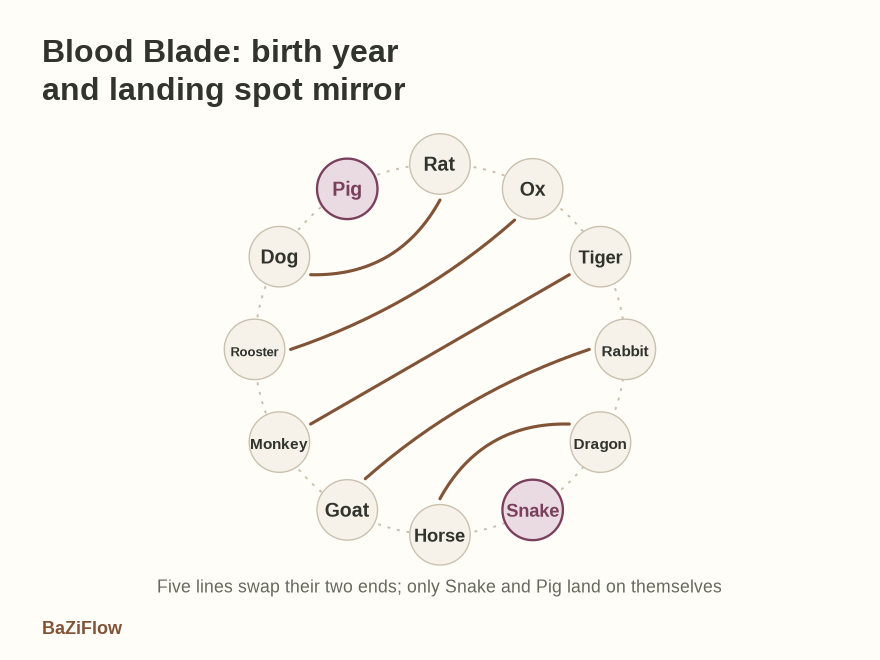
Sketch: the ring of twelve branches. Each line joins a birth year with its landing spot under "put Rat on Dog and count back", and the two ends swap; Snake and Pig are marked alone because they land on themselves. Landing spots were computed by script from the counting rule of the Float-and-Sink entry in juan 3 of the Sanming Tonghui.
Enlarge diagram · scroll sideways to read
Run through all twelve branches, the landing spots show one pattern: they swap in pairs. A Rat year lands on Dog and a Dog year on Rat; Ox and Rooster, Tiger and Monkey, Rabbit and Goat, Dragon and Horse behave the same way, and only a Snake year lands on Snake and a Pig year on Pig. The script confirmed this.
Enlarge diagram · scroll sideways to read
The second step is stuck at "count from the year palace"
After the starting spot the text continues:
Then count from the year palace and see which palace it is in.
The sentence does not say which palace the "year palace" is, nor how the twelve palaces are ordered, and the rest of the passage in juan 3 gives no answer. So this article can check only the first step:
How far this look-up can be checked
Checked
- Putting Rat on Dog and counting back
- The landing spots of all twelve years (script)
- The Flowing Blood star of the same juan is a separate method
Not written clearly
- Which palace the count starts from
- The order of the twelve palaces
- Which stem the light and heavy groups refer to
Handling here
- Give only the landing spot of step one
- Do not supply a palace order
- Schools differ; the site has not fixed one
What the book concludes, and what the Xiejibianfang answers
After the method, the Sanming Tonghui gives its verdicts, which read literally as follows:
Verdicts under the Float-and-Sink entry
The one good place
Falling in the Wealth palace it is called a "string of coins" (串钱) and is said to mean riches and savings; every other palace counts as unlucky.
Read by palace
Misfortune is read from the palace it falls in, the example being that in the Property palace it means breaking up the family inheritance, and the rest follow by analogy.
Two groups of stems
People of Yang Wood, Yin Wood, Yin Earth, Yang Metal and Yang Water meet it lightly, and those of Yang Fire, Yin Fire, Yang Earth, Yin Metal and Yin Water heavily; the text does not say whether the stem is the year stem or the day stem.
Tiger, Horse, Dog, Monkey, Goat
In these years the star "mostly means mishaps with water".
These are the book's verdicts. The site has not checked their basis, and they are not a warning for anyone.
The Xiejibianfang in juan 36 criticizes something else, the date-selection "Reverse Blood Blade" (逆血刃):
The Reverse Blood Blade spreads eight stems and four corner points over the sixty pillars, one character for each, and does not use the twelve branches. It has no reasoning at all; it only takes the frightening sound of its three characters to scare the foolish.
It goes on to say that a table is added below, but the table is not preserved in the transcribed text, so none is shown here. Another line from elsewhere in the same juan reads:
Looking over the evil stars, Fire Star and the Official Talisman and Blood Blade are the most numerous, because ordinary people fear lawsuits and fires, and the poor live only on their livestock.
Questions readers ask next
I was born in a Tiger year. Where does the Blood Blade land?
By the first step of the Sanming Tonghui: put Rat on Dog and count back, Ox lands on Rooster, Tiger on Monkey, so the starting spot is Monkey. The text does not say clearly where to begin counting palaces, so which palace of the chart it reaches is not filled in here.
The Xiejibianfang says the Blood Blade has no logic. Does that reject the Sanming Tonghui?
No. The Xiejibianfang criticizes the "Reverse Blood Blade", which spreads eight stems and four corner points over the sixty pillars for date selection; the Sanming Tonghui counts by the year branch for a chart, a different use.
The book says it mostly means water mishaps. Should people born in Tiger, Horse, Dog, Monkey or Goat years beware of water?
That is a line of the Sanming Tonghui about those five years. The site has not checked its basis or tested it, so it is shown as the book says and is not a warning for anyone.
Was this article helpful?