

Gou: from the tied brake to the horns
Content version · · Sources & references
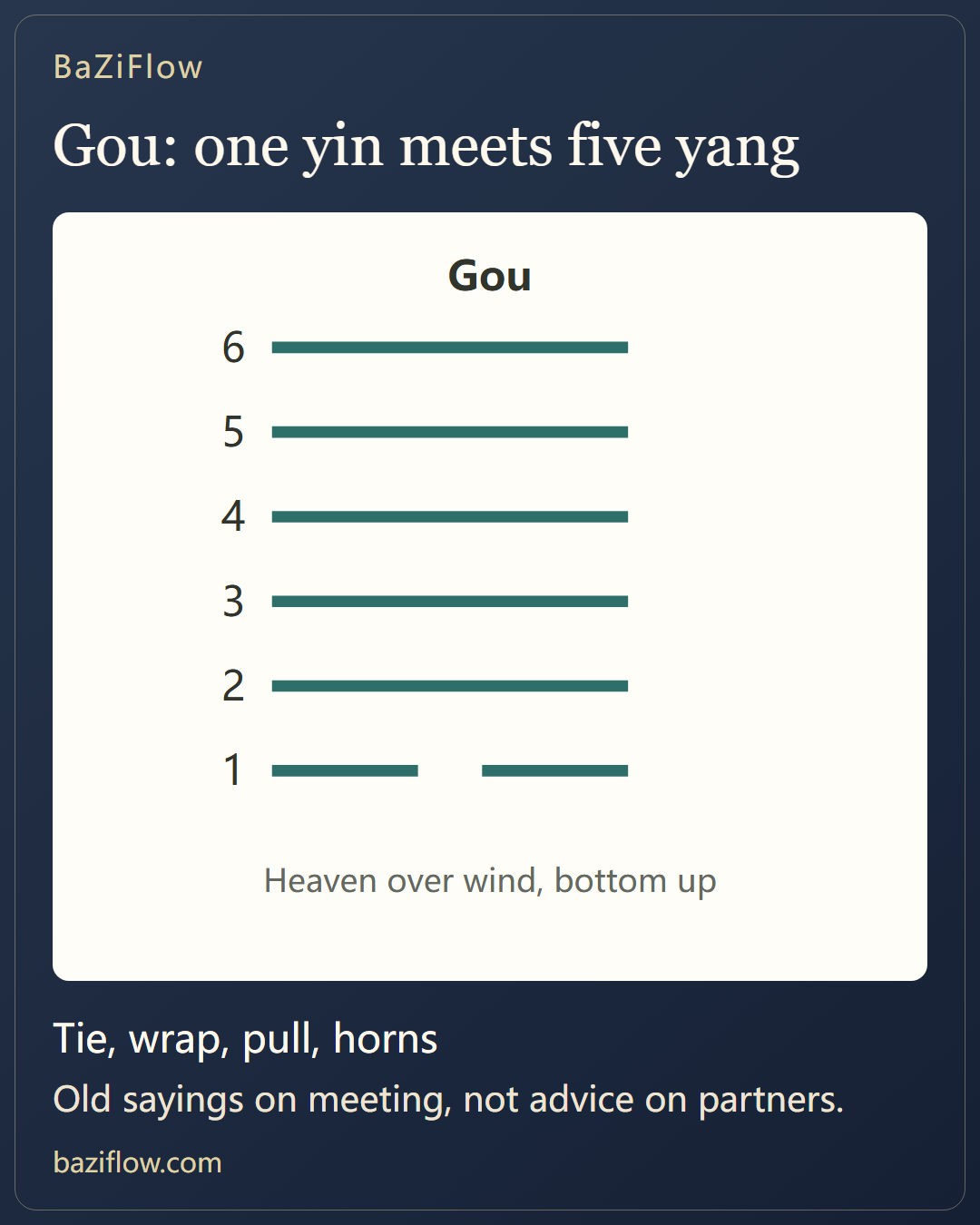
Gou is the 44th hexagram: Qian (heaven) above Xun (wind), with one yin line at the foot. Read the judgment “the woman is strong”, the narrow and wide readings of “meeting”, and its verbs of holding.
The short version7 min read
Gou has a single yin line, at the bottom. Its name, meeting, appears in the statements only on the top line; the others mostly say how a meeting is held on to: tied down, wrapped up, with pulling in the Small Images, and finally a meeting with horns.
- Gou stacks Qian (heaven) on Xun (wind): one yin line at the bottom, five yang lines above. The Shuo Gua calls Xun the eldest daughter, which fits that one yin line.
- The Commentary first says “meeting: the yielding meets the firm”, and the warning about marrying the woman covers only this one encounter. Then it widens: heaven and earth meet, and all kinds of things become manifest.
- “Wrapped” appears three times (lines 2, 4 and 5), “pulled” in the Small Images of lines 1 and 3, and at the top the wording turns to meeting with the horns.
Read first
The Sixty-Four Hexagrams: How Upper and Lower Trigrams Form One Figure ↗
Judgment and Line Statements: Whole Hexagram or Single Line? ↗
Wind beneath heaven: one yin line under five yang
Gou (姤) is Qian (heaven) above and Xun (wind) below. Counting from the bottom, the first line is yin and the other five are yang: the whole figure has one yin line, with five yang lines standing over it. In the Shuo Gua Qian stands for strength and Xun for entering, and Xun is also named the eldest daughter, since the lowest of Xun’s three lines is the yin one. So the figure can be read as one eldest daughter at the foot of five yang lines.
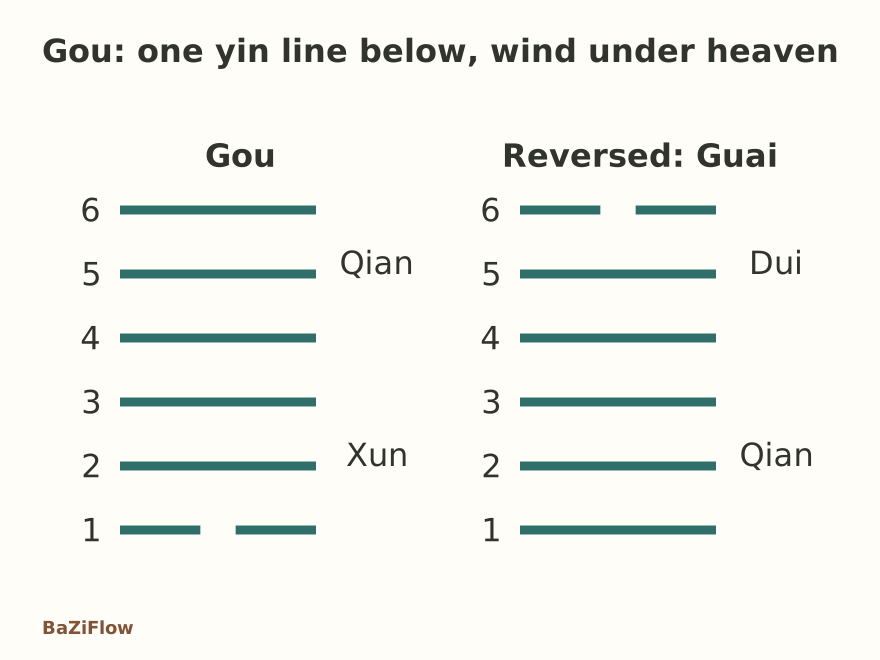
Gou and its reversed hexagram Guai: the single yin line at the bottom of Gou ends up at the top of Guai.
Enlarge diagram · scroll sideways to read
Three words to start with
- Gou
- The Commentary on the Judgments defines the name in its first sentence: Gou means meeting. The Xu Gua says the same, “Gou is meeting”, so the theme of the whole hexagram is an encounter.
- Yielding and firm
- A yin line is called yielding and a yang line firm. “The yielding meets the firm” describes the figure itself: one yin line meeting five yang ones.
- The woman is strong
- The first two characters of the judgment, literally “the woman is vigorous”. They are followed at once by “do not take the woman”, where “take” means to marry.
The judgment and the Commentary: a narrow meeting, then a wide one
The judgment is only a handful of words: the woman is strong; do not marry the woman. The Commentary on the Judgments treats it in two halves.
Gou means meeting: the yielding meets the firm. “Do not marry the woman”: one cannot stay with her for long. Heaven and earth meet, and all the kinds of things become manifest. The firm meets what is central and upright, and the world is greatly carried out. The meaning of the time of meeting is great indeed!
Enlarge diagram · scroll sideways to read
The first half sticks to the case: the yielding meets the firm, which is one encounter, and “cannot stay for long” says that such an encounter does not last. The second half pulls the camera back. When heaven and earth meet, the kinds of things each show their form (the word is “manifest”), and when the firm meets a central, upright place, matters under heaven are carried out. The same word “meeting” covers a brief encounter that should not be prolonged at one end and the joining of heaven and earth that gives things their shapes at the other. The closing exclamation praises the meaning of the time of meeting.
The Great Image: wind goes everywhere, and the sovereign sends out commands
The Great Image (大象) of Gou reads: beneath heaven there is wind, Gou; the sovereign issues commands and proclaims them to the four quarters. Here the subject is the sovereign; Great Images say “noble person”, “ancient kings” or “sovereign” depending on the hexagram, and the text decides which.
Enlarge diagram · scroll sideways to read
The Shuo Gua says wind is what disperses things, which sends them everywhere. The Image can be read against that: wind beneath heaven slips into every place, so a command should go out like wind and be proclaimed in all directions. It says nothing about a woman or about meeting, and takes only the way the wind travels.
Six lines: tied, wrapped, pulled, horns
The statements and Small Images of Gou share a small family of actions: tying down, wrapping up (three times in the statements), pulling along (only in the Small Images).
Enlarge diagram · scroll sideways to read
Line 1 is at the bottom and is the only yin line. “Tied to a metal brake” is traditionally read as fastened to a metal block of the kind that stops a cart wheel; the statement goes on, “steadfastness is fortunate”, while going somewhere “sees misfortune”. The next phrase is vivid: a lean pig will surely paw the ground in restlessness. The Small Image says: the way of the yielding pulls.
Line 2 sits right on top of line 1: “wrapped, there is a fish”, no blame, but “not fitting for guests”. The Small Image explains that by right it does not reach the guests. Line 4 is farther away: “wrapped, no fish; rising brings misfortune”, which the Small Image calls being distant from the people. The text does not say what the fish is; tradition usually matches it with line 1.
Line 3 is caught in the middle: no skin on the buttocks, a halting walk, danger but no great blame. Its Small Image is “his going is not yet pulled”. The word “pull” appears once in the comment on line 1 and once in the comment on line 3: in the first the way of the yielding is to pull, in the second this line has not been pulled along.
At line 5 the wrapped thing becomes a melon: wrapped with willow, “holding brilliance”, and “something falls from heaven”. The Chinese word behind “brilliance” here is the one the Commentary renders as “manifest”: the Commentary says the kinds of things all become manifest, while line 5 holds it inside.
At the top there is no more wrapping or tying: “meeting with the horns”, the horns being the last thing at the top, and the Small Image says: at the top, exhausted, hence regret. From tying and wrapping to horns, the way of holding on can be read as getting harder, and at the very top the meeting is made with horns.
Guai, Fu and Qian: the neighbors and the Xu Gua
The reversed hexagram (综卦) of Gou is Guai (夬): five yang lines below and one yin line at the very top. Turn Guai over and you get Gou. The inverse hexagram (错卦) is Fu (复): one yang line at the bottom with five yin lines above it, the opposite of Gou in every line. The nuclear hexagram (互卦) is Qian: lines 2 to 4 and lines 3 to 5 of Gou are all yang, and stacked they give Qian.
Enlarge diagram · scroll sideways to read
The Xu Gua places Gou after Guai: Guai means resolving, and once something has been broken open one is bound to meet something, so Gou comes next; after Gou comes Cui (萃), since things gather only after they have met. In Guai five yang lines push out one yin line; in Gou that same yin line reappears from the bottom. The two neighbors can be seen as the two ends of one yin line.
Questions readers ask next
Does “the woman is strong; do not marry the woman” forbid marrying a strong-willed woman?
Literally it says a woman is vigorous and one should not marry her. What the Commentary explains is “it cannot be kept up for long”, which concerns this one meeting, and the same passage goes on to read “meeting” as heaven and earth meeting. It does not widen the sentence into a verdict on a kind of person.
What is the fish in “wrapped, there is a fish”?
The text does not say. Tradition usually matches the fish with line 1, the only yin line. Line 2 sits right on top of it and has the fish; line 4 is farther off and the wrapping is empty. That is one reading, not something the text states.
How are Gou and Guai related?
They are each other’s reversed hexagram. Guai has five yang lines below and one yin line at the very top; turn it over and you have Gou. The Xu Gua links them in sequence: Guai is breaking through, and what is met after breaking through is Gou.
Was this article helpful?
Sources & references
Continue reading
Guai: a lake above heaven, from “proclaim in the court” to “no call” ↗
Cui: a lake above the earth, from confusion to guarding against the unforeseen ↗
The Sixty-Four Hexagrams: How Upper and Lower Trigrams Form One Figure ↗
Judgment and Line Statements: Whole Hexagram or Single Line? ↗