

Bi (比): whom to join, and from where
Content version · · Sources & references
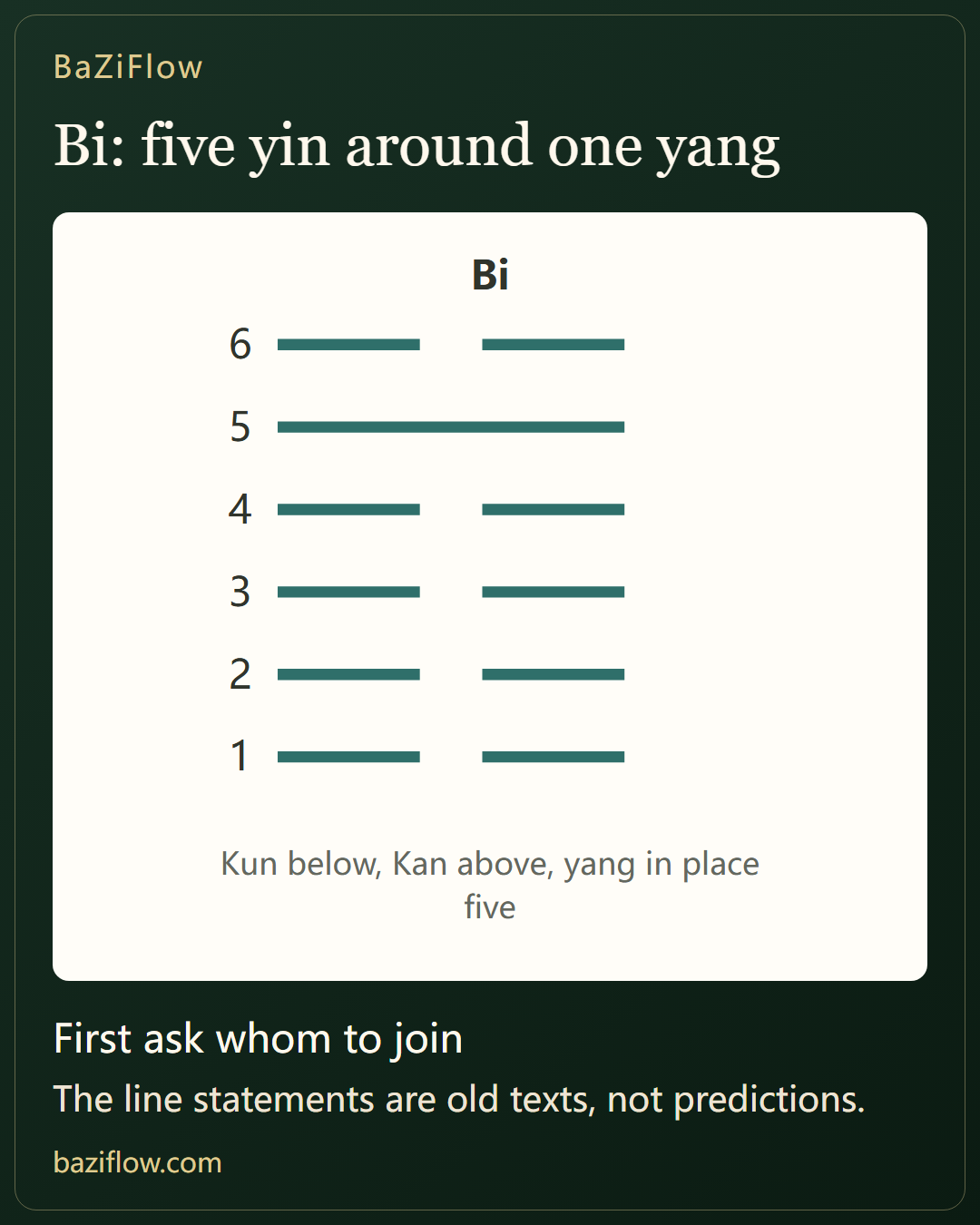
Bi has Kun (earth) below and Kan (water) above, and only one yang line, in the fifth place. Read its text in layers: the Judgment, the Great Image "water on the earth", and six line statements about six ways of joining.
The short version7 min read
The shape of Bi is its subject: five yin lines and one yang line in the fifth place. The six line statements each describe a different way of joining, from inner sincerity to joining the wrong people to having no head at all.
- Bi stacks Kan (water) on Kun (earth), and only its fifth line is yang. The Commentary on the Judgments glosses the name as "to assist; those below follow", and points to the single yang line with the words "firm and central".
- The Judgment carries an order in time: ask again first, then "the uneasy are only now coming", and misfortune for "the one who comes last".
- The lines run through sincere, from within, the wrong people, from outside, openly, and no head. In the Small Image, line 3 draws a sigh and the top line an ending that has nowhere to go.
Read first
The Sixty-Four Hexagrams: How Upper and Lower Trigrams Form One Figure ↗
Judgment and Line Statements: Whole Hexagram or Single Line? ↗
Five yin lines, one yang: the shape of Bi
The lower trigram of Bi (比) is Kun (坤, earth) and the upper trigram is Kan (坎, water), so it is read as Kun below, Kan above. From the bottom up, lines one to four are broken yin lines, the fifth is an unbroken yang line, and the top is yin again. Only one line in the whole figure is yang. The Shuo Gua gives Kun the word "yielding" and Kan the word "sinking".
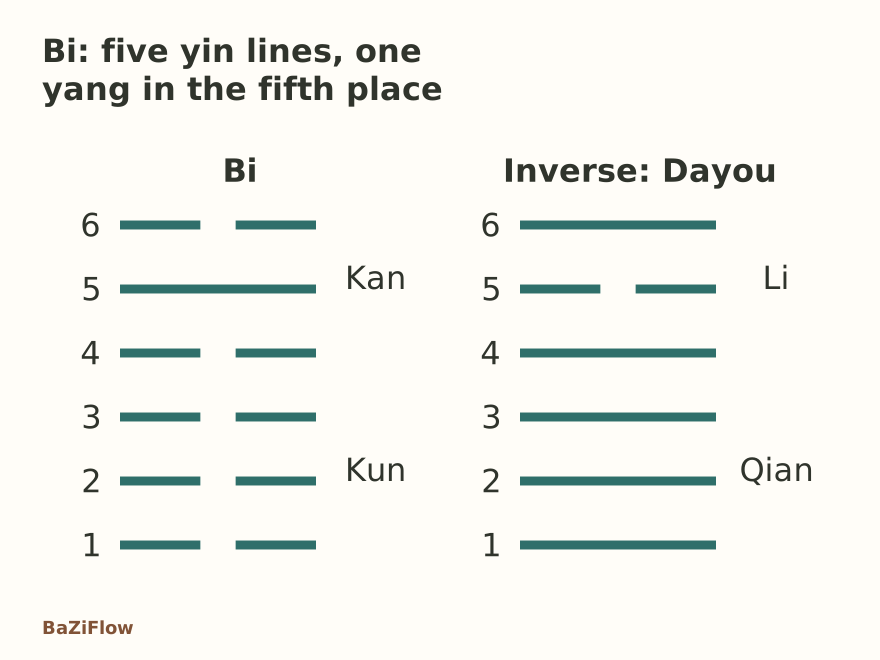
Bi and its inverse hexagram Dayou: a figure with its yang in place five and a figure with its yin in place five are each other's inverse.
Enlarge diagram · scroll sideways to read
Three terms to start with
- Bi
- The hexagram name. The Commentary on the Judgments glosses it as "to assist" and adds "those below follow": the lower side leans toward the upper and supports it.
- Nine in the fifth place
- The fifth line is yang, so it is called nine in the fifth place. It sits in the middle of the upper trigram and is the only yang line in the hexagram; the Commentary on the Judgments and the Small Image (小象) both speak around it.
- Firm and central
- The Commentary on the Judgments' phrase for that fifth line. Firm means yang; central means the middle line of a trigram. In Bi both conditions fall on the same line.
The Judgment: good fortune, asking again, and the one who comes last
The Judgment of Bi puts a single word first, "good fortune", and then sets conditions: "Good fortune. Ask the oracle again: supreme, enduring, steadfast, and there is no blame. The uneasy are only now coming; the one who comes last meets misfortune." The Commentary on the Judgments answers it phrase by phrase, beginning with the name:
Bi means good fortune; bi means to assist, those below follow.
Enlarge diagram · scroll sideways to read
The two words "yuan shi" (原筮) are read in two common ways: as "divine again", or as "divine by tracing back to the root". The Commentary on the Judgments does not explain them. It answers one question only, why there is no blame: "because it is firm and central", that is, because of the fifth line, which is both yang and in the middle. For "the uneasy are only now coming" the Commentary on the Judgments says "above and below answer one another"; for the latecomer it says "his way has come to its end".
The Great Image: water on the earth, and a subject who is a king
The Great Image (大象) for Bi reads: water on the earth, Bi; the former kings used it to found the many states and to befriend the lords. The first half is the figure: water (Kan) above earth (Kun). The second half is the conduct, and its subject is "the former kings" rather than the "noble person" of Qian's Image. The two things done are to found many states and to draw the lords close.
Enlarge diagram · scroll sideways to read
The fifth line also has a king: "the king drives game from three sides". The "former kings" of the Great Image share that viewpoint, that of the center looking at how people gather and how they are placed.
Six lines: six directions of joining
Every statement in Bi is about joining, and each one turns it to a different angle: by what means, from where, with whom, and whether there is a head or an end.
Enlarge diagram · scroll sideways to read
First six: "Sincere, he joins them: no blame. Sincerity fills the jar, and in the end something else arrives: good fortune." Sincerity comes first. The Small Image says "that something else arrives is good".
Six in the second place, "joins from within, steadfast: good fortune", and the Small Image says "he does not lose himself". Six in the fourth place, "joins from outside, steadfast: good fortune", and the Small Image says "he joins the worthy one outside, in order to follow the one above". The second line is in the inner trigram and the fourth in the outer one: one joins inward, one outward.
Six in the third place sits between them with four characters: "joining the wrong people". The Small Image gives the only exclamation among its six comments: "is this not painful!"
Top six: "joining with no head: misfortune." The Small Image says "there is nowhere for it to end". The word "misfortune" appears in the line texts and the Judgment only twice, once for the latecomer and once here: at one end the one who comes last, at the other a joining without a head.
The neighbors of Bi: Dayou, Shi and Bo
The inverse hexagram of Bi is Dayou: every line takes the opposite polarity, so one yang among five yin becomes one yin among five yang, and the odd line stays in place five, only changing from yang to yin. Its reversed hexagram is Shi: look at the figure upside down and the yang line drops to place two. Its nuclear hexagram is Bo: regroup the middle four lines into two trigrams and the yang line ends up at the very top.
Enlarge diagram · scroll sideways to read
The Xu Gua places Bi after Shi:
Where there are multitudes there must be something they join, so it was followed by Bi; Bi means to join.
The Xu Gua itself says what Shi is: "Shi means the multitude". With so many people, the question is where they lean, so Bi comes next. The Za Gua ties the two together in four characters: "Bi is joy, Shi is worry".
Questions readers ask next
Does "bi" simply mean being close to someone?
The text glosses it as "assist" and "those below follow": the yin lines lean toward the yang line above them and support it. Start from that direction, then see which kind of joining each line describes.
Who is "the one who comes last" in the Judgment?
The Judgment says only that this person meets misfortune, and the Commentary on the Judgments adds that "his way has come to its end". It names no one. The sentence before it speaks of the uneasy arriving, and the latecomer is the one left behind among them.
Why does the fifth line suddenly describe a hunt?
After "openly joining" it continues with a king who drives game from three sides and lets the one ahead go. The Small Image reads this as letting go of what runs against you and taking what comes along. The hunt turns an abstract idea, joining in the open, into a scene.
Was this article helpful?
Sources & references
Continue reading
Shi: one yang line leading five yin lines, and who leads the army in each line ↗
Xiaoxu (小畜): from "dense clouds, no rain" to "it has rained" ↗
The Sixty-Four Hexagrams: How Upper and Lower Trigrams Form One Figure ↗
Judgment and Line Statements: Whole Hexagram or Single Line? ↗