
Sun, Moon and rising: what the “Big Three” leaves out
Content version · · Sources & references
Two celestial bodies and one horizon point are often grouped together. Here is how to read them without turning them into three personality boxes.
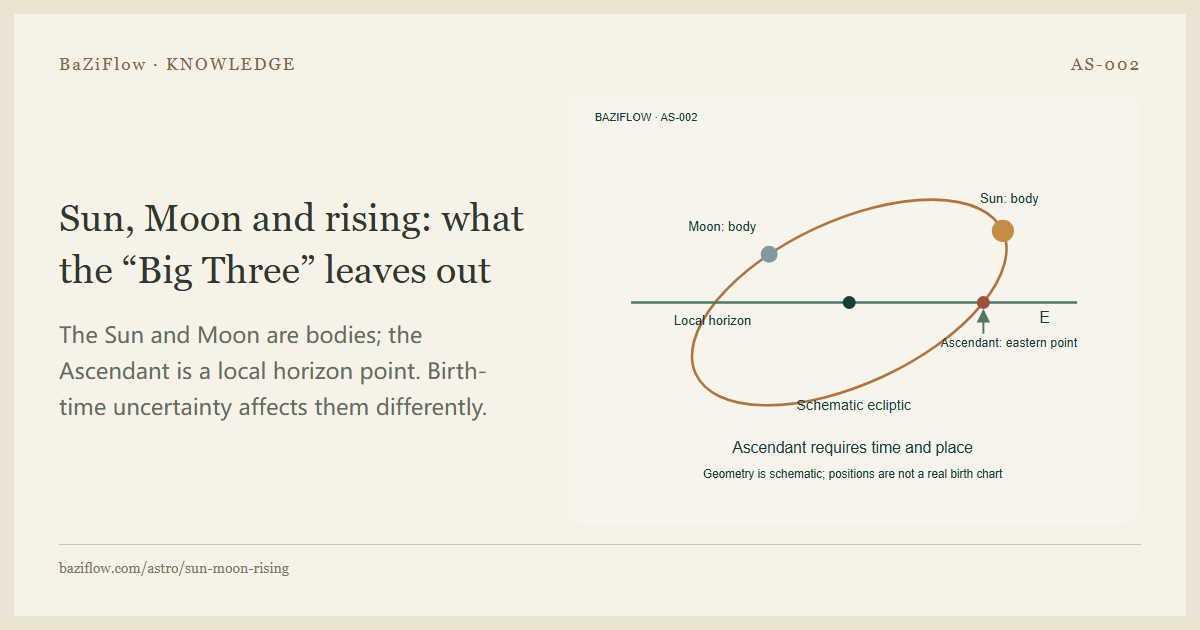
The Sun and Moon are bodies; the Ascendant is a local horizon point. Birth-time uncertainty affects them differently.
Two bodies, one point
The “Big Three” groups your Sun sign, Moon sign and rising sign. The first two describe the zodiacal positions of celestial bodies. The third describes the sign containing the Ascendant: the eastern intersection of the local horizon and the ecliptic at the birth moment. There is no extra planet called Rising.
This distinction matters because the three positions respond differently to missing birth data. It also prevents a common reading mistake: treating three sign labels as equal slices of a personality, with one third assigned to each.
What modern psychological language can—and cannot—do
Modern psychological astrology often associates the Sun with chosen identity and purposeful development, the Moon with habitual responses and familiarity, and the Ascendant with orientation toward the environment. These are introductory interpretive categories. They are not measured traits, and older traditions may assign the factors different roles or priorities.
Consider a person who likes directing a long project but prefers a predictable home routine. Those experiences can coexist without contradiction. Yet the observation is broad enough to fit many people, so it cannot independently validate a particular Sun–Moon combination. A useful reading needs details that distinguish the chart, not merely sentences that feel agreeable.
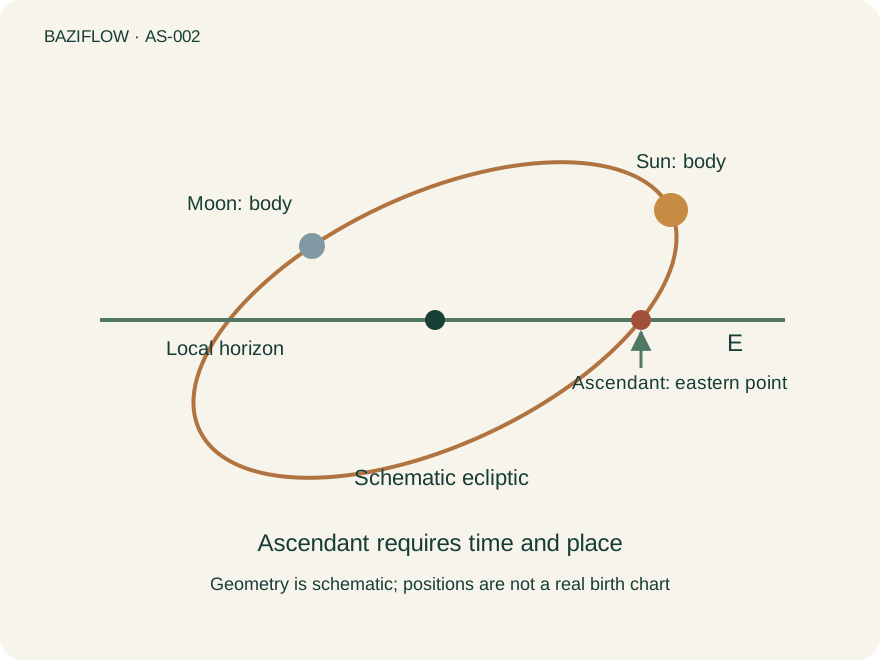
A conceptual guide, not a personal chart or a strength score.
A missing-time decision tree
If you have only a birth date, check the range of solar and lunar positions during that day. The Sun may remain in one sign; near an ingress it may not. The Moon can change signs during the day. Keep both possibilities where appropriate, and leave the Ascendant unresolved.
If the time is a family estimate near a boundary, compare candidate positions rather than selecting the more appealing description. If time and place are documented, calculate with the correct local time conversion and a declared zodiac. Then retain degrees, houses, aspects and the ruler of the rising sign—not just the three names.
The Moon completes a sidereal circuit in roughly 27.3 days, spending roughly two to three days per sign. The Sun takes a year for its apparent zodiacal circuit. Rising signs can change much faster; “every two hours” is only a rough average, with substantial variation by latitude and zodiacal region. A date alone is not a reliable Ascendant input.
Retire two tempting shortcuts
The Ascendant does not switch on at age thirty. It is part of the chart's geometry from birth, regardless of how a practitioner discusses development. Calling it only a social mask is also narrower than its role in many methods. In the same way, calling the Moon the “real you” demotes other chart factors without an argument.
Two people sharing all three sign labels can still differ in degrees, houses, aspects and the rest of the chart. Reusing the same substantial reading for both would erase those differences. For study, record choices, routines and responses to unfamiliar settings separately, then ask which claims actually have discriminating evidence.
Continue from labels to relationships
The Faculty's introductory material is a source for the modern symbolic vocabulary, while Astrodienst's house introduction discusses the Ascendant and its ruler. Neither makes these three labels a substitute for a full chart. Continue with planets, signs, houses and aspects to see how the remaining information connects.