

Making a reading checkable
Content version · · Sources & references
Use an invented fourteen-day discussion plan to separate interpretation, action, and evidence, while distinguishing practical benefit from prediction testing.
The short version6 min read
A phrase may suggest a useful action without confirming another person’s wishes. Make the interpretive bridge visible and keep the original target when later evidence changes your expectations.
- The fourteen-day deadline and thirty-minute meeting are stipulated, not extracted from the poem.
- Acceptance is not attendance, and missing evidence differs from a documented non-event.
- Your invitation changes the process and must remain in the record.
Read first
Turn a vague oracle-lot concern into one focused question ↗
Read the poem, allusion, and commentary as distinct layers ↗
A useful action is not an independent test of a prediction
Suppose a reading encourages you to invite friends to a small discussion, and the discussion happens. The action may have been useful. It does not follow that the text independently predicted an event unaffected by your response: the invitation and arrangements became part of the process that produced the outcome.
This distinction allows a reading to support reflection without being promoted into a verified forecast. Hsing Tian Kong's own religious explanation links lot reading with self-reflection. The practical worksheet below is this article's proposal, not a temple rule or a validated accuracy test.
Keep the bridge to observed events visible
- Prior criterion
- A defined subject, deadline and completion condition written before the result.
- Unverified
- Evidence necessary for classification is missing, rather than the result being unwelcome.
Show the bridge between the words and your interpretation
The Chinese Temples Committee's first Guanyin lot opens with a phrase about a favorable connection (roughly “heaven opens, earth breaks ground, making a good bond”). A reader considering a book discussion might connect that language with an opportunity to collaborate. That is the reader's interpretive step; the line has not confirmed either friend's willingness to participate.
Keep the original wording, the proposed interpretation, known circumstances, and a possible action in separate places. “This makes me want to explore a collaboration” is different from “the poem says these two people will accept.” The former identifies a personal response; the latter adds a factual claim the text cannot establish about other people's unexpressed intentions.
If the bridge cannot be explained, do not fill it with more ornate language. It is acceptable to say that a phrase prompted an idea without claiming that the idea was the text's only possible meaning. Framing the original question helps keep the subject stable.
Define one modest outcome before taking action
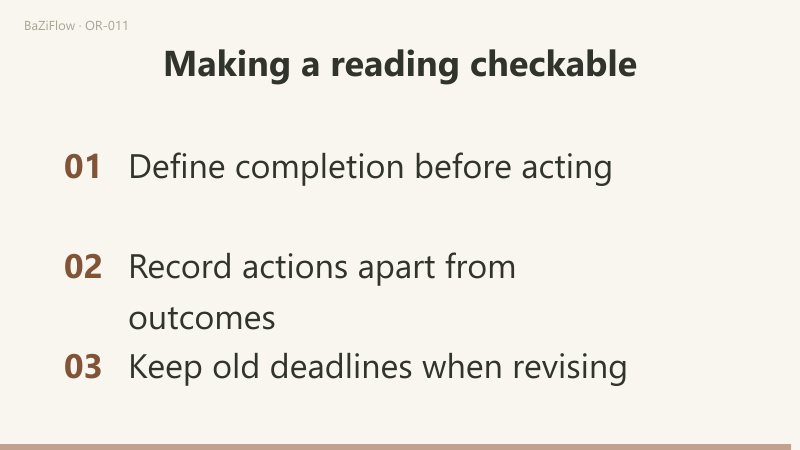
Use an entirely invented example. From the day of the note, the reader wants at least one friend to join a single thirty-minute book discussion within fourteen days. The reader does not count as the required friend. Sending an invitation and receiving agreement are intermediate steps, not completion of the discussion.
The proposed action is to invite two friends once each, with a clear topic and possible times. They remain free to decline or suggest another arrangement. The reading does not entitle the reader to demand participation. No real message is sent in this exercise; it illustrates a record that distinguishes one's action from another person's choice.
The thirty minutes and fourteen days are stipulated for the example. They are not a duration or deadline decoded from the poem. State that explicitly so a practical planning choice does not later appear as a traditional prediction.
Invite two friends
- Your action
Participate
- Their choice
Hold discussion
- Target event
Decide in advance how the record will be classified
| Evidence at the deadline | Classification against this goal | Limit of the conclusion |
|---|---|---|
| At least one friend actually joined a thirty-minute discussion within fourteen days | Goal met | This particular discussion took place |
| A complete record shows no discussion by day fourteen | Goal not met | This does not rule out all future collaboration |
| Essential attendance or duration records are missing | Not yet verifiable | Do not guess a result from preference |
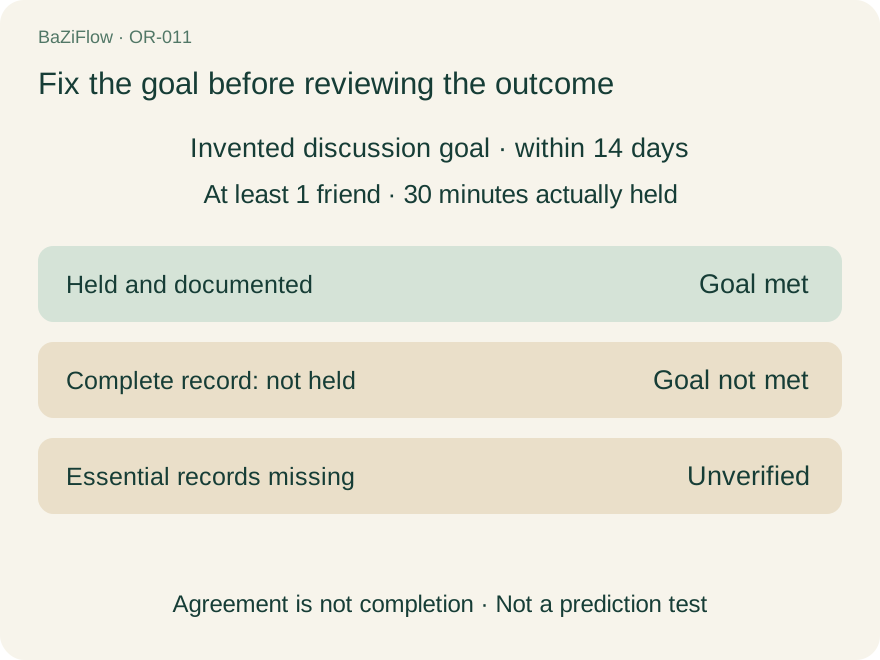
Original BaZiFlow action-review framework. Its deadline and duration are stipulated, not dates predicted by the lot.
If one friend accepts and the other declines on day seven, the record shows progress, not a completed event. If the discussion has not happened by the deadline and the record is clear, the goal was not met. A friend's reason for not replying may remain unknown, but that uncertainty does not make a clearly documented non-event an unknown outcome.
Use the unresolved category only when evidence needed for the defined classification is actually missing. It should not become a refuge for every unwelcome result. Equally, absence of a reply does not establish rejection or a damaged relationship; those would be additional claims about someone else.
Day 7 acceptance
- Agreement
- Yes
- Event held
- Not yet
- Original goal
- Not completed
Day 12, 30 minutes
- Agreement
- Yes
- Event held
- Yes
- Original goal
- Met
Day 16 meeting
- Agreement
- Yes
- Event held
- Yes
- Original goal
- Missed deadline
Name a condition that would change your interpretation
If both friends say they are unavailable for the period, acknowledge the missing conditions for the current plan. A later date can be proposed, but it becomes a revised plan with its own start and deadline. Do not count a late discussion as timely fulfilment of the earlier target.
A completed discussion also has a limited meaning. It does not establish a year of successful collaboration or guarantee that every later meeting will work. Keeping the original scope allows positive and negative evidence to be treated with the same discipline.
Write down a possible non-supporting result before it occurs: if this discussion does not form, retain that result rather than replacing it with an unrelated pleasant encounter. The encounter may matter in its own right, but it is not the event selected for observation. A claim that absorbs every possible outcome cannot help distinguish between interpretations.
Review the practical value without changing the question
After the deadline, ask what information was obtained, which actions were taken, and whether the stated goal was met. These questions can reveal practical value even when the event did not happen. They are separate from asking whether a divination method has demonstrated predictive accuracy.
Keep your intervention in the record. An invitation, a changed time, or a newly available friend is part of the explanation, not background to erase once a result looks favorable. Grades and outcomes addresses the related mistake of treating a textual label as an observed event.
Save the source and wording alongside the interpretation, deadline, actions, evidence, and any revisions. Date new information when it becomes known. Recording the lot source preserves the textual side. The result may be met, unmet, or genuinely unverified; what makes the reflection checkable is that another reader can tell exactly what was proposed and what was observed.
Original deadline
- Within fourteen days
Later arrangement
- A revised plan
Record
- Do not backdate fulfilment
Write the fixed target
At least one friend actually joins you for thirty minutes within fourteen days; you do not count as that friend.
Classify the day-seven reply
Acceptance is progress, while no discussion has yet occurred. Preserve that intermediate status.
Keep the value of a later event
A meeting on day sixteen may be worthwhile. Record it as a later event while retaining that the original deadline was missed.
Questions readers ask next
Does acceptance complete the target?
This example requires an actual discussion, so agreement is intermediate progress. Different targets are possible if defined before observing results.
Does no reply establish refusal?
No reply is an observation; refusal and motive are further claims. A clearly unheld meeting can be classified without inventing the reason.
Does a successful plan validate the prediction?
Not from this case alone. Your invitation and arrangements changed the process, and practical benefit differs from independent predictive evidence.
Was this article helpful?
Part of a learning path
Oracle lots: from versions to real-world thinking · Step 6 of 6 available
Sources & references
Continue reading
Recording an oracle-lot source: identifiers, dates, and gaps ↗
Upper and lower oracle lots are labels, not event outcomes ↗