

Tian Peng: the Water star of Kan One
Content version · · Sources & references
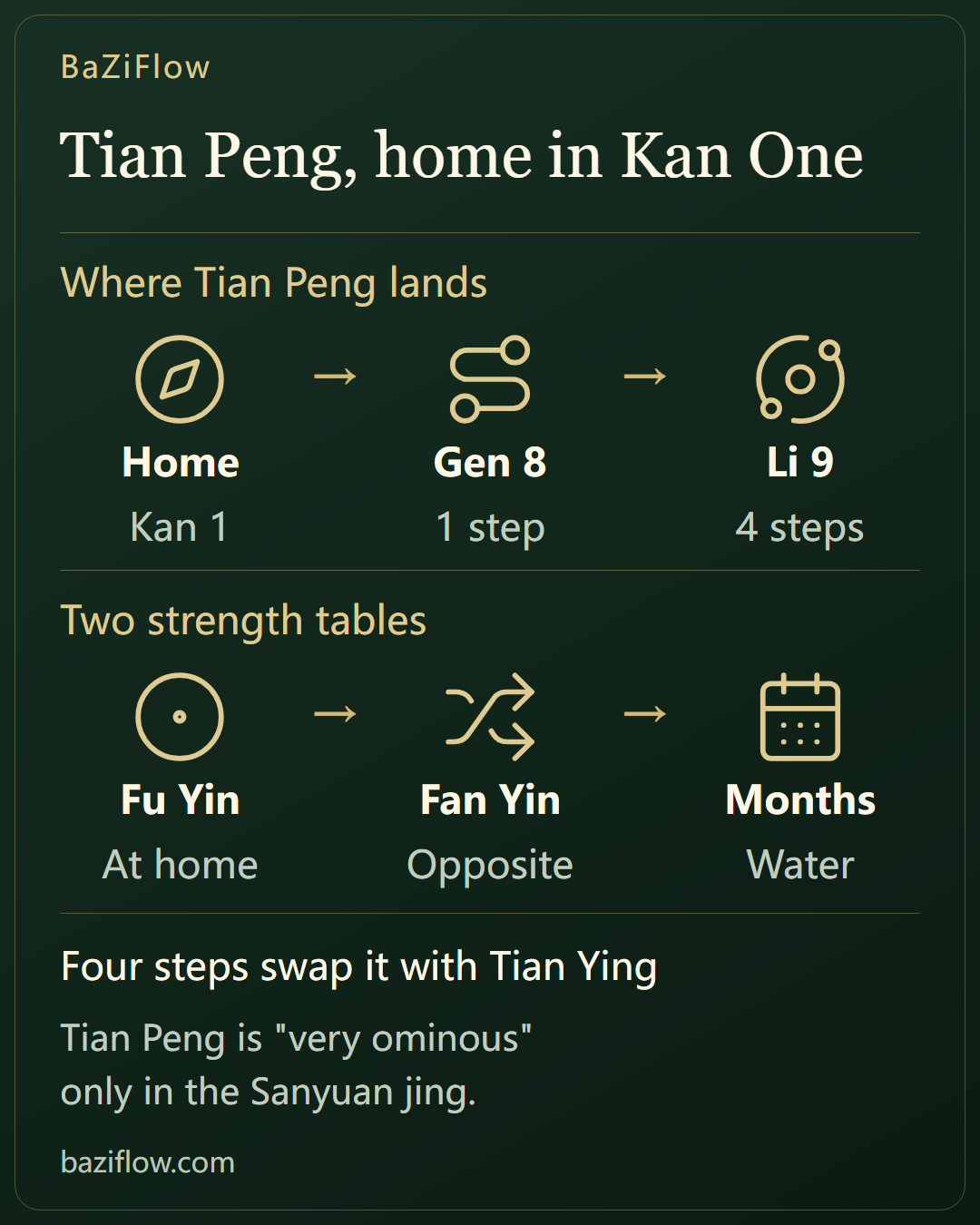
Tian Peng is the star whose home is Kan One, element Water. The book's "courtesy name", star-level Fu Yin and Fan Yin, the Water-star month table and three rankings keep the home position apart from where it lands.
The short version10 min read
Tian Peng is the star whose home is Kan One, element Water. It moves with the plate and lands on one of eight outer boxes; four steps bring it to the opposite box, Li Nine, which the book calls Fan Yin.
- The Yan Bo Diao Sou fu writes "Kan, Peng, a Water star": Tian Peng goes with Kan One and Water. Where it sits on a given chart depends on how far the plate has turned, so any outer palace is possible.
- Juan 2 calls "Peng over Peng" the star-level Fu Yin and "Peng at the Ying spot" the Fan Yin. They are a turn of 0 and a turn of 4, and recomputing the book's two hours gives the same result.
- Within one book Tian Peng is left unlisted, called "ominous" or called "very ominous" depending on the passage, and its season clause does not match the strong months of a Water star. Say which passage you are quoting.
Read first
Water in Kan One: the star with the smallest Luoshu number
In plain words first: Tian Peng (天蓬) is one of the nine stars, with its home in Kan One and the element Water. Home is the box it was set in at the factory; where it goes at a given hour depends on how the plate has turned, and that has to be counted separately.
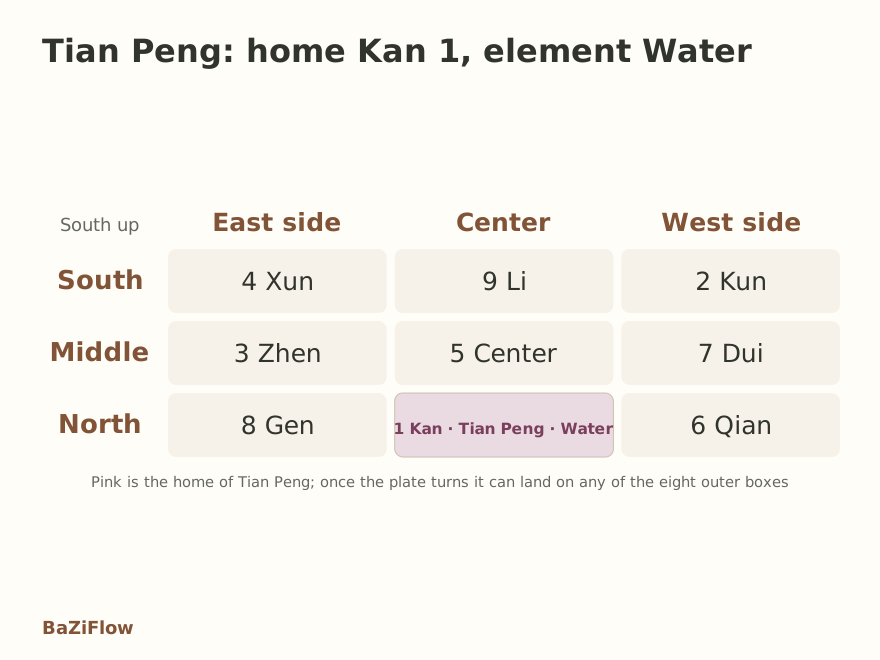
Nine-palace base grid with south at the top and east on the left; the home and element of Tian Peng follow the verse line "Kan, Peng, a Water star". Pink is the home position, not the landing at every hour.
Pink marks Kan One, the middle box of the bottom row (south is at the top, east at the left), number 1. Juan 1 of the Ming-dynasty Dun Jia Yan Yi (遁甲演义) carries a verse, the Yan Bo Diao Sou fu (烟波钓叟赋), that hangs each star's element on the palace it sits in: "Kan, Peng, a Water star; Li, Ying, Fire"; Center, Kun and Gen give Earth, Qian and Dui give Metal, Zhen and Xun give Wood. So Tian Peng being Water is not a label added later; the verse derives it from its palace (the palace itself is covered in Kan One).
Zi Qin: the star's courtesy name, and its eight possible landings
The star entries in juan 3 give every star a "courtesy name" (字), the formal second name a person used in the old days. Tian Peng's is Zi Qin (子禽). The name is put to use in the Human Escape example of juan 2: Tian Peng is added to the eighth palace, Gen in the northeast, and the reader is told to face that way and call the star by this name.
To go out toward the northeast, call the star by its courtesy name, Zi Qin, walk sixty paces, and enter the Great Yin.
The "qin" in Zi Qin is a character in a name; it has nothing to do with the star Tian Qin (天禽), which has a courtesy name of its own, Zi Gong. The same character in two places is a reason to check which layer it sits in.
Getting Tian Peng to a given box takes three steps: see who the duty star of the cycle is, see which palace the hour stem occupies on the earth plate, and turn the whole star layer around the outer ring until the duty star sits on that palace (how the duty star is found is in duty chief and duty door). Try it on Yang ju 1, hour Ding Mao on a Yang Wood and Yin Earth day:
Enlarge diagram · scroll sideways to read
The outer ring has eight boxes, and a turn of k steps moves it k boxes: 0 steps stays in Kan One, 1 goes to Gen Eight, 2 to Zhen Three, 3 to Xun Four, 4 to Li Nine, 5 to Kun Two, 6 to Dui Seven, 7 to Qian Six. The book's "Tian Peng added to the eighth palace" is a turn of 1.
Peng over Peng, Peng over Ying: Fu Yin and Fan Yin at the star layer
Two songs in juan 2 define the star-layer Fu Yin (伏吟) and Fan Yin (反吟) with Tian Peng as the example:
Star Fu Yin: the heaven-plate Tian Peng added onto the earth-plate Tian Peng, so the stars stay at their home palaces; this is called Fu Yin. ... Star Fan Yin: the Peng star on the heaven plate's first palace added onto the Ying star in the earth plate's ninth palace is Fan Yin.
Both examples are in the Yang ju 1 of the winter solstice, upper cycle, on a Yang Wood and Yin Earth day. At the midnight Jia Zi hour the duty star Tian Peng is added to the first palace and the hour stem is also in the first, so Tian Peng does not move: Fu Yin. At the Yi Chou hour the Yin Wood stem is in the ninth palace, the duty star Tian Peng is added to the ninth, and that is Fan Yin. Recomputing: the Jia Zi hour is a turn of 0, the Yi Chou hour a turn of 4, from Kan One to Li Nine, and Tian Peng and Tian Ying exchange places, as the book says.
Enlarge diagram · scroll sideways to read
The plate turns as one piece, so at the moment "Peng is back home" the other stars are also each back home, and when "Peng is at Ying's spot" the others each sit in their opposite boxes. Fu Yin and Fan Yin at the star layer count the steps of the turn; they are not about one star. The book adds a summary line, "any star and duty star in opposition is Fan Yin", which is exactly the opposite-box case. How the same two names work on the gate layer is in Fu Yin, Fan Yin and void branches.
A Water star's months: in this book the prosperous and the supporting swap
Juan 3 has a table of "nine stars: prosperous, supporting, abandoned, resting, confined". Each star, by element, is sorted into five groups of the twelve branch months; the Water star Tian Peng reads: Hai-Zi months, Yin-Mao months, Shen-You months, Si-Wu months, and Chen-Xu-Chou-Wei months. The verse in juan 1 uses Tian Peng as its own example for the same thing:
Take the Water star, Tian Peng: it supports in early and mid winter, flourishes in the first and second months, rests in the fourth and fifth; the rest follow from this, work them out yourself.
Set side by side, the two flourishing and supporting groups are exchanged:
Enlarge diagram · scroll sideways to read
The difference lies only in those two groups, and it does not look like a slip of the brush: the verse gives the rule "the same element is supporting, the month I produce is flourishing", while the note before the juan 3 table says each star "flourishes in the months of its own kind and is supporting in the months it produces". The two rules are opposite, and the book does not say which to follow. What is described above is how the Siku text reads in the Wikisource transcription; the facsimile pages have not been checked page by page on this site, so say whether juan 1 or juan 3 is being relied on.
Tian Peng in the lists of lucky and ominous stars: three passages, three wordings
Traditionally the nine stars are sorted into lucky and ominous ones, and the book gives three lists. Side by side in one table:
Enlarge diagram · scroll sideways to read
Side by side, Fu, Qin and Xin stand at the lucky end in every passage and Tian Peng at the ominous end. But in the Siku transcription the Diao Sou fu line reads "very ominous, meeting Rui" and never names Tian Peng (the characters for "meeting" and for "Peng" differ only by the grass radical; whether this is a copying slip, the site has not checked against other editions), and the Yellow Emperor's Hidden Talisman (黄帝阴符经) section of juan 1 says only "ominous"; the Sanyuan jing (三元经) of juan 3 writes "very ominous" and sets it beside Tian Rui. Three passages, three wordings, not one fixed rank. Before saying "Tian Peng is a very ominous star", say which passage it comes from.
Two checks by hand
Yang ju 1, hour Wu Chen: where is Tian Peng?
The hour stem Yang Earth is Kan One on the earth plate, as it is at the Jia Zi hour, so Tian Peng is back in its home palace: Fu Yin at the star layer.
Yang ju 1, hour Xin Wei: how many steps has Tian Peng turned?
Yin Metal is in Xun Four on the earth plate, and from Kan One to Xun Four is 3 steps. In this cycle of ten hours, the full 4 steps to Li Nine come at the Yi Chou hour.
To see what gates, stars and spirits each cover, read what doors, stars and spirits each do; following the Luoshu numbers the next star is Tian Rui.
Questions readers ask next
Does Tian Peng always stay in the northern Kan palace?
Kan One is only its home position, the factory setting. After the plate turns, the landing is fixed by the duty star and the hour stem: in Yang ju 1 it is in Kan One at the Jia Zi hour and in Li Nine at the Yi Chou hour, and in another of the book's examples it is added to Gen Eight, toward the northeast.
Do Fu Yin and Fan Yin say Tian Peng itself is faulty?
Both names describe a position. Fu Yin is a star back at its own home and Fan Yin is a star turned to the opposite palace. What weight the relation carries, and how to judge it, is given by other passages and depends on the question asked; the name does not settle it.
Tian Peng is Water, so is it strong in winter?
The juan 3 table makes a Water star strongest in the Hai and Zi months. The same juan's own clause for Tian Peng, however, says an army does well in spring and summer and badly in autumn and winter. The element rule and the star's own clause go separate ways and the book does not reconcile them, so say which one you consulted.
Was this article helpful?