

Knight of Swords: the full charge
Content version · · Sources & references
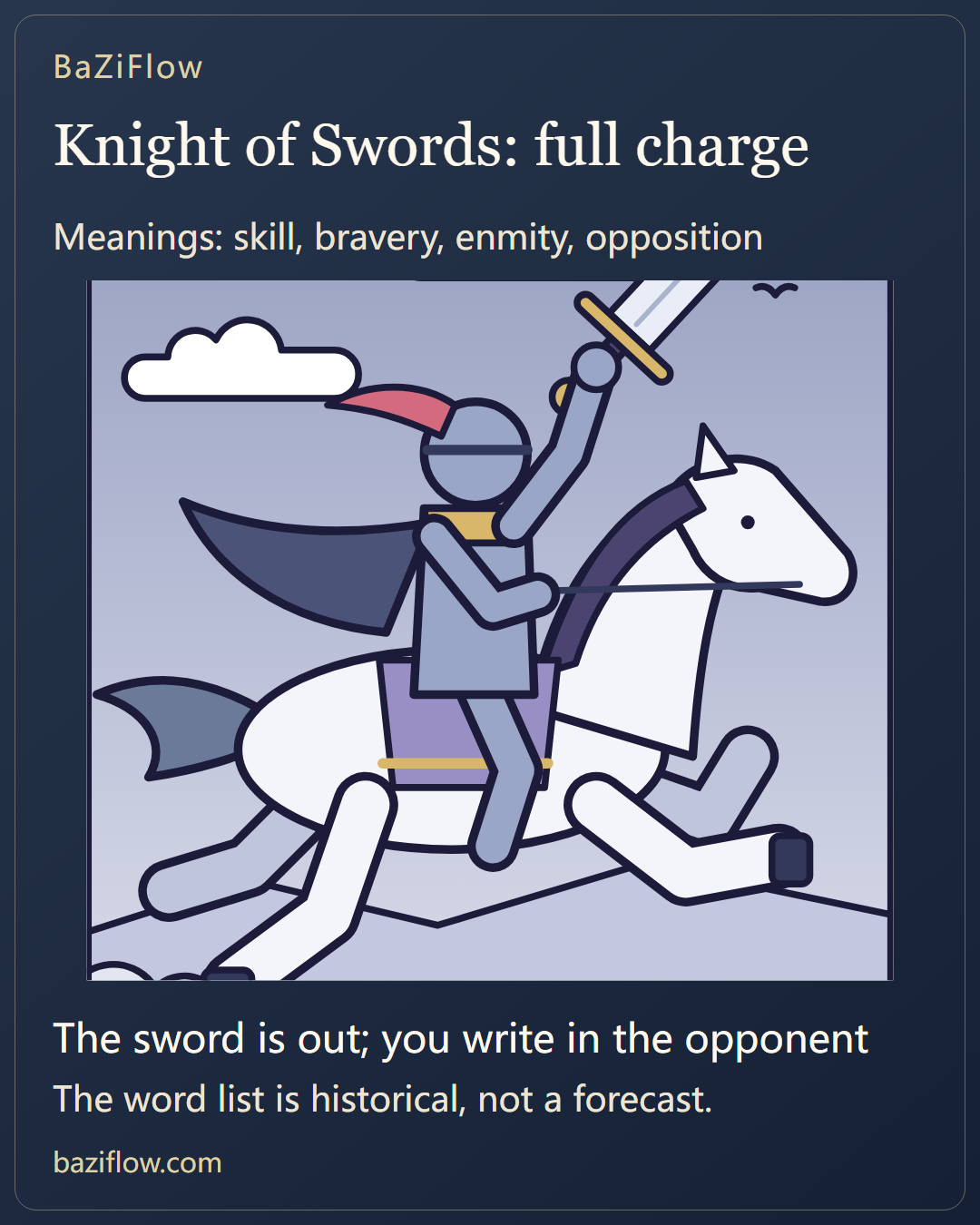
The Knight of Swords rides at full course with his sword raised. Separate the picture, Waite's word list, the reversed words and the extras, then practice writing the unseen opponent into a debate-team rebuttal.
The short version7 min read
The Knight of Swords gallops through a picture with no enemy in it. Waite's list opens with five words of skill and follows with seven of conflict, so the first question is where the charge is going.
- Waite's description: the rider is in full course, as if scattering his enemies, a prototypical hero of romantic chivalry who might almost be Galahad, whose sword is swift and sure because he is clean of heart.
- The first half of the list is ability (skill, bravery, capacity, defence, address); the second half is conflict (enmity, wrath, war, destruction, opposition, resistance, ruin). The sense of death holds only next to other cards of fatality.
- The reversed entry is three words: imprudence, incapacity, extravagance. The extras make him a soldier or man of arms and give "dispute with an imbecile person" when reversed.
Read first
Start with the picture: one rider at full speed, clouds and trees bent over
Waite describes the card in three sentences. The knight is riding in full course, as if scattering his enemies. In the design he is really a prototypical hero of romantic chivalry. He might almost be Galahad, whose sword is swift and sure because he is clean of heart.
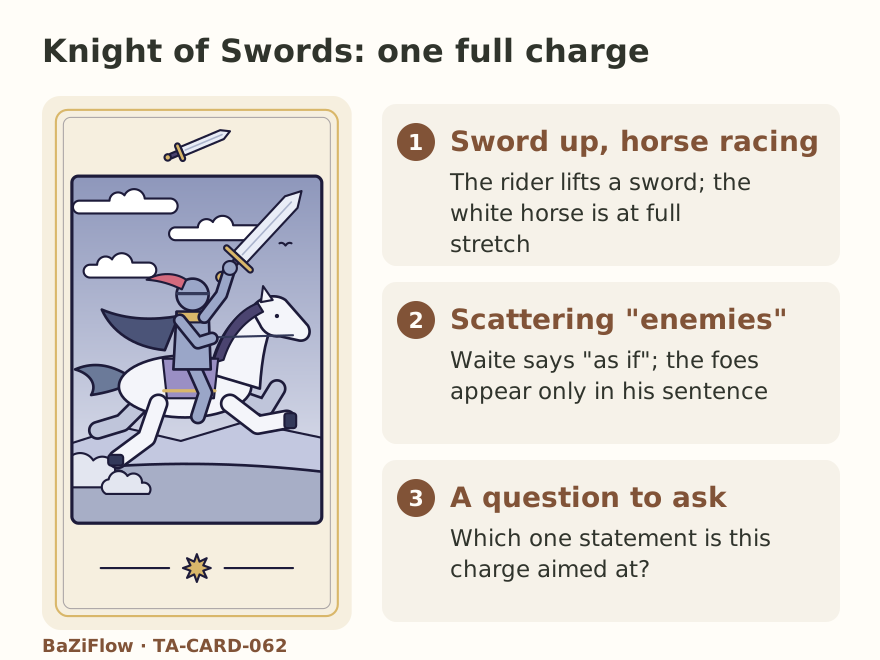
BaZiFlow original Knight of Swords
On the original Rider-Waite-Smith card the knight wears a helmet, his red cloak and plume stream out behind him, and his right hand holds a long sword high. The pale horse has its head low and its mane flung back; a few trees at lower left are bent by the wind, and the clouds are torn into long strips. There is no second person in the picture and no enemy being scattered. Read it from the top: the sword at the highest point, the horse in the middle, the landscape at the bottom, and all three layers lean the same way.
Enlarge diagram · scroll sideways to read
What Waite lists: skill in the first half, conflict in the second
Waite's divinatory meanings begin with skill, bravery, capacity, defence and address, then turn to enmity, wrath, war, destruction, opposition, resistance and ruin. He then adds a condition: there is a sense in which the card signifies death, but it carries this meaning only in its proximity to other cards of fatality.
Skill, bravery, capacity, defence, address, enmity, wrath, war, destruction, opposition, resistance, ruin.
Within one card, the first five words say how capable the rider is, and the last seven say how fierce the situation is. The list does not tell you which half will happen; it sets the two side by side. The sense of death is locked by Waite himself to the condition "in proximity to other cards of fatality", so it does not stand on a single card.
Enlarge diagram · scroll sideways to read
Galahad, the galloping horse and the bent trees: three details, three sources
Three details deserve a separate look. The first two connect to Waite's words, and the third belongs to the Rider-Waite-Smith picture only.
Three details, each with its source
- Galahad
- Waite says it outright: the knight might almost be Galahad, "whose sword is swift and sure because he is clean of heart". Galahad is the knight of Arthurian legend known for his purity, which is common knowledge; what Waite borrows from him is "clean motive, sure stroke".
- The galloping horse
- This entry says "in full course". About the horse, Waite adds a line under the Knight of Wands: the motion of the horse is a key to the character of its rider and suggests the precipitate mood. That belongs to another card; it is set beside this one for comparison and is not this entry's text.
- Bent trees, torn clouds
- They are in the Rider-Waite-Smith picture, and Waite never says a word about them, so they are not part of the meaning. What they do is give the picture its wind.
Enlarge diagram · scroll sideways to read
Reading "sure sword" as "clean motive" and "full speed" as "the direction of the drive" is a modern teaching borrowing. It turns the picture into questions you can put to yourself, and it is not in Waite's word list.
How to read it: write the missing opponent into the picture before you charge
The card comes with a ready shape: a charge, and no opponent. Carried to an everyday matter, it means adding three things before you act.
Fill in: write the opponent as one exact sentence
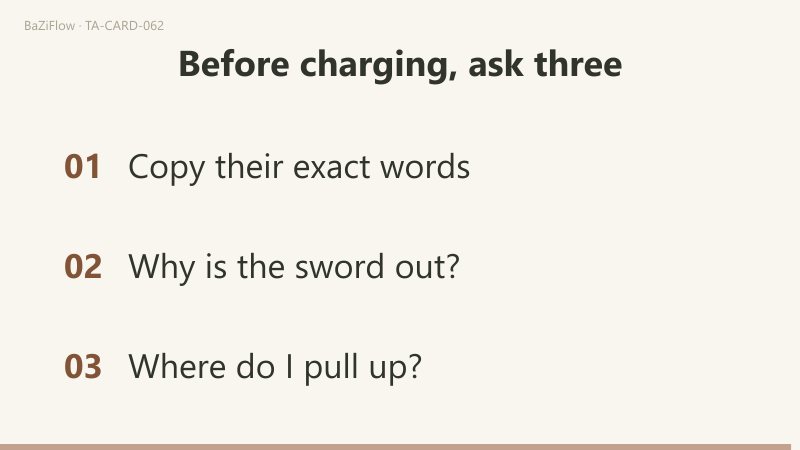
There is no enemy in the picture, so put one there: copy the single sentence the other side just said, word for word. Not "that side", and not a person. If you cannot copy it out, you are about to answer an impression and not an argument.
Test the sword: why is it out?
Waite says Galahad's sword is sure because his heart is clean. In teaching you can ask it this way: is this charge meant to move your own case forward, or only to win the energy of this one exchange? The answer decides where the point lands.
Pull up: one line, then return
The second half of the list is opposition and ruin, and a charge without an end turns into a chase. Set a stopping point: answer that one point in a single sentence, then go back to your own case.
An example: a school debate team is practicing a free-debate round on the motion "Community libraries should extend their evening hours". You are on the opposing side, and the other speaker has just said, "Evening hours give people who work days somewhere to study." You want to charge in. Here are the four steps a thirty-second rebuttal can follow:
Enlarge diagram · scroll sideways to read
A three-column debrief
Can be reviewed
- Were their words copied in full?
- Did you answer a point or a person?
Cannot be reviewed
- What they were thinking
- Whether the charge will win
Next round
- Write the stopping point in your notes
- Cut what one line cannot answer
Reversed, and others on the road: imprudence, incapacity, extravagance
Waite gives the reversed Knight of Swords three words: imprudence, incapacity, extravagance. The additional meanings are other readers' wording: upright, a soldier, man of arms, satellite, stipendiary, with heroic action predicted for a soldier; reversed, a dispute with an "imbecile person", and for a woman a struggle with a rival who will be conquered. That is period wording, and it treats the card as a person.
Enlarge diagram · scroll sideways to read
Three others on the road, each at a different pace
On foot, watchful
Waite has him walking swiftly over rugged ground, looking this way and that, as if an expected enemy might appear at any moment; the sword is in hand and the eyes are working.
Traveling, not warring
Waite says that although mailed he is not on a warlike errand, and the motion of the horse suggests a precipitate mood; also on horseback, but the Knight of Swords' list speaks of enmity and war.
Riding quietly
Waite has him riding quietly with a winged helmet, and the list is arrival, advances, invitation; the pace is slow and the subject is "drawing near".
Questions readers ask next
Is the Knight of Swords just the reckless card?
In Waite's upright list, skill, bravery and capacity come first; words like imprudence and extravagance appear only in the reversed entry. The card shows one charge at full speed. The speed is real; whether it is accurate depends on what it is aimed at and why the sword is out.
Does the Knight of Swords mean death?
Waite says that in a sense it does, but only in proximity to other cards of fatality. Read alone, "destruction" and "ruin" in the list describe what conflict can lead to, and death is not the card's own subject.
Are the "soldier" and "man of arms" in the extras about someone I know?
Those are other readers' old-style phrases, which treat the card as a person. A steadier way to teach it is as a stance: direct, quick, first into the matter. Speaking about a particular person needs information about that person, which the card cannot supply.
Was this article helpful?
Sources & references
Continue reading
Page of Swords: an upright sword, a fast walker on rough ground, and eyes everywhere ↗
Queen of Swords: sword upright, one hand out, and a card defined by what it is not ↗