

Water of the Great Stream: Yang Wood Tiger and Yin Wood Rabbit
Content version · · Sources & references
Two pillars of pure Wood share the twenty-sixth Na Yin name. The Sanming Tonghui’s two compass-based lines, the entry’s “return and feed” test, its named clashes, and a year pillar worked out by remainders.
The short version9 min read
Water of the Great Stream is the twenty-sixth Na Yin name, shared by Yang Wood Tiger and Yin Wood Rabbit. Unlike Mulberry Wood, these pillars are pure Wood, and the book names them by the direction the water flows, not by a life stage.
- Stems Yang Wood and Yin Wood, branches Tiger and Rabbit, hidden stems Yang Wood, Yang Fire, Yang Earth and Yin Wood: no layer holds Water. The “water” comes from the Na Yin alone, that is, from the book’s reasons.
- Neither of the two lines in the Sanming Tonghui uses the life-stage table: one speaks of water relying on its source and pouring east, the other of the Tiger as northeast and the Rabbit as due east.
- The entry loves “somewhere to return and something to feed it” and dislikes a Monkey or Rooster in the day, month or hour and the wind from the Dragon and Snake; the named combinations, clashes and punishments all check out in the table.
Read first
What is Na Yin in BaZi? Why Yang Wood Rat Gold in the Sea does not replace Yang Wood ↗
Wood pillars with a Water name: Yang Wood Tiger and Yin Wood Rabbit
Water of the Great Stream (大溪水) is the twenty-sixth Na Yin name, shared by Yang Wood Tiger (甲寅) and Yin Wood Rabbit (乙卯). This pair is the reverse of Mulberry Wood: there Water pillars took a Wood name, here pure Wood pillars take a Water one.
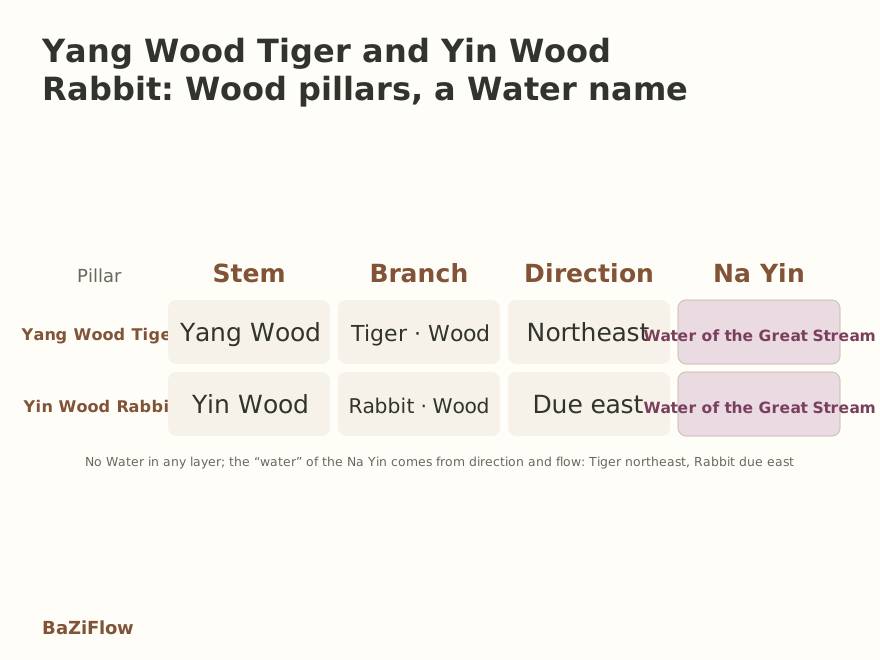
Four Wood characters: the direction column follows the calendar specialists, and “water” appears only in the Na Yin column.
The picture also lists the directions, which are needed later: the calendar specialists (日家) put the Tiger in the northeast and the Rabbit due east. Yang Wood Tiger is Yang Wood on the Tiger, which is Wood, and the Tiger hides Yang Wood, Yang Fire and Yang Earth. Yin Wood Rabbit is Yin Wood on the Rabbit, also Wood, and the Rabbit hides only Yin Wood.
Water running east: this time the book skips the stage table
In juan 1 the Sanming Tonghui (三命通会) walks through the twelve branches two at a time. The Rat and Ox are yin and yang just conceiving; for the Tiger and Rabbit it writes “yin and yang gradually open out and people gradually grow”, with husks splitting and blossoms slowly parting. For Yang Wood Tiger and Yin Wood Rabbit it then says:
Yang Wood Tiger and Yin Wood Rabbit: the qi comes out into the light of yang; the water relies on its source and pours eastward, and its force grows steadily. So it is called Water of the Great Stream.
“Comes out into the light” is qi leaving the dark, “relies on its source” is water leaning on its spring, and “pours” and “grows steadily” say the flow keeps swelling. Not one life-stage word appears. The calendar specialists’ line is the same:
Yang Wood Tiger and Yin Wood Rabbit: the Tiger is the northeast corner and the Rabbit is due east. Water that flows due east follows its nature, and rivers, ravines, pools and ponds all join it and return.
The Tiger is the corner of the northeast and the Rabbit is due east; water running due east follows its nature, and rivers, ravines, pools and ponds all flow in and come home to one place.
Compare the two earlier pairs. For Gold in the Sea (“Death” and “Storage”) and for Hairpin and Bracelet Metal (“Decline” and “Weakening”), the calendar specialists worked backward from the stage table; for the Great Stream they pick up another ruler. They do not ask what stage Water is in on the Tiger and Rabbit, they ask which way the water goes. In this site’s table, counted by Yang Water, Water is at Weakening on the Tiger and at Death on the Rabbit, and neither naming line uses either word. The book's pillar-by-pillar commentary in juan 1 does call Yang Wood Tiger "water sick in itself" and Yin Wood Rabbit "water dead in itself", matching the table, but that sizes up the pillars themselves (it goes on: "though dead and sick, Earth cannot overcome it") and is not a reason for the name.
Enlarge diagram · scroll sideways to read
The two columns do not refute each other; each answers its own question. Before reading a Na Yin entry, ask which ruler the book is using. For the stage table in full, see Twelve Life Stages and Void Branches.
Somewhere to return, something to feed it: what it fears
The entry opens with surging waves, then says what this water wants and what it dreads:
It most loves having somewhere to return and something to feed it: meeting Kan means a place to return, finding Metal means feeding. What it dislikes is a Monkey or Rooster in the day, month or hour that stirs it by clash, or the wind from the Dragon and Snake, which leaves it drifting.
“Return” is where the water goes. Kan is north and water; Gen is northeast and the mountain, and the entry places branches with them: Yang Wood Rat “belongs to Kan”, Yin Wood Ox “is Gen”, the Water Below the Ravine entry has “the Ox as Gen”, and for the Great Sea the word is “pay court”, the place hundreds of rivers end up. “Feed” is Metal, which produces Water, and the entry calls Hairpin and Bracelet Metal and Sandstone Metal the “most suitable” and White Wax Metal “also clear”.
What it fears is clash and wind: a Monkey or Rooster in the day, month or hour stirs it up, and the Dragon and Snake are the southeast wind that leaves the water drifting. Note that the book counts the day, month and hour and leaves the year pillar out.
Enlarge diagram · scroll sideways to read
The named combinations, clashes and punishments, checked
The entry names a run of pillars. This time the book uses the very words combination, clash and punishment, so the engine’s tables can be set against it:
Enlarge diagram · scroll sideways to read
This stretch lines up neatly. The entry says “only Yin Earth Rooster combines”, and in the table Yang Wood Tiger and Yin Earth Rooster are the Yang Wood–Yin Earth combination; “Yang Earth Monkey clashes”, and Yang Wood Tiger against Yang Earth Monkey is Tiger against Monkey; “Yang Metal Rat punishes”, and Yin Wood Rabbit against Yang Metal Rat is Rat against Rabbit. Going the other way, Yin Wood Rabbit against Yin Earth Rooster is Rabbit against Rooster, a clash the book does not mention; that is a layer the table adds.
The two lines on Mulberry Wood are of interest too: the entry says that “Yang Wood Tiger meeting Yang Water Rat is good, Yin Wood Rabbit meeting Yin Water Ox is good”, and both pairs happen to be free of clash and punishment between the branches, while the crossed pair, Yin Wood Rabbit with Yang Water Rat, is a Rat–Rabbit Punishment in the table, and the book did not pick it. This does not contradict the clashes and punishments elsewhere; they are separate layers.
Working out a year pillar by remainders: finding Yang Wood Tiger and Yin Wood Rabbit
Yang Wood Tiger is the year 1974 and Yin Wood Rabbit is 1975; the pair came before in 1914 and 1915 and returns in 2034 and 2035. No table is needed: 1984 is a Yang Wood Rat year, so subtract 1984 from the year (add 60 first if the result is negative), divide by 10 and by 12, and the remainders give the stem and the branch, counting stems from Yang Wood and branches from the Rat.
Enlarge diagram · scroll sideways to read
This gives the pillar that matches a calendar year; the real change waits for the Start of Spring. In Beijing time it fell at 13:00 on 4 February 1974, at 18:59 on 4 February 1975 and at 00:39 on 5 February 1976. Since 1976 was a leap year the moment passed midnight, so someone born at night on 4 February still has the year pillar Yin Wood Rabbit although the calendar says the 4th.
A Start of Spring night, and the remainder method
Born at 11 p.m. on 4 February 1976: which year pillar and which Na Yin?
The 1976 Start of Spring is at 00:39 on 5 February, which 11 p.m. has not reached, so the pillar is still Yin Wood Rabbit with the Water of the Great Stream; after 00:39 it is Yang Fire Dragon and the Na Yin becomes Earth in the Sand.
Find the year pillar of 2034 by remainders.
2034 − 1984 = 50. Divided by 10 it leaves 0, which is Yang Wood; divided by 12 it leaves 2, which counts to the Tiger. So the pillar is Yang Wood Tiger, valid from 02:41 on 4 February.
The next pair is Earth in the Sand, and the “paying court” where this stream is meant to end refers to Yang Water Dog and Yin Water Pig, Water of the Great Sea. For which layer Na Yin covers, see Na Yin and the regular five elements.
Questions readers ask next
Does the “water” in this name mean Yang Wood Tiger and Yin Wood Rabbit hide Water?
No. Their stems, branches and hidden stems hold no Water; they are pure Wood. Water of the Great Stream is the name the Na Yin gives to the whole pillar, and it comes from direction and flow: the Tiger in the northeast, the Rabbit due east, water running east. It does not become a point of Water in an element count.
This site’s table puts Water at Weakening on the Tiger and Death on the Rabbit. Does that contradict “great stream”?
No, they answer different questions. The stage table asks what state Water is in at that position; the book’s naming asks which way the water runs. Neither naming line uses a stage word, and where juan 1 does call these pillars water “sick” and “dead” in itself it is sizing up their strength, so “Weakening” and “Death” must not be read as comments on the name.
Born at 1 a.m. on 4 February 2034: which year pillar?
Yin Water Ox, not Yang Wood Tiger. The Start of Spring in 2034 falls at 02:41 Beijing time on 4 February, and 1 a.m. is before it, so the pillar still belongs to the previous year. From 02:41 it is Yang Wood Tiger, and the Na Yin changes from Mulberry Wood to Water of the Great Stream.
Was this article helpful?
Sources & references
Continue reading
Five Elements cycles: learn the relationships, not just the order ↗