

Horary and electional timing
Content version · · Sources & references
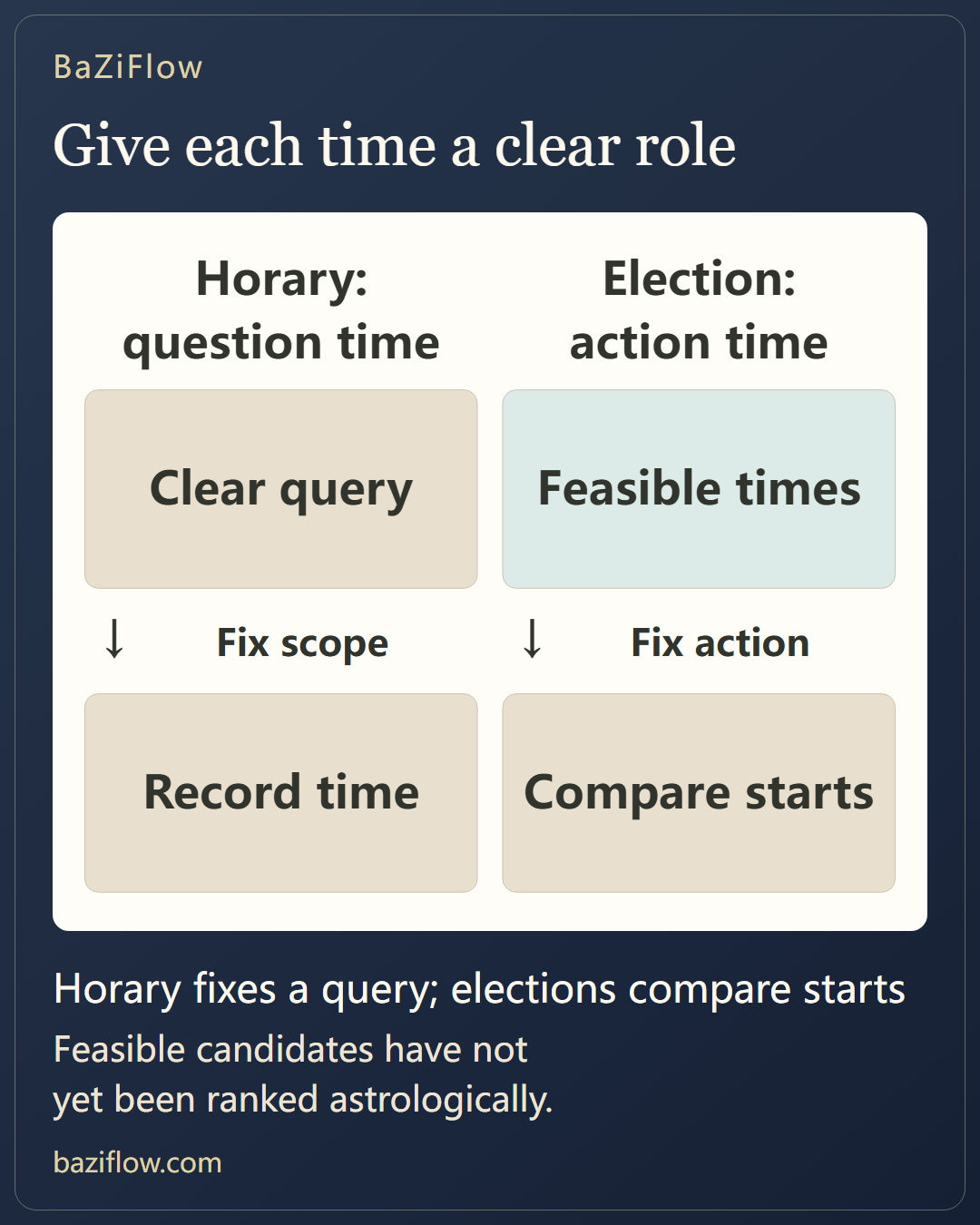
Separate a question chart from candidate action times and the eventual event record. A repair-session example shows why scope and practical constraints come before chart interpretation.
The short version6 min read
Horary fixes a chart around a defined question; electional work compares possible starts for an action. Identify the job of each clock value, then separate plan from occurrence. One event can involve several records without making them interchangeable.
- First thinking, sending and understanding a question may occur at different moments. A horary record needs its stated timing convention.
- Electional work first defines the action and excludes infeasible times. Two surviving candidates are not yet an astrological ranking.
- Planned 11:00 and actual 11:08 are two records eight minutes apart. The event time should not silently overwrite the prior selection.
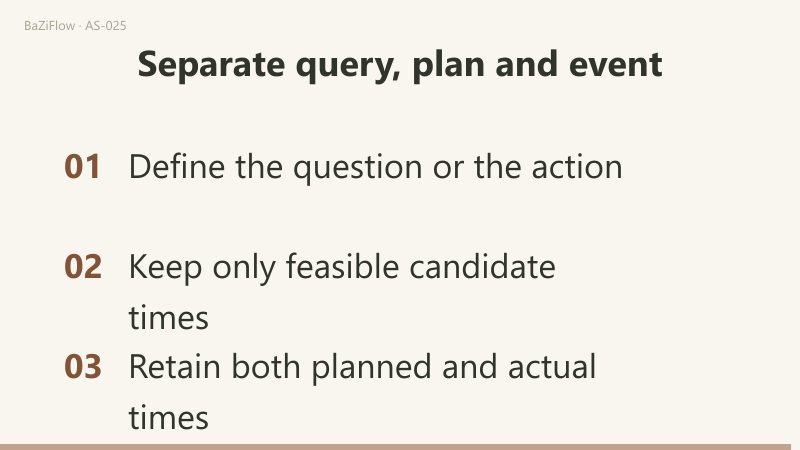
Read first
Traditional and modern astrology: compare the rules, not the labels ↗
The clock value needs a job description
A community repair group might ask whether a borrowed room will be available under the terms already discussed. It might instead ask which available time to begin its next session. These are different tasks even though both concern the same project. The first centers on a question; the second treats the action time as something to choose.
Horary astrology casts a chart for a defined question under a stated timing convention. Houlding's introductory account associates that chart with the question becoming clear and being submitted for astrological examination. Electional astrology compares prospective action times. Frawley's account places such choices within practical possibilities. These descriptions identify methods; they do not demonstrate that a forecast or selected time will produce a promised outcome.
The original sources also contain claims beyond those definitions. This article does not adopt their unsupported statements about medical outcomes, destiny or the limits supposedly fixed by a natal chart. A source can document a practice without establishing all of its causal explanations.
Horary: question time
Election: action time
Freeze the horary question, not just a timestamp
Return to the room question. “Will it be okay?” leaves the object and desired outcome unclear. “Will the room be available for this session under the terms already discussed?” gives a more bounded inquiry. If that clarification occurs after the first message, preserve the final wording and explain which point your timing convention uses.
First thinking of the issue, sending a message and understanding the completed question can be different moments. A record should not slide among them without notice. Include the location and time-zone settings used for the chart, as well as the context that gives the question its meaning.
Changing the inquiry from room availability to the group's long-term future is also a change of scope, even if the same participants are involved. An old chart with a new question silently attached is not a transparent record. This article does not invent a horary chart to answer the example; it shows what would need to be fixed before one could inspect the procedure.
Object
Availability of this room for this session, not the group’s entire future.
Existing terms
Retain the discussed conditions and the clarified inquiry.
Timing convention
State the rule for raising, receiving or understanding the question.
Work backward from the action you can actually identify
For the repair group, “begin” could mean publishing the announcement, opening bookings, unlocking the room or starting the first repair. Here the action is opening an on-site booking desk and its system, so staff and usable space are prerequisites. If the task is to choose when bookings open, write that down before looking at candidate charts. Otherwise a later writer can select whichever of several beginnings best fits the story.
Now suppose the possible clock times are 9, 10, 11 and 14. At 9 the necessary staff are absent; at 10 the required space is unavailable. At 11 and 14 the basic conditions in this invented exercise are met. The first two are not usable options merely because a symbolic reading might sound attractive.
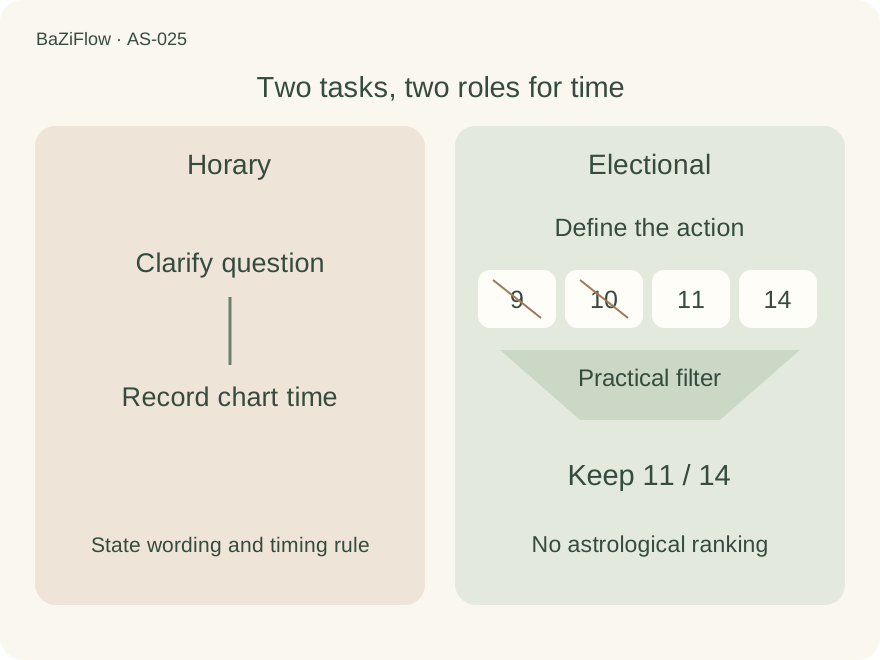
Original workflow illustration with invented schedule constraints. No ephemeris has been calculated and no lucky time is recommended.
The illustration stops at feasibility. It supplies no actual date, location or planetary positions, so it cannot establish that 11 is astrologically preferable to 14. To continue an electional exercise, specify the calculation settings and the criteria used to compare the surviving candidates. If not all preferred conditions can coexist, record the trade-off instead of implying that a perfect chart has been found.
A schedule constraint and an astrological preference should remain distinguishable. You can verify staff availability from the schedule. You cannot infer it from the Ascendant. The quality of the latter's interpretation does not repair a missing person or a locked room.
Time
09:00
- Staff
- Absent
- Space
- —
- Result
- Exclude
10:00
- Staff
- —
- Space
- Unavailable
- Result
- Exclude
11:00
- Staff
- Ready
- Space
- Ready
- Result
- Retain
14:00
- Staff
- Ready
- Space
- Ready
- Result
- Retain
A dash means unspecified here; an exclusion already has a reason
Separate the proposed time from what happened
Four records can be relevant without becoming interchangeable:
| Record | What its time refers to |
|---|---|
| Natal chart | A person's birth reference |
| Horary chart | The question under the selected timing convention |
| Electional candidate | A prospective action time being considered |
| Event chart | The recorded occurrence of the actual event |
Suppose bookings were scheduled to open at 11 but actually opened at 11:08. Keep both entries. The eight-minute difference is a checkable fact; a claim that it reverses the fate of the project is an additional interpretation. Do not erase the delay to preserve a narrative, or assume that every delay has a particular symbolic consequence.
The same care applies to repeated questions. Recasting until a pleasing chart appears does not provide independent confirmation. If circumstances genuinely change, document that change before deciding what new inquiry is appropriate. An unsatisfying interpretation alone does not make the original timestamp wrong.
Planned 11:00 · 0
0 min ↔ 10 min
- Plan: 0 min · 0
- Actual: 8 min · 8
Axis: minutes after 11:00; the two instants differ by 8 minutes
Evaluate the plan you made, without replacing its target
Before the session, the group might define its practical goals as opening bookings on time and sending confirmations reliably. Afterward, a pleasant atmosphere is useful feedback, but it should not replace those goals just because one was missed. Save the candidate list, reasons for the selection, actual start and the originally defined outcomes.
A successful event also has several possible contributors: clear instructions, prepared volunteers and available tools. Crediting the selected moment alone removes those known processes from the explanation. One satisfactory result cannot tell you exactly how the unused candidate would have turned out.
For the wider distinction between an author's rules and a broad school label, see traditional and modern astrology. The whole-chart reading guide offers a way to mark missing inputs before interpretation. The present example is a method comparison, not a completed election or a recommendation for a real event.
Define completion beforehand
Bookings open on time and confirmations are sent reliably.
Keep the actual process
Record opening at 11:08 and the reason for the delay.
Compare with the original target
Separate punctuality from participant experience instead of replacing the goal.
Questions readers ask next
Why distinguish horary and elections for the same activity?
Horary centers on a defined inquiry; an election treats the action time as a variable to choose. Asking whether a room will be available and choosing when to start an agreed session require different timing references.
Why do only 11:00 and 14:00 survive the example?
These are scheduling constraints: staff are absent at nine and the space is unavailable at ten. The other times satisfy the assumed basic conditions, but no date, place or planetary positions are supplied to rank them astrologically.
What should be done when the actual start is eight minutes late?
Retain planned 11:00 and actual 11:08 and explain the execution delay. Their difference is factual; neither erasing it nor assuming it reverses the outcome is justified by the clock values alone.
Was this article helpful?
Theme: Timing & action