

The Hermit: a lamp on a height
Content version · · Sources & references
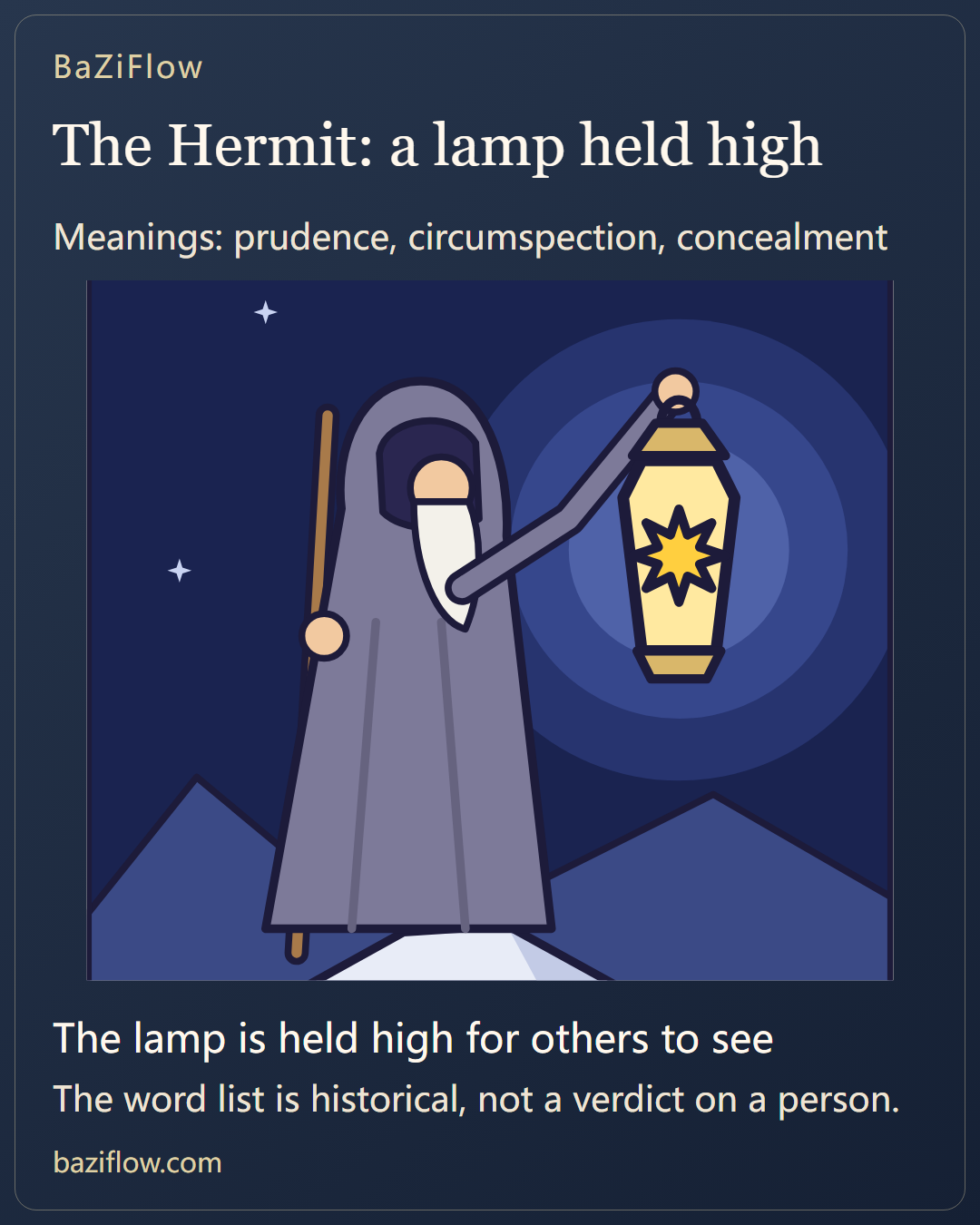
The Hermit raises a lantern with a star in it on a height. Separate Waite's picture, a lamp held in the open, from his list, which speaks of dissimulation, then practice "lamp, star, staff" on a talk with a neighbor.
The short version6 min read
The Hermit raises a lamp on a height and does not hide it in his cloak. Waite's picture and word list point in different directions here, so read them apart.
- The picture: the lamp is no longer wrapped in the mantle, and a star shines in it; he holds it up on an eminence, and Waite says it means "where I am, you also may be".
- The word list starts from prudence and swings to treason and dissimulation, marked "especially"; the reversed words end on a caution that has no reason behind it.
- Waite rejects several popular readings, among them "isolation to protect oneself". The practice: is the lamp uncovered, which matter is the star, where does the staff land.
Read first
On a height, with the lamp outside the cloak
Waite opens his comment on this card with how it differs from the usual models: in the conventional picture the lamp is partly enveloped in the mantle of its bearer; here it is not. The bearer blends the idea of the Ancient of Days with the Light of the World, and it is a star which shines in the lantern. He has said elsewhere that this is a card of attainment, and to extend that idea the figure is seen holding up his beacon on an eminence.
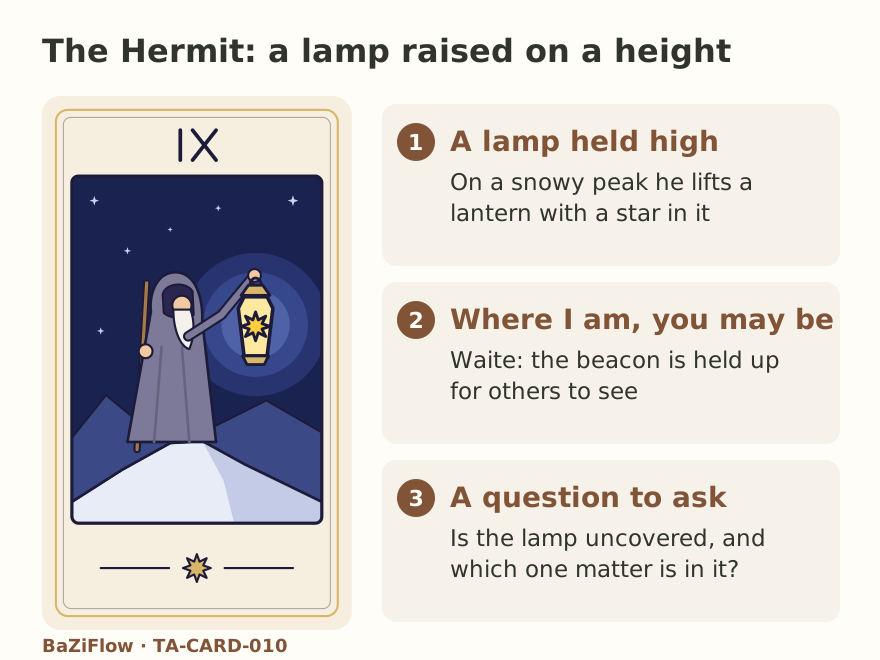
The Hermit: an old man raises a starlit lantern on a snowy peak.
Look closely at the original Rider-Waite-Smith card: the numeral IX at the top, a gray-blue sky, an old man in a long gray hooded cloak with a white beard. In one hand he has a long golden staff whose tip touches the snow; the other raises a lantern high in front of him, and it gives off light. There is snow at his feet and a low ridge of hills far off.
Enlarge diagram · scroll sideways to read
What Waite lists: prudence first, treason and dissimulation "especially" after
Waite's divinatory meanings read: prudence, circumspection; also and especially treason, dissimulation, roguery, corruption. Reversed: concealment, disguise, policy, fear, unreasoned caution.
Prudence, circumspection; also and especially treason, dissimulation, roguery, corruption. Reversed: Concealment, disguise, policy, fear, unreasoned caution.
Enlarge diagram · scroll sideways to read
The picture is about a lamp in the open, and the list moves from "prudence, circumspection" to "especially treason, dissimulation, roguery, corruption", all words about hiding. Both were written by Waite, who does not explain how they relate or how the listed words fit the picture.
Popular readings, and which ones Waite rejects
The Hermit is often read as a solitary sage or a person in retreat. Waite's Part II has some very direct words about this, worth taking one at a time.
Lamp, mantle and height: what Waite said
- The star in the lamp
- Waite says only that a star shines in the lantern, and does not say what it stands for.
- The mantle
- He says it is understood quite incorrectly when connected with occult isolation, as the protection of personal magnetism against admixture, one of the frivolous renderings owed to Éliphas Lévi and adopted by the French Order of Martinism. In true Martinism, he says, the phrase "unknown philosopher" meant that the Divine Mysteries secure their own protection from those who are unprepared.
- The lamp on a height
- He says the Hermit is not, as Court de Gebelin explained, a wise man in search of truth and justice, nor, as a later explanation proposes, an especial example of experience. His beacon intimates that "where I am, you also may be."
Enlarge diagram · scroll sideways to read
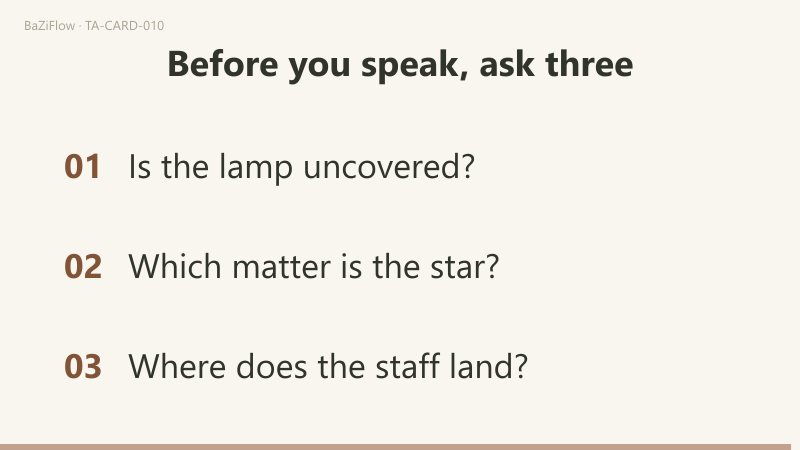
How to read it: clutter on a shared landing, three questions before you knock
The picture brings three things of its own: a lamp, the one star in the lamp, and a staff. Carry them to an everyday matter: a neighbor keeps a shoe cabinet and cartons on the shared landing, and you would like them moved, but do not know how to start.
Is the lamp uncovered?
Waite's one change is that the lamp is no longer wrapped. Has your view reached the other person? Venting in a group chat or keeping a tally in your head is a lamp inside the cloak; knocking once, or leaving a note that says which flat you live in, holds the lamp up.
Only one star in the lamp
Waite writes a star in the lantern. Bring one request at a time, in one sentence: "Could the shoe cabinet go inside your door?" The other grievances stay out of the lamp this time.
Where does the staff land?
The staff steadies the next step. Write the next step as something you can check: look again at the weekend, or ask which day suits. "Where I am, you also may be": the note says where you stand, and leaves the other person a place to walk to.
The three rows below match lamp, star and staff in order:
Enlarge diagram · scroll sideways to read
Before you speak to a neighbor: what the card sets down
What it helps with
- Seeing whether the lamp is covered
- Pressing the request into a sentence
What it cannot manage
- Whether they will agree
- Who is in the right
What you do
- Knock or leave a note
- Fix a day to look again
Reversed and neighboring cards: unreasoned caution, and three cards about light and silence
The reversed string is: concealment, disguise, policy, fear, unreasoned caution. The last is the only one that answers the upright "prudence" directly, and it adds a qualifier: no reason. That is something seen by comparing the lists; Waite does not explain it.
Light and silence: where neighbors put them
The list begins with "secrets"
Waite's list is secrets, mystery, the future as yet unrevealed, silence and tenacity. Both have to do with not saying, yet the Hermit's picture is a lamp shown to others.
Also a staff, a different stance
The Fool's staff carries a wallet and he pauses at an edge, with a sun that knows the way back; the Hermit stands on a height with a staff in one hand and a lamp in the other.
Light in the sky, or in the hand
The Star's list opens with loss and theft and, by another reading, turns to hope and bright prospects. Its star is in the sky, set off by the pouring figure; the Hermit's star is in a lantern, held up by a hand.
Enlarge diagram · scroll sideways to read
Questions readers ask next
Is the Hermit a card of solitude and retreat?
Waite says it is understood quite incorrectly when linked with occult isolation, as the protection of personal magnetism, and he calls that one of the frivolous renderings handed down from Lévi. His picture is a man holding a beacon on a height. "Retreat" is a later reading.
Why does the Hermit's list speak of treason?
Waite lists prudence and circumspection, then "also and especially" treason, dissimulation, roguery, corruption, and never explains how those words relate to the picture. Quote them apart: the picture as one layer, the list as another, with no smoothing over on his behalf.
Why is there a star in the Hermit's lamp?
Waite writes only that a star shines in the lantern and does not say what it stands for; the change he stresses is that the lamp is no longer enveloped in the mantle. Reading the star as guidance or hope is a later teaching borrowing.
Was this article helpful?
Sources & references
Continue reading
The High Priestess: seated between two pillars, her scroll half covered ↗
The Magician: one hand to heaven, one to earth, and a table to take stock of ↗