

Bi (賁): fire beneath the mountain, adornment to white
Content version · · Sources & references
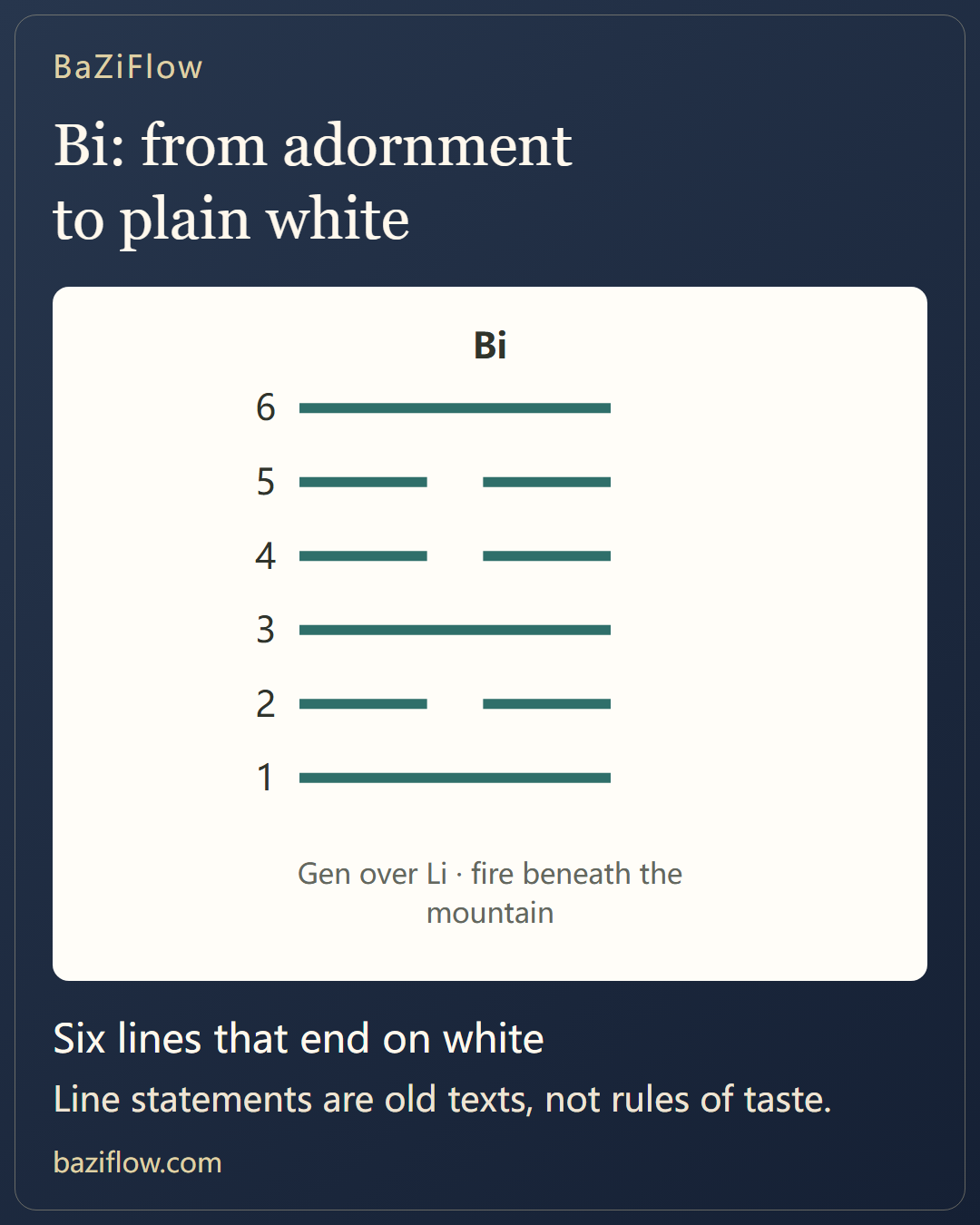
Bi (賁) is the 22nd hexagram, Tai with two lines exchanged. The Commentary on the Judgments separates the pattern of heaven from that of humankind; the statements run from toes to plain white, the only color named.
The short version8 min read
Bi (賁) literally means adornment, a different character from Bi (比) though they sound alike. The Commentary splits adornment into the pattern of heaven and the pattern of humankind, and the statements run from the toes and the beard to the hills and gardens, ending on "plain white".
- Bi stacks Gen (mountain) on Li (fire) and can be seen as Tai with its second and top lines exchanged; the Commentary on the Judgments' "the yielding comes and adorns the firm" and "the firm is parted off and goes up" point at those two lines.
- The Commentary says "firm and yielding cross: the pattern of heaven; brightness that stops: the pattern of humankind". The Great Image (大象) begins "beneath the mountain, fire" and ends on not daring to decide cases.
- The six statements adorn six places: toes, beard, a manner, a person, hills and gardens, and white. Line one "gives up the carriage", the top line is "plain white", and white is the only color word in the hexagram.
Read first
The Sixty-Four Hexagrams: How Upper and Lower Trigrams Form One Figure ↗
Judgment and Line Statements: Whole Hexagram or Single Line? ↗
Fire beneath the mountain: Tai with two lines exchanged
Bi (賁) is the 22nd hexagram: Li (fire) below, Gen (mountain) above, so the mountain stands over the fire. The word means adornment and is not the Bi (比) of the eighth hexagram, which has a different character. The Shuo Gua says "Gen is stopping" and "Li is clinging": the fire clings to the foot of the mountain, and the mountain holds it from going higher. Yang occupies places one, three and six; yin takes places two, four and five.
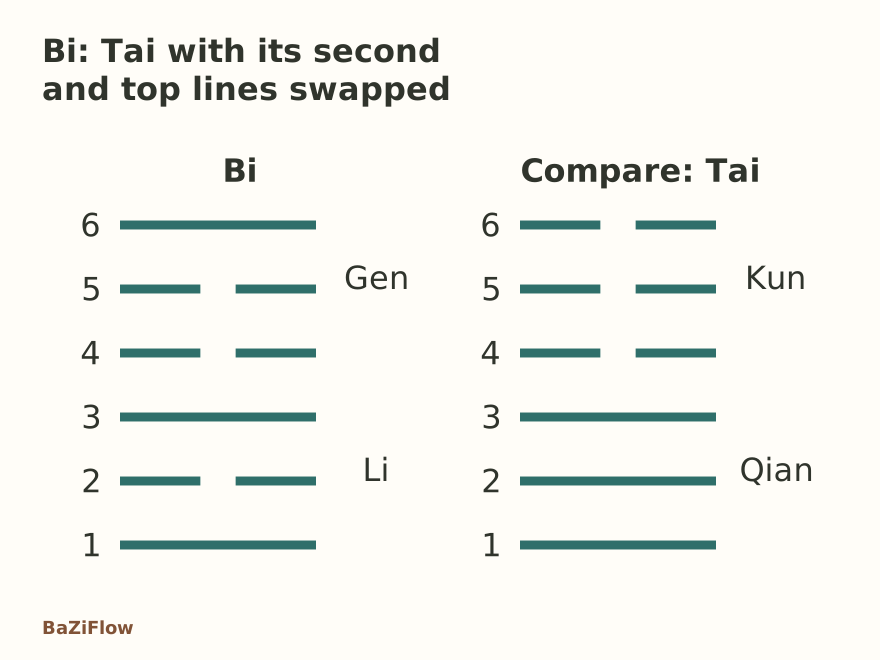
Bi beside Tai: exchange the second and top lines of Tai and you get Bi.
Enlarge diagram · scroll sideways to read
Three terms before reading Bi
- Bi
- Adornment, decoration. The Xu Gua explains it with one word: "adorning".
- Pattern
- The word wen: a design, a texture, and by extension refinement or civilization. The "pattern of heaven" and "pattern of humankind" in the Commentary use this same word.
- Li and Gen
- Li is clinging and brightness, Gen is stopping. The Commentary joins them in one phrase: "brightness that stops".
The figure above sets Bi beside Tai. Tai has three yang lines below and three yin lines above; exchange the second and top lines and the result is Bi. The Commentary on the Judgments has two sentences that match this.
The judgment and the Commentary: the pattern of heaven, the pattern of humankind
The judgment is brief:
Success. A little gain in going on.
A little gain means just a little. The Commentary first gives the reasons, and then splits the word "pattern" into two layers:
Bi: success. The yielding comes and adorns the firm, therefore success. The firm is parted off and goes up to adorn the yielding, therefore a little gain in going on. Firm and yielding cross: this is the pattern of heaven. Brightness that stops: this is the pattern of humankind. Observe the pattern of heaven to read the changes of the seasons; observe the pattern of humankind to transform and complete the world.
Some editions have the four words "firm and yielding crossing" before "the pattern of heaven", and the quotation above follows that reading.
"The yielding comes and adorns the firm": a yin line arrives among the yang lines and gives the firm a pattern, hence success. "The firm is parted off and goes up to adorn the yielding": a yang line leaves, goes up to the top and gives the yielding a pattern, so the gain is only a little. A common reading puts these two sentences onto the figure: the top yin line of Tai comes to the second place and the second yang line goes up to the top, and that is Bi.
Then the Commentary changes subject. Yang and yin crossing is the "pattern of heaven", the markings of the sky; the brightness of Li together with the stopping of Gen is the "pattern of humankind", the markings of human life. "Observe the pattern of heaven" is for reading the changes of the seasons, and "observe the pattern of humankind" is for transforming the world. The verb "observe" is the same character as in Guan.
Enlarge diagram · scroll sideways to read
The Great Image: fire beneath the mountain, dare not decide cases
The Great Image ends on two matters of government:
Beneath the mountain there is fire: Bi. The noble person accordingly makes the many affairs of government clear, and does not dare to decide criminal cases.
"The many affairs" are the everyday tasks of government, and "to decide cases" is to judge criminal matters. A fire beneath a mountain lights only a limited area; a common reading is that such a light is enough to make routine affairs clear but not enough for deciding cases. So half of the line is "make clear" and half is "dare not".
Enlarge diagram · scroll sideways to read
The two hexagrams are each other's reversal: turned over, the fire goes from above to below, and the words of the Image turn with it. Read this way it is no surprise that one subject yields opposite sayings: each follows its own image.
The six statements: where the adornment sits, and where it ends
Each of the six statements contains the word Bi, and the place that is adorned changes from line to line.
Enlarge diagram · scroll sideways to read
Line one adorns the toes, but its second half is "he gives up the carriage and goes on foot": the carriage is set aside and he walks. The Small Image says "it is right not to ride". Line two, "adorning his beard", adorns what moves along with the chin, so the Small Image says "it rises together with what is above". Line three, "adorned, glossy-looking": the second word is moist, shiny. The statement goes on "lasting steadfastness, good fortune", and the Small Image says "in the end no one overrides him".
Line four reads most like a scene: "Adorned, plain white; a white horse comes winging; not a raider, but a suitor." The word for plain white is simply white; the last word of the horse phrase is traditionally taken as swift as flight; and the one who comes is "not a raider, but a suitor". The Small Image divides in two: "in its proper place, yet doubtful", a yin line in the fourth place, and "in the end there is no fault". Line five, "adorning the hills and gardens", is plain ground; "a bundle of silk, small and scant", where the last word is generally read as slight; "regret, but good fortune in the end", and the Small Image says "there is joy". The top line is just "plain white adornment, no blame", and its Small Image says "above, he attains his aim".
Neighbors of Bi: Shihe, Kun, Xie, and "adorning" in the Xu Gua
Turn Bi upside down and you have Shihe (噬嗑), so the pair are each other's reversed hexagram. Flip all six lines and Kun (困) results; the nuclear hexagram of Bi is Xie (解), and its derivation is laid out in the structure of a hexagram.
The Xu Gua attaches Bi to Shihe in this way:
Things must not just be joined carelessly; so Bi follows. Bi means adorning.
Joining alone is not enough; it should not be mere casual joining, so adornment is needed. After that, the Xu Gua says that once adornment is pushed to its limit the road runs out, and what follows is Bo (剝).
Enlarge diagram · scroll sideways to read
Questions readers ask next
How is the name pronounced, and how does it relate to Bi (比)?
In this hexagram the character reads bi and means adornment; the Xu Gua glosses it with a single word, "adorning". The other hexagram called Bi uses a different character with a different meaning. This site tells them apart by the original character and by number.
Does "plain white adornment" mean white decoration?
Literally it is a white adornment. The top line gives only those words plus "no blame", and the Small Image (小象) says "above, he attains his aim". It is the only line that names a color apart from line four's white, so it is best read against the whole hexagram.
Do "dares not decide cases" and the Shihe Image contradict each other?
The two Images do say opposite things, but each rests on its own image: in Shihe thunder and lightning, with fire above, and in Bi fire beneath a mountain. Tradition usually reads each by its image, so they do not collide.
Was this article helpful?
Sources & references
Continue reading
Shihe: something in the mouth, from "shackle over the toes" to "cangue over the ears" ↗
Bo: a mountain on the earth, from "stripping the bed legs" to "a great fruit uneaten" ↗
The Sixty-Four Hexagrams: How Upper and Lower Trigrams Form One Figure ↗
Judgment and Line Statements: Whole Hexagram or Single Line? ↗