

Orientation and reversal rules
Content version · · Sources & references
Compare three different reversal patterns in Waite’s text, then test an interpretation against a concrete question. Keep a recorded orientation separate from the rule used to interpret it.
The short version7 min read
A reversal first records an orientation; its interpretation depends on a chosen convention. Waite’s Sun, Wheel and World offer different patterns. Compare them to test a universal opposite rule, then let real information test a specific application.
- Reduced degree for the Sun, increase for the Wheel and stagnation for the World show that Waite supplies no universal negation formula.
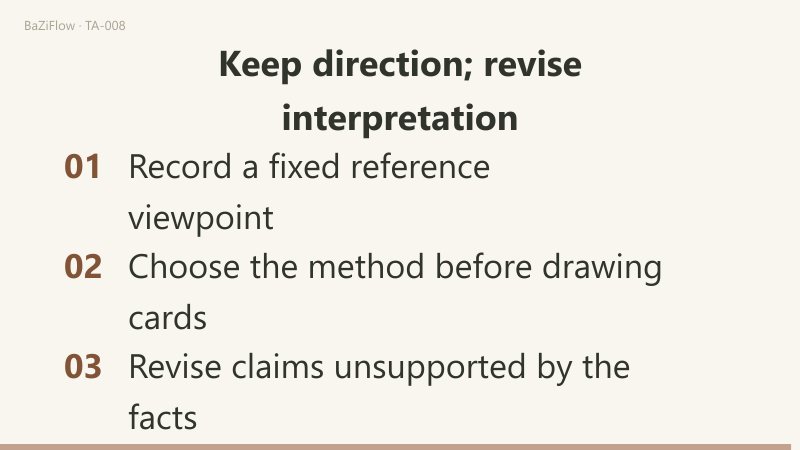
- Record orientation from a fixed reader’s viewpoint and decide before drawing whether reversals are part of the exercise.
- Check a concrete hypothesis against actual information. When unsupported, revise the interpretation while retaining the original card orientation.
Read first
Now test whether the handbook supplies one universal operation
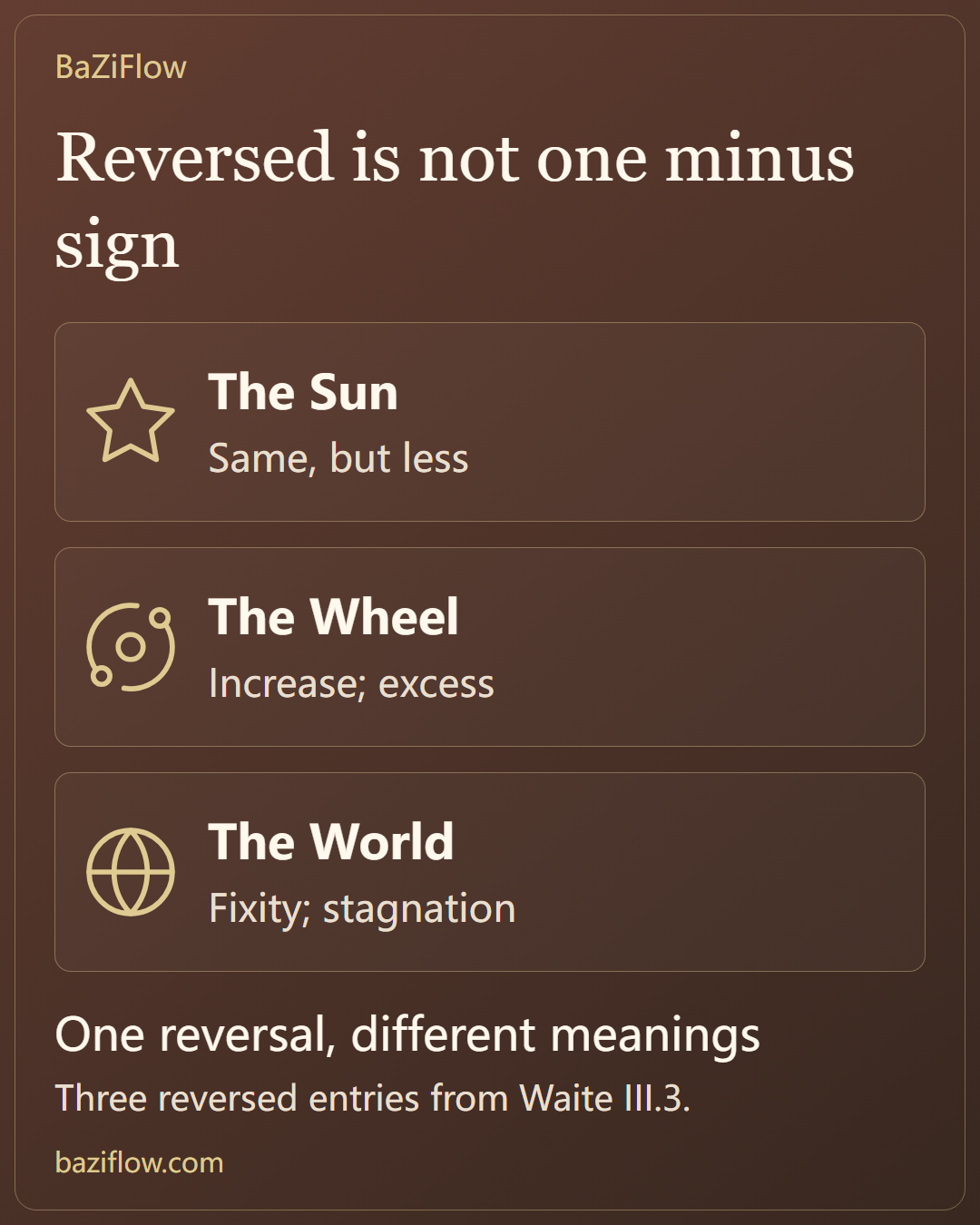
Suppose the rule is “a reversed card means the opposite of its upright meaning”. It sounds economical, but it should survive a comparison with the text it claims to summarise. In Part III, section 3 of Waite's 1911 Pictorial Key, the reversed Sun retains the same kind of meaning in a diminished degree. That is a change in intensity, not a complete logical negation.
The reversed Wheel of Fortune includes increase, abundance and excess, while the reversed World includes inertia, fixity and stagnation. These are authorial assignments, not demonstrated facts about future events. For our limited purpose, however, they provide enough variation to reject a single “turn it upside down and reverse everything” formula. Nor can the Sun's example be stretched into a claim that every reversed card is simply weaker.
| Entry in Waite's major-card list | What it tests |
|---|---|
| Sun, reversed | Reduced degree need not mean the opposite |
| Wheel of Fortune, reversed | Increase is not automatically a negative value |
| World, reversed | Stagnation is a different pattern from simple reduction |
The comparison is deliberately narrow. It is not a complete card dictionary, and it does not tell you what will happen in a particular situation. Its job is to make a proposed general rule answer to specific counterexamples.
Sun
- Same kind
- Less degree
Wheel
- Increase
- Abundance
World
- Fixity
- Stagnation
Waite III.3 reversal excerpts: one orientation, different interpretive patterns
What can a photograph of the table establish?
A photograph sent to a study partner may show the cards clearly while leaving the reader’s seat outside the frame. Before discussing a reversal, identify the viewpoint used for the record. Rotating the photograph to make it easier to read does not necessarily change the original orientation. If nobody recorded the reference direction, the image alone may not settle it.
The physical record can say that a card was upside down relative to the reader. The interpretation then depends on a convention. These are separate layers. Another person looking across the table sees the opposite orientation, but that does not automatically change the recorded reading. A card rotated during reveal may also end up in a direction different from the one it had in the pack.
Decide whether reversals are being used before drawing. An upright-only observation exercise is a coherent choice when labelled as such; it does not discard half of reality. A reversal convention is a reading condition, not an extra physical fact discovered inside the card. Equally, adding reversals does not in itself demonstrate greater accuracy.
Record the choice alongside the selection and handling procedure in your draw notes. If the original orientation was lost, write “unknown” rather than reconstructing it from the meaning you would prefer. An honest gap in the record is more useful than a precise but invented direction.
Not rotated
Relative to initial direction
Half-turn
Relative to initial direction
These are rotation angles, not a scale from favourable to unfavourable meaning
Choose one interpretive route and name it
One route is textual: consult the specified author's entry for the exact card and edition. Another is an exercise in degree: ask where a theme appears only partly expressed or limited. A third is question-led: use the image to propose a condition that can be checked in the situation. The last two are optional exercises presented here, not claims that Waite defined every reversal in those terms.
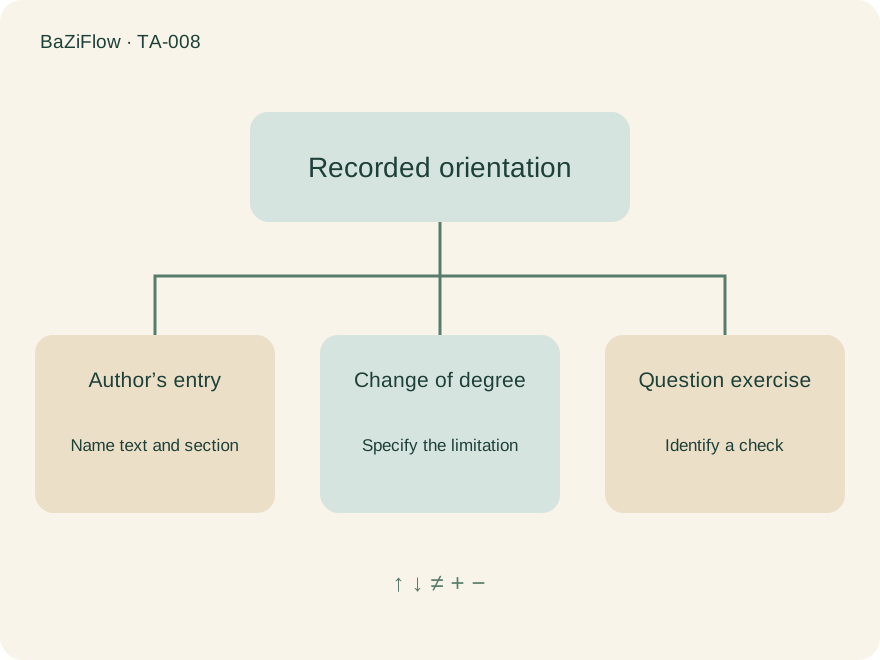
Original BaZiFlow method map. The branches distinguish reading conventions; they do not claim that card orientation causes events.
These routes are not a menu from which to pick whichever answer happens to fit after the event. If a reversal means excess when there is too much, shortage when there is too little, hidden activity when nothing is visible, and the opposite whenever necessary, it becomes difficult to say what the interpretation actually commits to. A longer list of possibilities is not necessarily a more informative reading.
State the rule, connect it to the position and visible material, and leave unsupported possibilities unused. It is acceptable to conclude that the chosen route produces no useful interpretation in this instance. You do not have to rescue every draw with an alternative vocabulary.
A booking question can survive a failed interpretation
Suppose an original practice exercise asks, “What information should our group confirm before using the exhibition room?” A position has already been assigned to outstanding preparation. A reader chooses to treat a reversal as a prompt to check an incomplete arrangement. The resulting claim is specific: perhaps the booking has not been confirmed.
Look at the booking acknowledgement and its date. If confirmation is missing, that document check identifies the gap. If the acknowledgement explicitly confirms the agreed room and time, the proposed gap is unsupported. Do not preserve the reading by quietly changing “unconfirmed booking” into “the group is inwardly unprepared”. The latter would require different information from the people concerned.
The card need not be turned over or redrawn to record this outcome. Its orientation remains an observation; the booking hypothesis is a claim that the document failed to support. The group can still check access arrangements for practical reasons, but those new questions should be named as new questions rather than evidence that the initial claim was secretly correct.
This is a reflective exercise created for the article, not an episode from Waite’s book. It does not demonstrate that a reversed card detected an administrative problem. The distinction matters even when a prompted check happens to be useful: usefulness of a question and accuracy of a prediction are different claims.
Actual check
Booking acknowledgement
- Observed result
- No confirmation found
- Hypothesis status
- Further confirmation needed
Booking acknowledgement
- Observed result
- Room and time confirmed
- Hypothesis status
- Missing-booking claim unsupported
Not checked yet
- Observed result
- Status unknown
- Hypothesis status
- Cannot settle hypothesis
Keep disagreements between texts visible
After listing additional minor-card meanings in Part III, section 4, Waite remarks on their frequent disagreement with earlier entries and their modification by position in a sequence. His own discussion gives a reason to preserve chapter and context rather than flatten every statement into one consistent-looking keyword table.
When two books differ, note which deck, edition, author and method each uses. Do not resolve the disagreement merely by calling your preferred wording the universal original meaning. A source may establish that an author printed a claim; it does not establish that the claim is an accurate description of your circumstances.
A review sheet can separate card and orientation, chosen rule, interpretation, and later information. Revise the interpretation when new evidence warrants it, while preserving the original record. This is especially important when moving between deck systems: names, numbering and accompanying texts should be checked rather than assumed interchangeable.
Upright cards can involve difficulty, and reversed cards need not be verdicts of failure. Once the direction has been given an appropriately limited role, reading cards in relation can address the more interesting question of how distinct images and positions contribute to a coherent discussion.
Retain orientation
The recorded direction stays when an interpretation changes.
Identify the method
Keep different chapters distinct even within one author.
Revise the specific claim
Use later information to state which claim gained support.
Questions readers ask next
Why is the reversed Sun not the complete opposite of the upright Sun?
Waite’s III.3 retains the same kind of meaning in a lesser degree. That changes intensity without negating the category. The Wheel and World use different terms, so the Sun’s pattern cannot become a universal rule for every reversal.
Does an upright-only exercise omit half the information?
It chooses a reading convention while leaving figures, actions, objects and positions available for discussion. Orientation is a physical record; reversed meanings are interpretive rules, not a measured half of all facts about reality.
What if a reversal suggests a missing booking that is already confirmed?
Mark the specific missing-booking hypothesis as unsupported and keep the card and orientation. An inner readiness claim is a different question requiring participants’ accounts, not a substitute that makes the first claim unfalsifiable.
Was this article helpful?