

Shihe: biting through what is in the mouth
Content version · · Sources & references
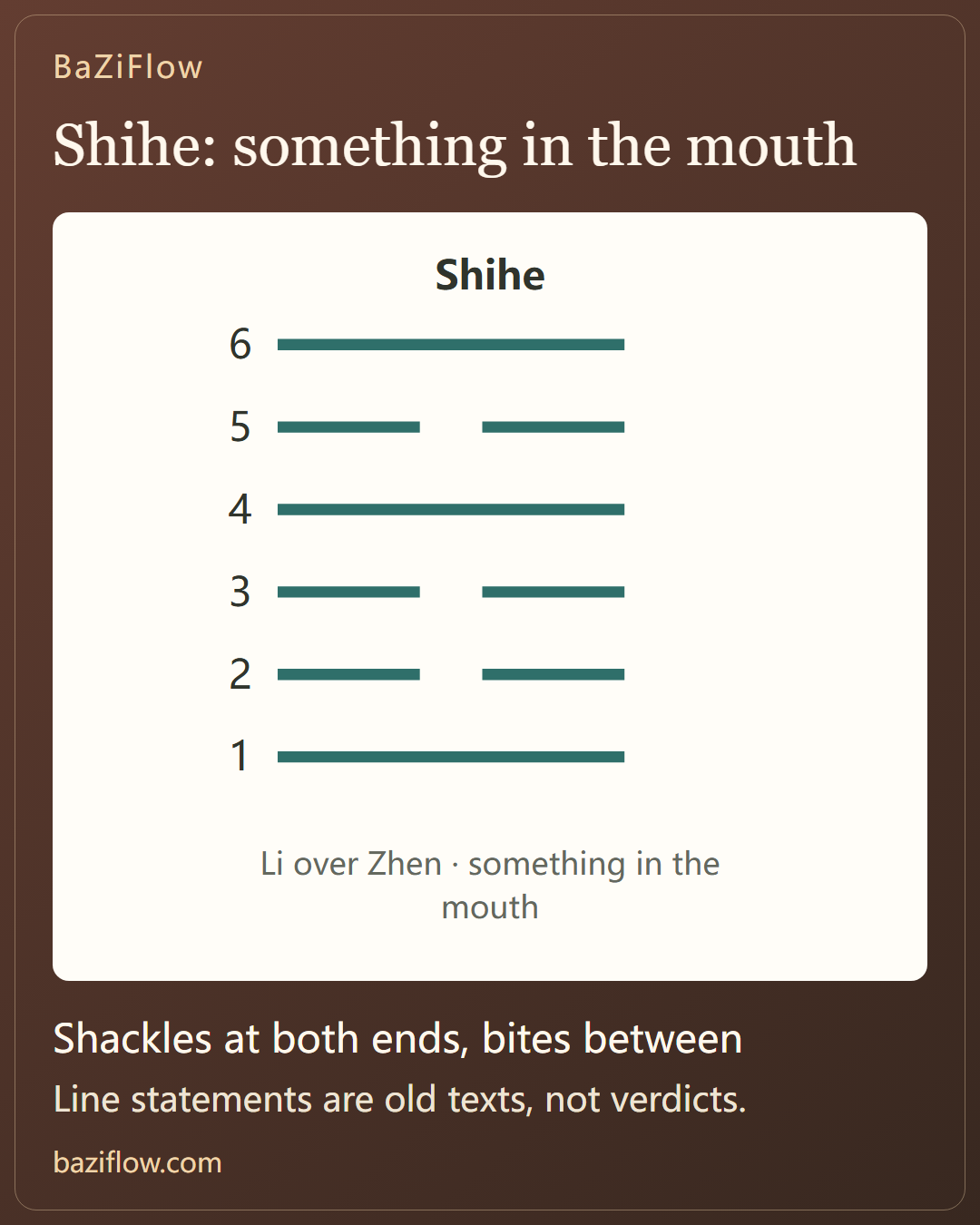
Shihe is the 21st hexagram: Li above Zhen, the mouth hexagram Yi with one more yang line. The judgment is four characters; in the lines the two ends wear shackles and the middle four bite skin, cured meat and dried meat.
The short version7 min read
Shihe literally means biting together. The Commentary reads the figure first, as a mouth with something in it; the statements run from a shackle on the feet to a cangue on the shoulders, with four bites in between.
- Shihe (噬嗑) stacks Li (fire) on Zhen (thunder) and differs from the mouth-shaped Yi (頤) by one yang line at place four. The Commentary opens with "something in the jaws"; shi is to bite and he is to close together.
- The judgment is "success; fitting for handling legal cases". The Commentary adds "it moves and is bright, thunder and lightning join", and the Great Image (大象) has the ancient kings make penalties clear and put laws in order.
- In the statements line one and the top line each wear a restraint, while the four lines between bite skin, cured meat, bone-in dried meat and dried meat. The Commentary calls line five "not in its place", yet its Small Image (小象) says "he gets what fits".
Read first
The Sixty-Four Hexagrams: How Upper and Lower Trigrams Form One Figure ↗
Judgment and Line Statements: Whole Hexagram or Single Line? ↗
Something in the mouth: fire over thunder, a figure shaped like a mouth
Shihe (噬嗑) is the 21st hexagram: Zhen (thunder) below, Li (fire) above. The yang lines are at the first, fourth and top places; the yin lines at the second, third and fifth. The Shuo Gua says "Zhen is moving" and "Li is clinging", and Li also stands for brightness.
Look first at the lowest and the top lines, both yang with a row of yin between them: that is the outline of Yi, the open mouth, with the two yang lines as the upper and lower teeth. Shihe is Yi with one more yang line at place four: something has been put in the mouth.
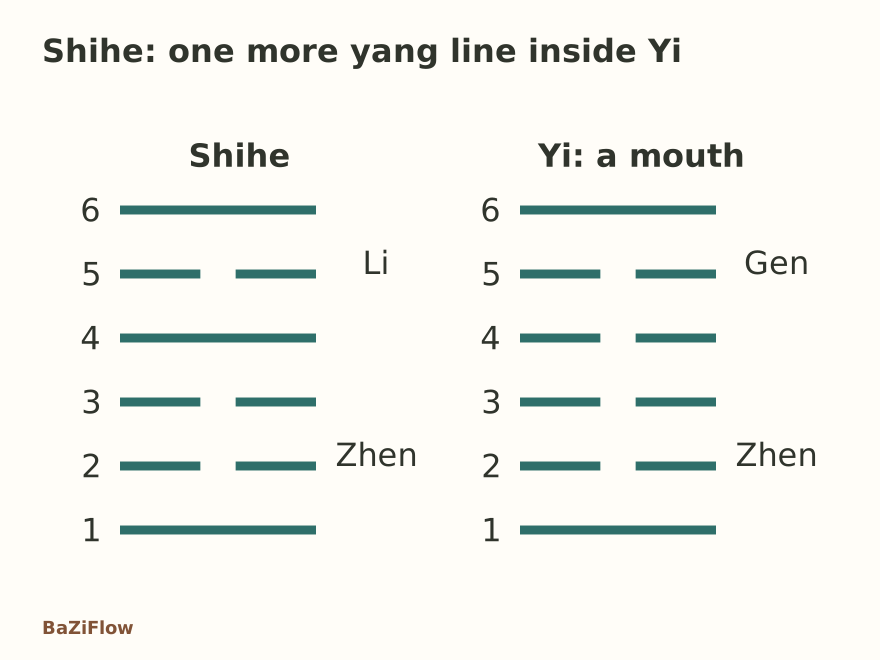
Shihe beside Yi: Yi is a mouth, and Shihe has one more yang line in its fourth place.
Enlarge diagram · scroll sideways to read
Three words in the name
- Shi
- To bite. The statements list what is bitten one item at a time: skin, cured meat, bone-in dried meat, dried meat.
- He
- To bring the jaws together. With something stuck in the mouth, the mouth can shut only after it is bitten through.
- Yi
- The cheeks, and so the mouth. Yi is the 27th hexagram; only its two end lines are yang, so the figure itself is a mouth.
The judgment and the Commentary: four characters, then the figure
The judgment is brief:
Success. Fitting for handling legal cases.
The word for "legal cases" means cases and punishments, so the judgment says the hexagram suits dealing with matters of that kind. Nothing more is said in the four characters, and the Commentary on the Judgments supplies the figure and the reason:
Something in the jaws: this is called Shihe; biting through, there is success. The firm and the yielding are distinct; it moves and it is bright; thunder and lightning join and shine forth. The yielding gains the center and goes up; though it is not in its proper place, it is fitting for handling legal cases.
The Commentary takes the name from the figure: something is "in the jaws", hence Shihe, and once it is bitten through there is passage, hence "success". "The firm and the yielding are distinct" describes yang and yin lines set apart in the figure; "it moves and is bright" is Zhen below moving and Li above shining; "thunder and lightning join" puts the two images together, and the last word means they become plain to see. The final sentence looks at line five: it is a yin line at the center of the upper trigram, so "the yielding gains the center and goes up". But the fifth place is a yang place and a yin line sits on it, hence "not in its proper place", and still "fitting for handling legal cases".
Enlarge diagram · scroll sideways to read
The Great Image: thunder and lightning, clear penalties, ordered laws
The Great Image is a single line:
Thunder and lightning: Shihe. The ancient kings accordingly made penalties clear and put the laws in order.
This Image does not say "something above something"; it goes straight to "thunder and lightning", and the subject is "the ancient kings". To make penalties clear is to state them plainly, and to put the laws in order is to set the statutes straight. Thunder startles and lightning lights things up; together they give the kings two tasks, penalties that are clear and laws that are in order.
Enlarge diagram · scroll sideways to read
The next hexagram, Bi (賁), says the opposite about the same kind of matter in its Image, "dare not decide cases"; it is left for that article.
The six statements: shackles at both ends, bites in the middle
Of the six statements, line one and the top line are not biting anything; each wears a restraint. Only the four between them do the biting.
Enlarge diagram · scroll sideways to read
Line one: "feet in shackles, the toes covered: no blame". The restraint is of wood and fits the feet, hiding the toes; the Small Image says "he cannot walk". The top line: "carrying the cangue, the ears covered: misfortune". The cangue sits on the shoulders and covers even the ears, and the Small Image says "his hearing is not clear". Three statements in the hexagram speak of something being covered: the toes in the lowest line, the ear in the top line, the nose in the second line between them, and the three parts run from low to high.
The four middle lines bite different things. Line two bites skin, soft flesh, so deeply that the nose sinks into it, and the Small Image says "it rides on the firm": this yin line sits on the yang line of line one. Line three bites old cured meat, which some sources write with a different character (昔, "old"), and the result is that he "meets poison"; the Small Image says "the place is not fitting". Line four bites dried meat on the bone and "finds metal arrows", with "fitting to stay on course in hardship: good fortune"; the Small Image says "not yet bright". Line five bites dried meat and "finds yellow gold": "staying on course in danger: no blame", and the Small Image says "he gets what fits".
Neighbors of Shihe: Bi, Jing, Jian, and "joining" in the Xu Gua
Turn Shihe upside down and you have Bi (賁), so the two are each other's reversed hexagram. Both keep yang lines at the two ends. Shihe puts its extra yang line at place four and Bi puts it at place three. Flip the polarity of all six lines and Jing (井) results. The nuclear hexagram is Jian (蹇); the structure of a hexagram shows where it comes from.
Enlarge diagram · scroll sideways to read
The Xu Gua attaches Shihe to Guan (觀) with this sentence:
Once there is looking, there is something to bring together; so Shihe follows. Shihe means joining.
Looking comes first and joining after it; the joining of Shihe is the jaws closing. As for what follows, the Xu Gua says that joining cannot stop at mere joining, so adornment, Bi, comes next.
Questions readers ask next
What do the two words in Shihe mean?
Shi is to bite and he is to bring the jaws together. First something sits in the mouth, then it can be bitten through and the mouth closed; the Xu Gua also glosses he simply as "joining".
Does "fitting for handling legal cases" say that the hexagram suits a lawsuit?
The word means cases and punishments here. The judgment gives only those few words, and the Commentary hangs it after "the yielding gains the center and goes up" without developing it. It sums up the matter the hexagram deals with, and should not be taken as advice to the reader.
Line one and the top line both wear a restraint. How do they differ?
Both statements use the word for a wooden restraint: in line one it is on the feet and covers the toes, in the top line it is carried on the shoulders and covers the ears. One is low, one high, and the verdicts differ accordingly, "no blame" for the first and "misfortune" for the last.
Was this article helpful?
Sources & references
Continue reading
Guan: wind over the earth, from "washed but not yet offered" to "observing my own life" ↗
Bi (賁): fire beneath the mountain, from "adorning the toes" to "plain white adornment" ↗
The Sixty-Four Hexagrams: How Upper and Lower Trigrams Form One Figure ↗
Judgment and Line Statements: Whole Hexagram or Single Line? ↗