

Upper and lower lot grades
Content version · · Sources & references
Separate grades, textual conditions, and observed results through a ten-entry exercise, without turning religious exhortation into a personal verdict.
The short version6 min read
A grade classifies a text; an outcome records what happens. Keep the edition and wording visible, and name the objects counted before interpreting a percentage.
- Upper labels are not successful events and lower labels are not failed events.
- Six over ten counts catalog labels and entries, with no outcome observations supplied.
- A religious exhortation does not establish a moral cause for someone else’s difficulty.
Read first
Turn a vague oracle-lot concern into one focused question ↗
Read the poem, allusion, and commentary as distinct layers ↗
A grade is not an observed outcome
A favorable label and a successful event are different kinds of information. The first belongs to a text or classification; the second belongs to what happened in the world. Reading an upper lot as guaranteed success silently substitutes one for the other. Reading a lower lot as inevitable failure makes the same substitution in the opposite direction.
Keep three questions separate: how does this edition label the lot, what does its wording actually say, and what later happens in the matter asked about? They can be recorded together without one answering all three. A screenshot containing only the grade removes precisely the context needed to distinguish them.
Grade
- Text classification
Wording
- Specific conditions
Outcome
- Observed event
Keep the numerator and denominator identified
- Label share
- The number of entries with a label divided by all recorded entries.
- Observed outcome
- What later happens in a defined real-world matter, collected separately.
A sixty-percent label count does not predict sixty-percent success
Consider ten invented catalog entries made solely for this exercise. Six are labeled upper and four lower. This is not a count from a real temple collection, and it does not imply that actual collections have only two grades. The record includes neither a drawing mechanism nor real-world outcomes.
| Invented entries | Count | What can be calculated | What was not recorded |
|---|---|---|---|
| Upper labels | 6 | 6 / 10 = 60% of entries | Successful events |
| Lower labels | 4 | 4 / 10 = 40% of entries | Failed events |
| All entries | 10 | 100% of the catalog exercise | Draws and subsequent outcomes |
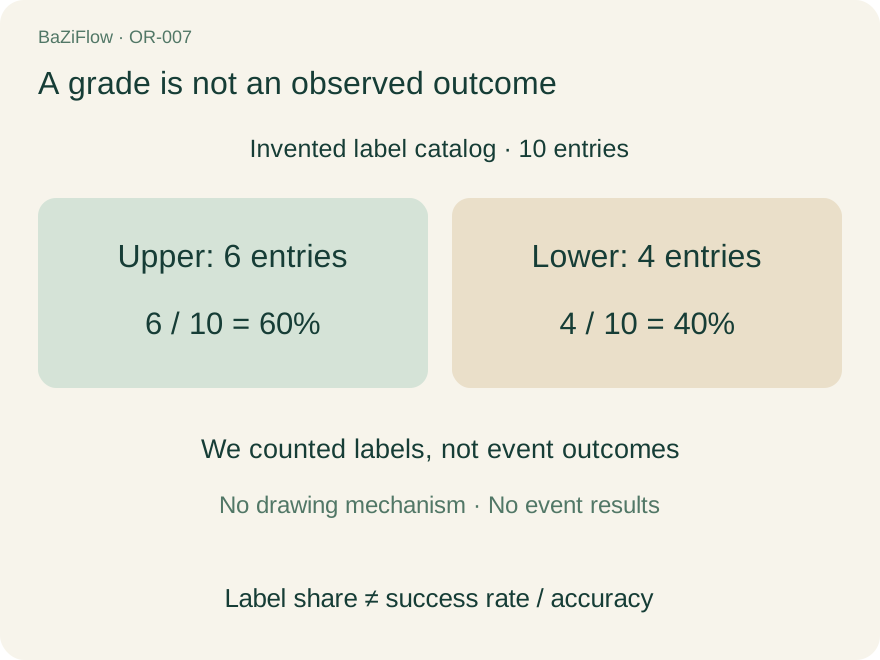
Original BaZiFlow denominator exercise. The invented counts do not describe any temple's actual lot distribution.
The numerator counts labels, not successes. The denominator counts entries, not future comparable events. Calling the resulting sixty percent a success rate would change the meaning of both. Correct arithmetic cannot repair that change of subject.
Even a chance of drawing an upper label cannot be established from this table alone. We have not specified whether entries are equally likely to be drawn, whether some are repeated, or whether the record is selected. A drawing probability, if properly defined, would still be distinct from the probability of an outside event.
There is also no prediction-accuracy calculation here. No predictions with defined targets have been paired with observed outcomes. The example is deliberately small because the conceptual error does not require a large dataset to expose: a label frequency is being asked to answer a question about something it never measured.
6 / 10
Invented catalog: six upper and four lower labels
Keep the grade attached to its edition
The Chinese Temples Committee's editorial introduction includes grades among the fields in which it considered version differences, and describes its presentation as a reference supplement rather than an attempt to unify all versions. A grade should therefore be cited with the particular material being read, not detached from its source and treated as a universal value for that number.
An ordinal-sounding label is not automatically a numerical scale. Assigning 100 to upper and zero to lower introduces a new scoring system; those numbers are not already contained in the words. Averaging such scores can create a false impression of precision when the meaning of the distances between them has never been justified.
The wording also matters within one grade. Conditions, qualifications, and changes of direction in a poem cannot be deleted simply because the heading sounds favorable. Poem, allusion, and commentary explains how to keep the component texts visible rather than treating the grade as a replacement for the whole page.
Original labels
- Upper / lower
Added scores
- 100 / 0
Probability
- Requires a defined model
Religious exhortation is not a verdict on the person
Senso-ji's FAQ discourages fear of an unfavorable result and frames a constructive response in terms of patience and sincerity. Hsing Tian Kong's explanation links the reading to conduct, caution, and reflection. These are the named institutions' religious perspectives, not an empirical prediction model validated by this article.
They should not be reversed into an accusation that anyone encountering difficulty must have behaved badly. A person's circumstances cannot be morally diagnosed from a lot grade. Preserving the religious context of an exhortation is different from claiming that it supplies a demonstrated causal account of another person's setback.
A favorable lot likewise cannot fill a missing fact. An unanswered invitation remains unanswered; a timetable conflict remains a conflict until something actually changes. An unfavorable grade does not remove every adjustable condition or erase the value of obtaining information. The useful distinction is between the symbolic reading and the concrete facts still available to check.
Favorable label
- Still to check
- Has the person replied?
Unfavorable label
- Still to check
- Which conditions can change?
Do not enlarge a narrow question into a lifetime forecast
Suppose the recorded concern is whether a particular course enrollment fits the current schedule. Turning a lower label into “I am unsuited to learning for life” changes both the timeframe and the subject. Turning an upper label into “I will pass every future examination” does the same. Return to the original question before accepting either expansion.
A reading note can retain the exact grade, the relevant wording, the reader's interpretation, and the practical information still missing. If the reader changes an arrangement, identify the real conditions informing that change rather than attributing every decision to the label. This makes it possible to see where reflection ends and an additional claim begins.
When sharing the reading, include its question and source where appropriate. Context does not guarantee accuracy, but it prevents a two-word label from being mistaken for a complete judgment about a life. Private identifying details are not needed to explain the scope of a textual exercise.
An unresolved conclusion can remain unresolved
There is no obligation to convert every reading into either certainty of success or certainty of failure. Keep an uncertain point uncertain. If the urge is simply to replace an unwelcome grade with a preferred one, preserve the earlier text and notice the changed expectation; repeated drawing addresses that follow-up issue.
Grades can retain a place within religious reading without being promoted into outcomes, scores, or calibrated probabilities. The task is to read the classification with its wording and context, then keep observations about the world in their own evidential category.
This course intake
- A bounded arrangement
Unable to learn for life
- A different, enlarged claim
Identify six and ten
Six upper labels among ten catalog entries gives 60% of the invented record.
Correct one classification
If checking the material shows one upper entry should be lower, the counts become five and five; the total remains ten and the share becomes 50%.
Keep outcomes unchanged
Correcting a catalog label has not turned an observed success into a failure. No event outcomes were collected in this exercise.
Questions readers ask next
Does six upper entries establish the chance of drawing one?
Not without a drawing mechanism, relative selection chances and information about repetition or selection of the record.
May upper and lower be coded as 100 and zero?
That can be declared as a chosen code, but it is not a scale already contained in the labels or a calibrated success probability.
Does an exhortation explain why someone suffered a setback?
Not by itself. A religious perspective is not evidence identifying the moral character or the causal circumstances of another person.
Was this article helpful?
Part of a learning path
Sources & references
Continue reading
Why the same oracle-lot number can have different versions ↗
Turn a lot reading into checkable reflection without moving the goal ↗