

Checking an allusion source
Content version · · Sources & references
Trace a Fan Zhongyan story from a temple magazine to examined historical passages, distinguishing supported details from an unresolved four-portion claim.
The short version6 min read
Start with the sentence you want to support. A matching name or respected book title may locate useful material, but actions and quantities still need their own textual basis.
- The modern magazine identifies a lot heading; historical passages support particular narrative claims.
- Study, porridge and four portions are separate claims even when combined in one sentence.
- Repeated copies may share one source, and absence from a passage is a bounded finding.
Read first
Recording an oracle-lot source: identifiers, dates, and gaps ↗
Read the poem, allusion, and commentary as distinct layers ↗
“Not in this passage” is a useful finding
Checking an allusion does not always end with a complete origin story. Sometimes the useful result is narrower: the passage supports hardship and study, but not a particular detail about how a bowl of porridge was divided. Preserving that boundary is more accurate than attaching a prestigious book title to an entire modern retelling.
Our example begins with the Lungshan Temple magazine, issue 43, dated January 2019. Its article introduces lot eight through the Fan Wengong porridge story. This identifies the story heading used by that modern explanation. It is not a contemporary record of Fan Zhongyan's life, nor does it by itself establish an ancient source for every narrative detail.
A familiar story still needs passage-level evidence
- Reading scope
- The edition and passages actually examined, rather than an entire work by implication.
- Transmission layer
- The relationship through which one source quotes or reproduces another.
Break the retelling into claims small enough to check
Ask separately whether a source describes intensive study, inadequate food and porridge, and the specific division into four portions. These details belong to a related narrative, but a passage supporting one does not automatically support the others.
The opening of Fan Zhongyan's biography in Song Shi, volume 314, describes study at Yingtian, sustained reading, using water on his face when exhausted, and subsisting on porridge when food was insufficient. That opening passage does not give the four-portion detail. It can be cited for what it says without being made to carry the rest of a modern account.
The Fan Zhongyan section of Song Mingchen Yanxing Lu, Siku edition, front collection volume seven, likewise begins with passages about intense study and meager sustenance. The two passages read here mention inadequate porridge but do not describe dividing it into four. Similarity at the level of hardship does not manufacture an absent detail about quantities.
Read Song Shi passage
- Study
- Described
- Porridge
- Described
- Four portions
- Not stated
Read Yanxing Lu passages
- Study
- Described
- Porridge
- Described
- Four portions
- Not stated
A comparison table should state the limit of each citation
| Claim under review | Material actually read | Supported conclusion |
|---|---|---|
| A modern lot explanation uses the Fan Wengong story | Lungshan magazine 43 | The heading is locatable in that modern article |
| Fan Zhongyan is described studying hard and eating porridge in scarcity | Song Shi 314, opening; the two cited Yanxing Lu passages | These descriptions have corresponding text |
| Porridge was divided into four, with specified portions eaten | Not stated in those examined ancient passages | Those passages cannot substantiate that detail |
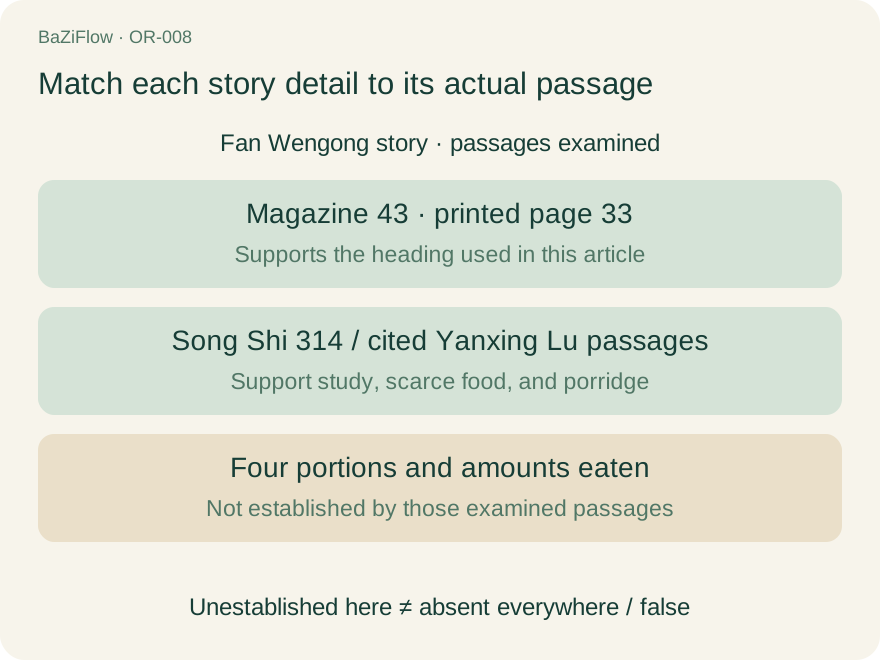
Original BaZiFlow diagram showing the support provided by the examined passages.
The last row is a research limit, not a declaration that the story is false. A detail absent from these passages may occur elsewhere. If a suitable passage is later located, add its book, section, edition, and wording. Do not retroactively pretend that the earlier citation already contained it.
This exercise deliberately stops short of claiming the earliest source of the four-portion story. Its purpose is to show how a partially relevant citation differs from a fully supporting one. That distinction remains useful even when the wider history of a story requires further work.
Supported here
- Study and porridge
Unresolved here
- Four portions
Preserve the route through which the evidence reached you
Printed page numbers and PDF viewer positions may differ. Record the magazine's printed page and issue rather than relying on a viewer's page counter alone. For an online ancient text, retain the volume, the person or section heading, a locating phrase, and the version consulted. A stable revision link helps another reader return to the same transcription.
Yanxing Lu is itself a compilation, and the examined passages carry source indications at their ends. Reading the compilation does not make its compiler an eyewitness. If you follow those indications to an earlier text, that is a further research step; until then, describe the level actually consulted.
Likewise, ten websites repeating the same passage do not necessarily provide ten independent witnesses. They may reproduce one transcription or one later retelling. Compare their wording and attributions before treating repetition as corroboration. A clear transmission route can be more informative than a long list of nearly identical links.
Search is a way to locate text, not a substitute for reading it
Traditional, simplified, and variant character forms can change search results. A fixed story title may not appear even where the event is described in other words. Failure to find a phrase is therefore not, by itself, proof that a whole work lacks the story.
Once a likely passage appears, read the surrounding sentences. Check the subject, place, and event rather than relying on the matching name. Distinguish the original narrative from a modern annotation or a quotation embedded in another discussion. If a scan is needed to resolve a doubtful transcription, only mark the page as checked after actually viewing it.
The note should also distinguish quotation from paraphrase. A concise paraphrase can be useful, but additions such as a precise duration or quantity need their own textual basis. Do not make modern punctuation, a supplied heading, or an editor's explanatory note look like an unquestioned part of the earliest narrative.
A sourced story still needs an argument before it becomes an interpretation
Establishing that a text recounts Fan Zhongyan's experience does not establish that the reader will follow the same path. A duration in his story is not automatically a waiting period for a present concern. Shared interest in learning is not enough to justify that transfer.
An interpreter may connect a story's theme with a stated question, but should identify that connection as interpretation. Poem, allusion, and commentary keeps the textual layers visible. Appreciating persistence does not require copying an ancient lifestyle or treating hardship itself as a guarantee of achievement.
Leave a note that another reader can continue: the claim being checked, the passages read, their actual support, and the unresolved detail. Recording the source preserves the material, while edition matching makes sure it belongs to the right lot text. The aim is not an impressive bibliography; it is a citation that supports the sentence beside it.
Source question
- What does this passage say?
Interpretive question
- Why does it apply here?
Separate the combined sentence
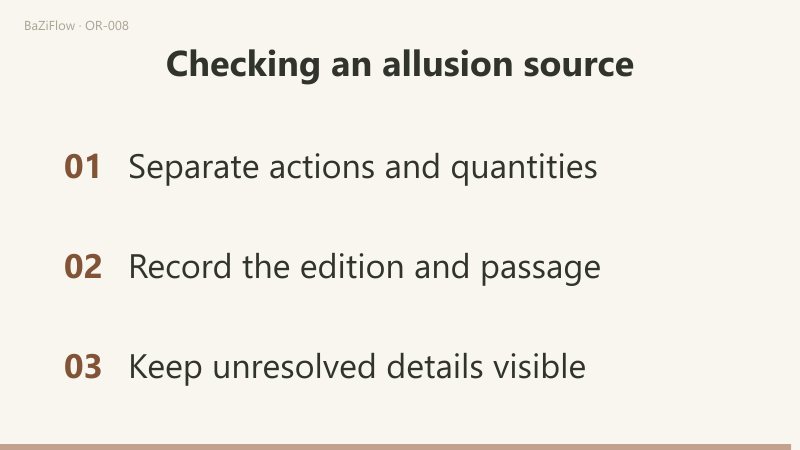
Split “studied hard and divided porridge into four” into study, porridge and four portions.
Assign support claim by claim
The examined passages support the first two but do not supply the quantity. Mark the third unresolved in this reading scope.
Update only the relevant claim
If a later passage explicitly provides four portions, add its edition and location. Do not pretend the earlier passages already contained it.
Questions readers ask next
Can two mentions of porridge establish four portions?
No. The shared evidence concerns porridge; the quantity still requires explicit wording rather than a combination of similar themes.
Does an unsuccessful search disprove the story?
Not across every version. State which passages were read and which detail those passages did not substantiate.
Do many repeated webpages provide stronger evidence?
Check their relationship first. Copies of one transcription increase repetition without necessarily adding independent testimony.
Was this article helpful?
Sources & references
Continue reading
Why the same oracle-lot number can have different versions ↗
Guanyin Hundred Lots: collection size, editions, and identity ↗
Turn a lot reading into checkable reflection without moving the goal ↗