

Mourning Gate: two ahead of the year branch
Content version · · Sources & references
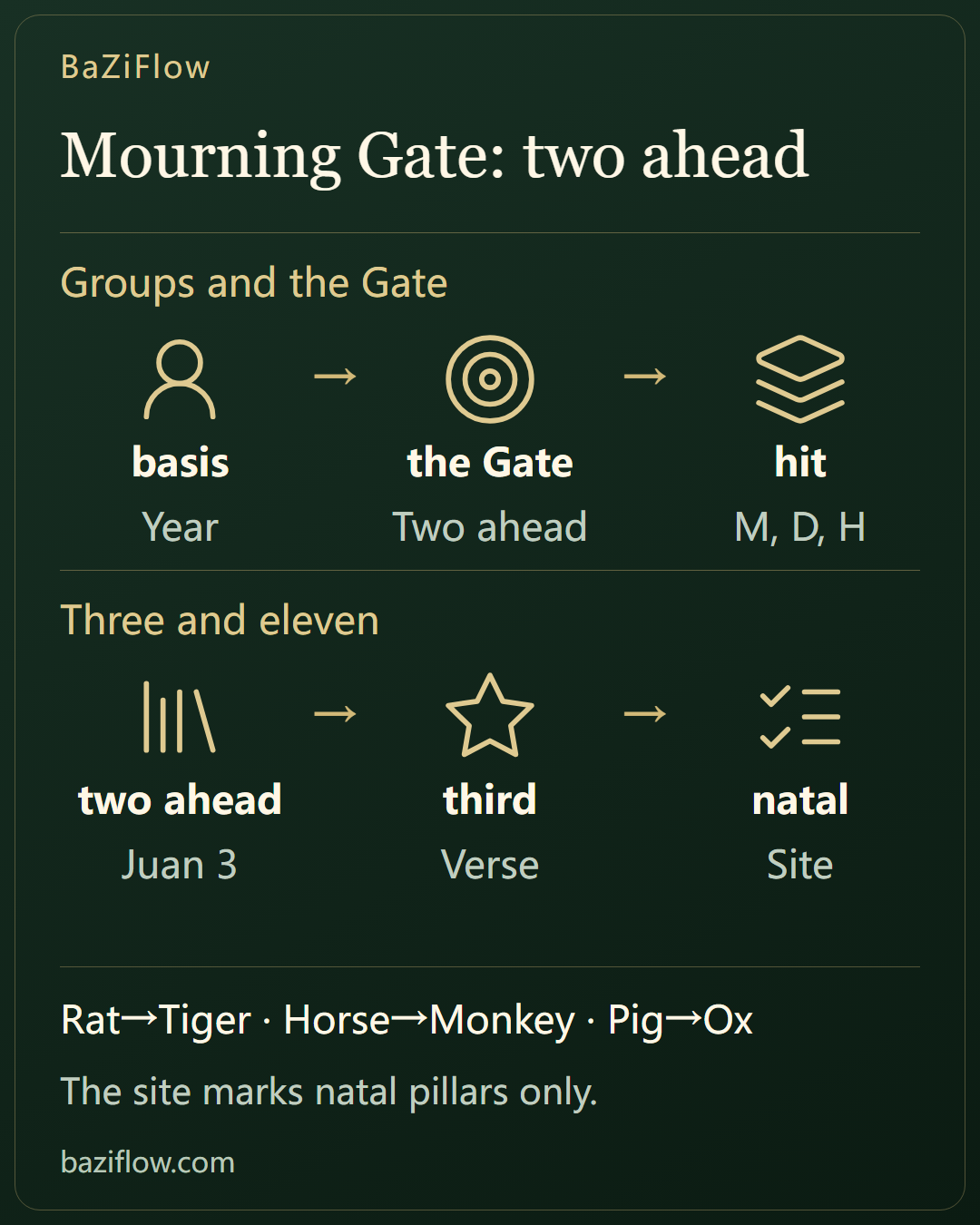
The Mourning Gate starts from the year branch and takes the second branch ahead of it, read in the month, day and hour pillars. A table, two charts, and the old books on its name and the White Tiger.
The short version8 min read
The basis of the Mourning Gate is the year branch: it lands on the second branch ahead of it and is looked for in the month, day and hour pillars; the year pillar itself can never be hit.
- Every year branch has its Mourning Gate in the Three Harmony group that clashes its own group: Monkey-Rat-Dragon years give Dog, Tiger and Horse; Tiger-Horse-Dog years give Dragon, Monkey and Rat.
- The Sanming Tonghui, juan 3, calls it "the two ahead of the life branch"; the "three" in the old verse "three Mourning, eleven Visiting" is its place, third counting from the year branch.
- The book reads it against the year of the moment and the luck periods; the site marks only the natal pillars and words it as "a position tied to parting and farewell".
Read first
Symbolic Stars in BaZi: Check the Reference and Rule Before the Meaning ↗
Two places ahead of the year branch
The Mourning Gate (丧门) is counted from the birth year. Look at the branch of the birth year, then count two places ahead in the order Rat, Ox, Tiger, Rabbit; the branch you land on is the Gate.
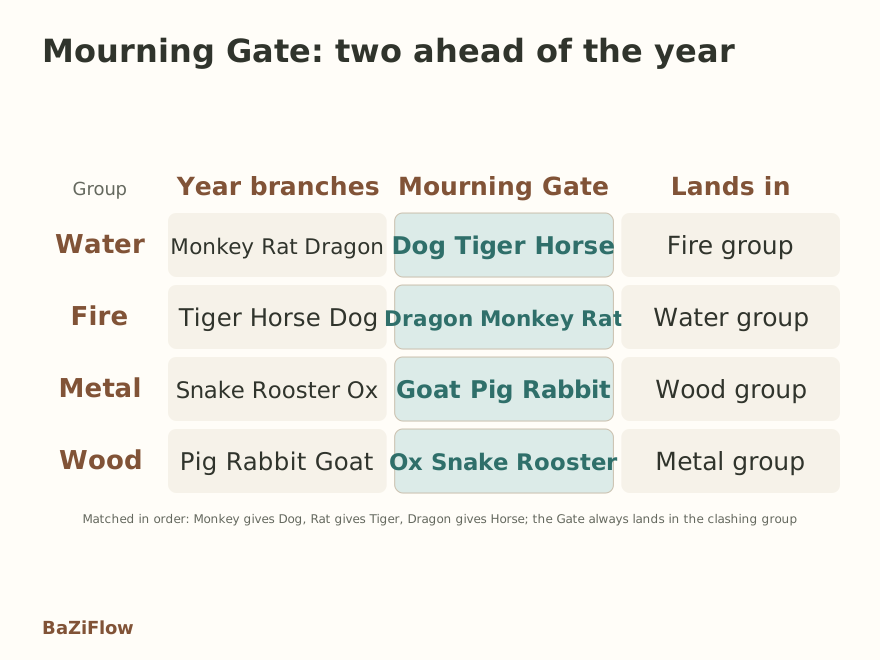
Twelve year branches in four group rows: the Mourning Gate follows the site engine (the second branch ahead of the year branch); each row lists the three year branches of one group, matched in order with the Gate on the right.
The table is laid out by the four Three Harmony groups: each row lists the three year branches of one group, and the Gates on the right match them in order, Monkey to Dog, Rat to Tiger, Dragon to Horse. One pattern hides in it: for every group of year branches, the Gates land in the group that clashes with it, Water against Fire and Metal against Wood.
"Three Mourning, eleven Visiting": the third of twelve
The Sanming Tonghui (三命通会), a Ming-dynasty fate compendium, devotes an entry in its third juan to the "Mourning and Visiting Sha", also called the "Crossbar Sha". It states the position at once and adds an old verse:
Take the two branches ahead of the life branch as the Mourning Gate and the two behind it as the Visiting Guest. ... An old verse says: five is Official, six is Death, twelve is Illness; three is Mourning and eleven is Visiting, and they come to call.
The "life branch" is the year branch of the birth, and "two ahead" is the counting above. The numbers in the verse are the places of twelve gods, with the year branch as the first: the Official Talisman (官符) is fifth, the Death Talisman (死符) sixth, the Illness Talisman (病符) twelfth, the Mourning Gate third and the Visiting Guest eleventh. Lay out the relevant places for a Rat year and the counting checks out:
Enlarge diagram · scroll sideways to read
Why a "gate"? The editors of the Xieji Bianfang Shu (协纪辨方书) answer in a single line of their general essay: gates stand at the front, which is why the branch ahead of the year branch carries the name Gate, while the one behind is given to a visitor arriving from another quarter, the subject of the next article.
A Xin Hai year, and which pillar the Ox lands in
Juan 11 of the Sanming Tonghui, while discussing a tomb that sits in the controlling element, gives a ready-made example:
Take the two branches ahead of the life branch as the Mourning Gate: a person of a Xin Hai year who meets Ji Chou has both entered the tomb and come to the mourning.
A person of a Xin Hai (辛亥) year has the year branch Pig; two ahead are Rat and then Ox, so Ox is the Mourning Gate, which agrees with the engine. The annotation reads "entered the tomb" by Na Yin (纳音): the Xin Hai year's Na Yin is Metal, and Metal's Storage is at Ox; the Ji Chou (己丑) pillar's Na Yin is Fire, which controls Metal, and the note's own example is that Metal fears Ji Chou Fire. That is the tomb sitting in the controlling element. Here the one branch Ox is both the Storage and the Mourning Gate. What the Storage stage itself means has its own page, Storage.
Now two charts. The first takes the book's starting point: year Pig, month Tiger, day Ox, hour Horse. The second has year Rat, month Horse, day Tiger, hour Tiger.
Enlarge diagram · scroll sideways to read
In chart A only the day pillar's Ox is hit, exactly the branch of the book's example. In chart B the Tiger appears twice, in the day and the hour pillar, and the site marks each.
Across from it stands the White Tiger
Two ahead of the year branch, the Mourning Gate has the White Tiger directly across, six places away, at the eighth place ahead of the year branch. The Xieji Bianfang Shu quotes the Renyuan Mishu Jing for the White Tiger, which it says sits four behind the year and brings "mourning dress" calamity to anyone who offends it; the site's engine does not look it up. In the same juan Cao Zhengui calls the Mourning Gate the "camp gate" of the Grand Duke and reports a saying that it clashes the White Tiger, which governs mourning dress, so clashing it is unlucky. The editors disagree: to take the word "gate" as a military gate is to cling to the surface of the name, they say, and the Grand Duke's gate need not be a gate of mourning.
Enlarge diagram · scroll sideways to read
The explanations of the name differ, while the position agrees: two ahead, on the clashing side of the Three Harmony groups.
How heavily the book weighs it: natal chart, passing year, luck period
Back to the juan 3 entry. Right after the position comes a condition:
If the Grand Duke and the unlucky shas arrive together at a luck period, it will surely bring misfortune.
The same entry adds that these twelve places are not only unlucky when the birth chart has them but worse in the year they arrive. So the book grades it in layers: in the natal chart, merely "unlucky"; met in a passing year, heavier; and only when the Grand Duke and other unlucky shas land together on a Luck Pillar or a minor luck period does it write "surely brings misfortune". These are the old book's verdicts, not the site's inference. The site's shensha table marks the natal pillars and does not take that step for you; its wording is "a position tied to parting and farewell, pointing to a draining stretch for feelings and relationships; not an event prediction".
A few words you will meet in this entry
- The two ahead of the life branch
- The "life" is the year branch of the birth; "ahead" counts in the order Rat, Ox, Tiger, Rabbit, and "behind" counts backward.
- Crossbar Sha
- Another name for the Mourning and Visiting Sha; the book says it takes that name when a Yang Blade in the month helps the unlucky sha to arrive.
- Earth Female
- A note gives an alias: the Mourning Gate is the "Earth Female" and the Visiting Guest the "Heavenly Dog".
- Grand Duke
- The year branch of the current year, and the reference point of the date-selection books; "the Grand Duke arriving at the luck periods" means the Grand Duke of the year and the unlucky shas landing together on a Luck Pillar or a minor luck period.
The next place behind is the Visiting Guest, on the other side of the year branch; the one before is the Death God, whose start is the day branch. The talk of the Gate and the White Tiger "clashing" is easier to follow inside the general frame of clash, punishment, harm and destruction.
Questions readers ask next
I was born in a Pig year. Which branch is my Mourning Gate?
First confirm the year pillar's branch: BaZi changes year at the Start of Spring, so someone born before it uses the previous year's branch. A Pig year branch counts two ahead to Ox; if the real year branch is Dog, the Gate becomes Rat.
Does the Mourning Gate mean a death in the family?
The name borrows an image of mourning, but the site's line is "a draining stretch for feelings and relationships; not an event prediction". A position cannot say who or when; it only suggests which ties deserve a little extra care.
If my year pillar's branch were the same as the Gate, would it be marked?
That cannot happen. The Gate always sits two places past the year branch, so in one chart it can only show up in the month, day or hour pillar, never in the year slot.
Was this article helpful?