

Nine Heaven: the last seat, next to the Chief
Content version · · Sources & references
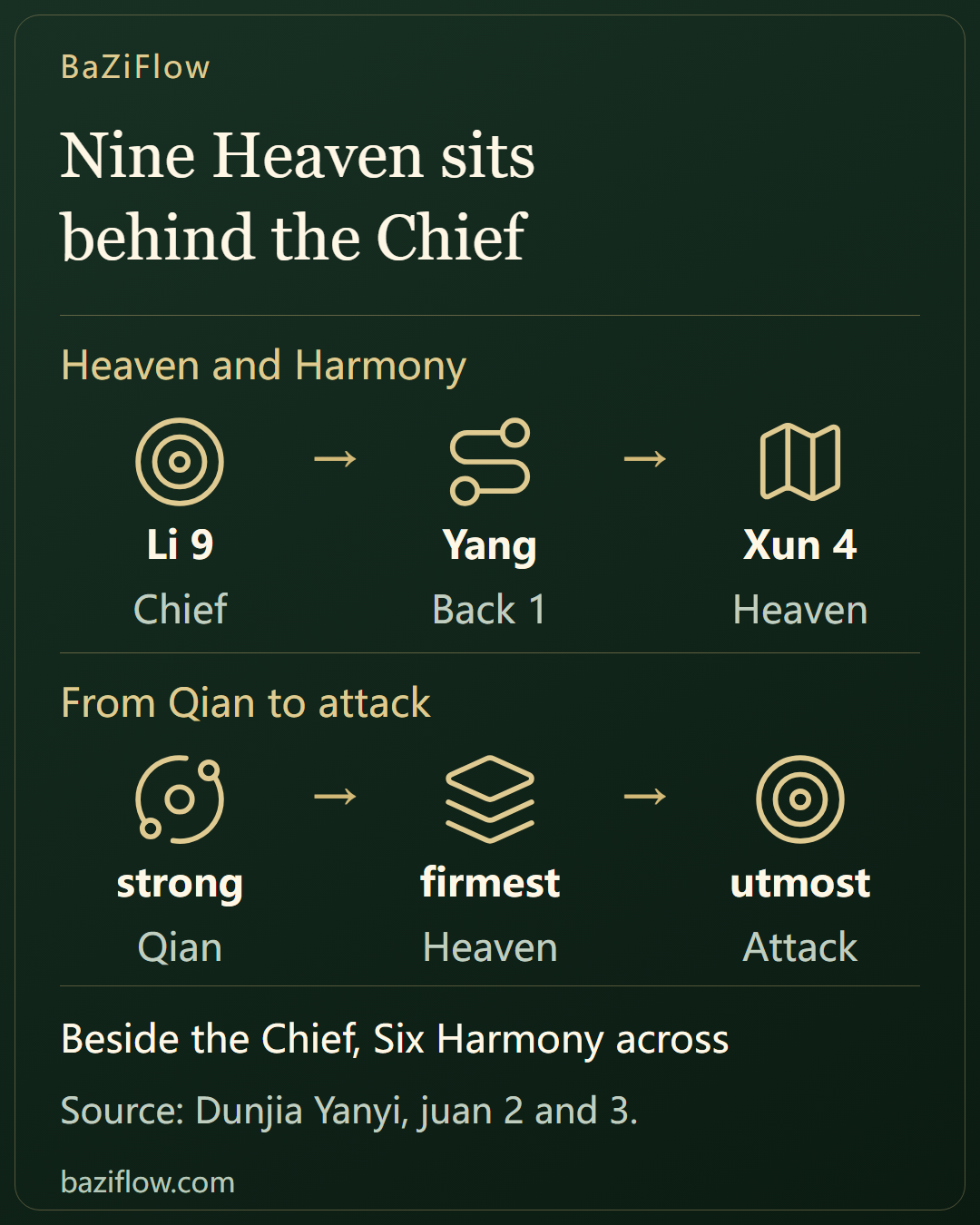
Nine Heaven is the eighth Qimen god, beside the Chief and across from Six Harmony. How the book reasons from Qian's "strong" to its "attack", why "above the Nine Heaven" names two boxes, and three combinations over it.
The short version7 min read
Count once round from the Chief and the last spirit lands right back beside it: Nine Heaven touches the Chief and faces Six Harmony, while the book's phrase "above the Nine Heaven" can point at two different boxes.
- Nine Heaven is the eighth and final seat, one step behind the Chief in Yang mode and one step ahead in Yin mode, always facing Six Harmony across the center.
- The book builds Nine Heaven up from Qian: the original sense calls it "the utmost of firm and strong", the Shuo Gua says Qian is strong, and the gods passage gives it a use with no exception clause.
- "Above the Nine Heaven" means the god in the song and its commentary, but the six Yang Wood, the palace of the Chief, in Wang Zhang's note; the "Nine Heaven palace" is also second in the three wins and the five not to strike.
Read first
One seat behind the Chief
Nine Heaven (九天) is the eighth of the eight gods, and the last: deal a full ring out from the Chief (值符) and it lands right before the Chief. In Yang mode it stands on the box immediately behind the Chief, in Yin mode on the box immediately ahead.
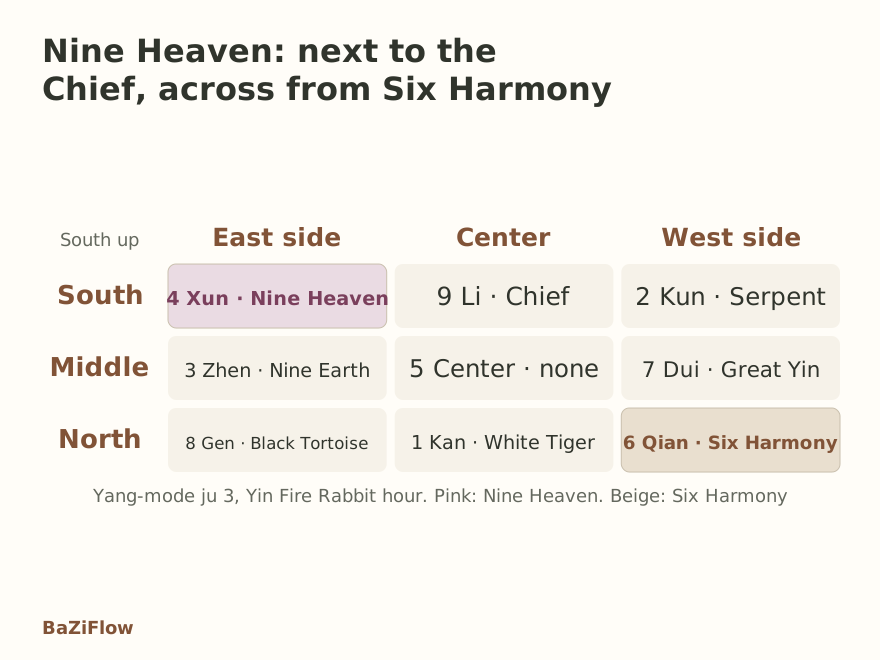
Nine-palace base, south up and east on the left. The seats follow the "three wins" example in juan 2 of Dunjia Yanyi (Yang-mode ju 3, Yin Fire Rabbit hour): the Chief, Nine Heaven and Life Gate the book names match the engine, and the rest are filled in by the same order. Pink is Nine Heaven, beige Six Harmony.
The chart comes from the passage on the "three wins" in juan 2 of Dunjia Yanyi (遁甲演义), a Yang-mode (阳遁) ju 3 example for a Yin Fire Rabbit (丁卯) hour. The text says the heaven-plate Chief rides Yin Fire onto palace 9, due south, that Nine Heaven is in palace 4, southeast, and the Life Gate in palace 7, due west. What the site engine casts for that ju and hour is the same in all three places. Nine Heaven lands in Xun Four, the Chief is next door in Li Nine, and directly across in Qian Six stands Six Harmony (六合), the palace numbers 4 and 6 summing to 10.
Enlarge diagram · scroll sideways to read
"The utmost of firm and strong": how the book gets from Qian to attack
The line juan 3 gives Nine Heaven states a use and borrows a saying from the art of war:
Nine Heaven is a god of might and defense. It can be used to raise troops, deploy them, shout and wave the banners. Sunzi says: the good fighter moves above the Nine Heaven.
Why should Nine Heaven be the one to raise troops? The original-sense passage of the same song steps back one stage:
Nine Heaven is the utmost of firm and strong. ... Because it moves in the Nine Heaven, it is called the utmost of attack.
"Strong", the second half of that phrase, is the word the Shuo Gua (说卦) uses for the trigram Qian in its seventh chapter:
Qian is strong; Kun is yielding.
The original sense goes on to call Nine Heaven the killing breath of heaven, which in this direction can be borrowed to raise troops and show might. Put side by side, the pieces make a chain from the trigram to the use:
Enlarge diagram · scroll sideways to read
How the "nine" is counted from Yang Wood is worked through in the Qian Six palace article and is not repeated here. Unlike the White Tiger, the Black Tortoise and the Serpent, whose lines end on an escape clause, the line on Nine Heaven stops at its use.
"Above the Nine Heaven": one phrase, two boxes
The phrase "above the Nine Heaven" does not always point at the same thing. The song and its original-sense passage mean the god itself. Wang Zhang's note ties the phrase to the six Yang Wood (六甲) instead, which is the palace where the Chief sits, and adds a rule: at the six Yang Wood hours, turn your back on that palace and strike the palace across from it. Set on one chart, the two meanings are two different boxes:
Enlarge diagram · scroll sideways to read
The note limits that rule to the six Yang Wood hours, and a Yin Fire Rabbit hour is not one of them; this chart is used here only to show where each meaning falls. The book carries the rule into no conclusion about real life, so say which box is in hand when quoting.
In the juan 2 section on the "three winning palaces and five not to strike", the Nine Heaven palace comes up twice more, both times in second place: the second of the three wins and the second item on the list of palaces never to strike. It is Xun Four on the Yang ju 3, Yin Fire Rabbit chart and Zhen Three on the Yin ju 8, Yang Earth Dragon chart. To stand on that palace is a "win", while to the side being attacked it is a palace not to strike. The whole set of wins is in the Life Gate article.
Nine Heaven under other signs: the Heaven feint, the Human feint and the Spirit escape
In juan 2 Nine Heaven is the palace beneath three combinations:
Enlarge diagram · scroll sideways to read
The Heaven feint entry also tags the three wonders with a word each: the Yin Wood is "virtue", the Yang Fire "might", and the Yin Fire is glossed as the spirit tied to Great Yin and the three wonders. The Spirit escape entry says that the heaven-plate Yang Fire joins Nine Heaven and then the Life Gate, and that a wonder and the Life Gate on the Nine Heaven seat are "veiled by the spirits" in that direction. The Human feint is the Shock Gate joined to Six Harmony over the Nine Heaven palace; "joined" in one place and "over" in the other, and the original does not unpack the difference.
For where Nine Heaven fits in the whole chart, read what doors, stars and spirits each do first. Its deep counterpart is Nine Earth, and the count begins at the Chief.
Questions readers ask next
Is Nine Heaven always in the south, up high?
On a chart its seat is set only by the count from the Chief. Across all 1,080 combinations of 18 ju and 60 hour pillars the site engine puts Nine Heaven in Dui Seven and in Li Nine 180 times each and in every other outer palace 120 times, so the southern Li Nine does not hold it alone. "High" belongs to the name's imagery, not to a direction.
Does Nine Heaven mean the heaven plate, or something nine days away?
Neither. Nine Heaven is one of the eight gods, counted from the Chief; the heaven plate is the layer of the palaces that carries the heaven stems and the nine stars. The "heaven" in the name follows the image of Qian as heaven. It is not a span of time and it forecasts nothing about nine days on.
Can "the good fighter moves above the Nine Heaven" be used as a ground for action?
The book credits that line to Sunzi and borrows it as a gloss on Nine Heaven, in a setting of marching and deploying armies. Cite it with the book and juan, and say that it belongs to that military setting; it is not a verdict on any palace on a chart.
Was this article helpful?
Sources & references
Continue reading
Nine Earth in Qimen: the Second Seat Behind the Chief, Facing Great Yin ↗