

Eight trigrams make sixty-four figures
Content version · · Sources & references
Build the eight trigrams and compare Pi with Tai, then distinguish Meihua casting numbers, line changes and interpretation from the structure of a figure itself.
The short version6 min read
Each line has a yin or yang form. Three lines make eight trigrams, and choosing an upper and lower trigram makes sixty-four ordered figures. Pi and Tai show why position matters. A four-cell exercise and the remainders of sixteen and seventeen distinguish drawing a structure, assigning a number and interpreting a reading.
- Three positions with two choices each produce eight trigrams. Choosing independently for the upper and lower halves produces sixty-four ordered combinations.
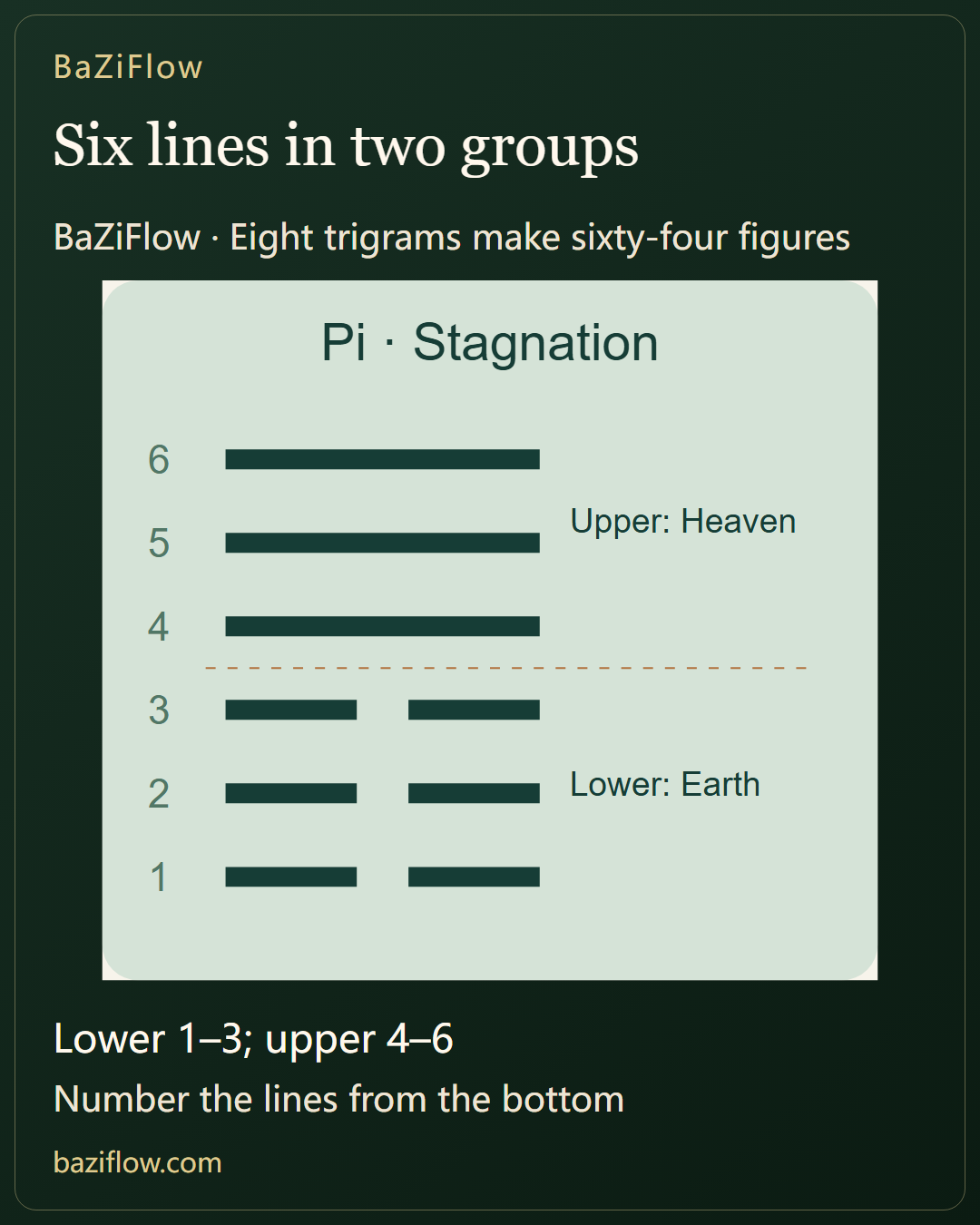
- Line one is at the bottom; the lower trigram occupies lines one to three and the upper occupies four to six. Qian over Kun is Pi; the reverse is Tai.
- Qian one through Kun eight is a casting correspondence, not the hexagram chapter order. Sixteen selects Kun and seventeen selects Qian, each supplying only one trigram.
Eight building blocks, sixty-four arrangements
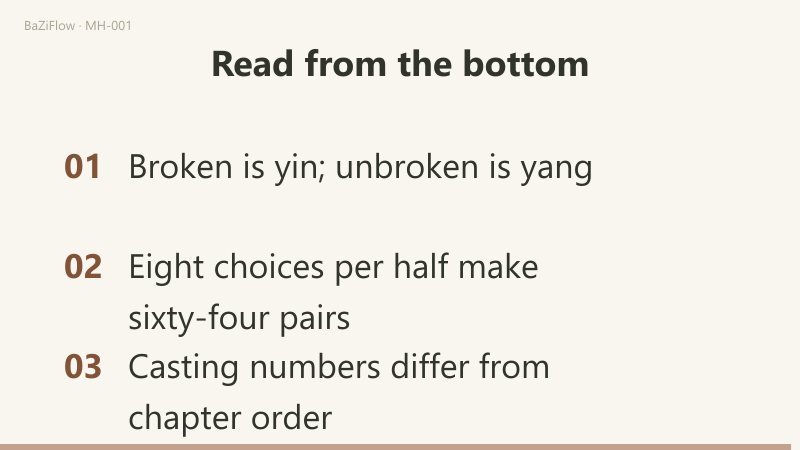
Start with a strip of paper and two marks: an unbroken line for yang and a broken line for yin. Stack three marks, reading from the bottom upward. Each position has two choices, so the number of possible three-line figures is 2 × 2 × 2 = 8. These are the eight trigrams. Choose one for the lower half and one for the upper half of a six-line figure: 8 × 8 = 64 combinations.
That calculation counts structures. It does not provide sixty-four ready-made forecasts, nor does it assign a single life situation to each figure. Meihua Yishu uses this shared symbolic vocabulary, then adds conventions for obtaining a figure from numbers, time or observed features and interpreting its relationships. Learning the building blocks comes before attempting a reading.
Shrink the choice to just Qian and Kun and build a four-cell table. Qian over Qian is the doubled Qian figure; Qian over Kun is Pi. Kun over Qian is Tai; Kun over Kun is doubled Kun. That gives 2 × 2 = 4 arrangements. Do not count only the mixed pair, and do not remove the two repeated pairs. Expanding each position back to eight choices gives 8 × 8 = 64.
Lower Qian
- Upper Qian
- Qian doubled
- Upper Kun
- Tai
Lower Kun
- Upper Qian
- Pi
- Upper Kun
- Kun doubled
Order matters: the same pieces make different figures
Heaven, or Qian, has three unbroken lines. Earth, or Kun, has three broken lines. Put Heaven above Earth and the result is Pi, described as Blocked Exchange. Reverse them and the result is Tai, described as Open Exchange. Both contain the same pair of trigrams. Their positions distinguish them.
The first line is always at the bottom. In Pi it is broken, because the lower trigram is Earth. In Tai it is unbroken, because the lower trigram is Heaven. Looking at the top of a picture first must not be confused with the order in which line positions are numbered.
| Position in the six-line figure | Pi: Heaven over Earth | Tai: Earth over Heaven |
|---|---|---|
| Lower half, lines 1–3 | Earth: three yin lines | Heaven: three yang lines |
| Upper half, lines 4–6 | Heaven: three yang lines | Earth: three yin lines |
| Full sequence from the bottom | yin, yin, yin, yang, yang, yang | yang, yang, yang, yin, yin, yin |
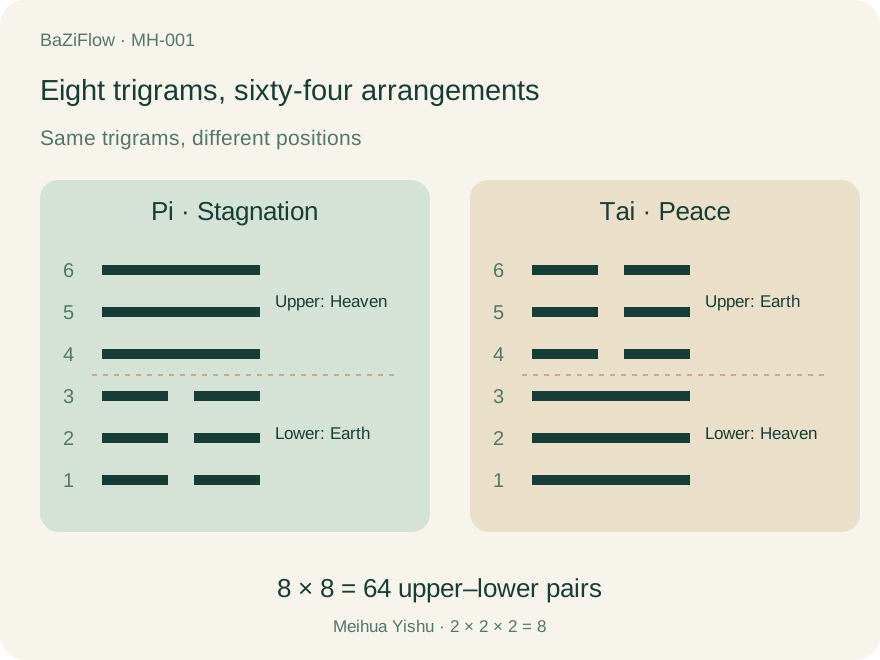
Original BaZiFlow teaching diagram comparing the upper and lower trigrams of Pi and Tai; neither figure is a personal reading.
The corresponding Zhou Yi chapters supply distinct statements for the figures and their individual lines. The English labels Open Exchange and Blocked Exchange are reading aids, not unconditional verdicts. This exercise has no question, no selected moving line and no event to interpret. Its purpose is to check the arrangement without smuggling a forecast into a drawing.
Lines 4–6: upper
The top half of the figure
Lines 1–3: lower
Line one is at the bottom
What Meihua adds to the shared figures
Volume 1 of Meihua Yi Shu sets out several starting procedures, including calendar-based numbers, counted objects, sounds and observed images. These are different routes to the upper trigram, lower trigram and moving line. The familiar modern exercise of naming numbers is therefore not the entire tradition.
The primary hexagram is the initial six-line structure. A moving line identifies a position at which yin changes to yang or yang to yin, producing the changed hexagram. A nuclear hexagram draws on the inner lines of the primary figure. Body and Use (体用) assign interpretive roles within the Meihua framework; they cannot be inferred simply by saying that Heaven must always be the reader and Earth must always be the situation.
These distinctions explain why a note saying only “Tai appeared” is incomplete. It does not show the starting procedure, original material or selected line. Nor should a reader invent a moving line merely because an unmarked diagram feels unfinished. A correctly drawn figure and a reproducible divination record answer different questions.
Primary figure
Initial six-line structure
Moving / changed
A specified line changes form
Nuclear / Body and Use
Inner structure / interpretive roles
The trigram number is not the hexagram's chapter number
The opening numerical correspondence in volume 1 of Meihua Yi Shu assigns Qian 1, Dui 2, Li 3, Zhen 4, Xun 5, Kan 6, Gen 7 and Kun 8. It is an eight-item casting correspondence. It is not the sequence of sixty-four chapters in the Zhou Yi, and it is not the numbering of Qimen's nine palaces. Kan having the value 6 does not make it the sixth hexagram.
The same volume's division-by-eight rule provides a small arithmetic exercise. Seventeen equals two eights plus one, so its remainder selects Qian. Sixteen is exactly divisible by eight, so it selects Kun, represented by 8; there is no zero trigram. These are examples of mapping a single number to one trigram, not complete casting instructions.
A full record must still identify the source of the other trigram and the rule for the moving-line total. Eight objects, eight sounds and a spoken number eight can have the same numerical value without belonging to the same starting procedure. If a reader chooses a desired figure first and then searches for convenient numbers, the arithmetic may remain correct while the reason for selecting the input has disappeared. Number sources in Meihua casting examines that distinction in more detail.
17 = 8×2 + 1
16 = 8×2 + 0
Reading a transmitted manual without overstating its history
The transmitted work is commonly associated with Shao Yong, and its plum-blossom narrative names a teacher by his honorific Kangjie. That is evidence of how the text presents its tradition. The story alone does not establish that every passage was written by the historical Shao Yong, or resolve the work's layers of compilation. Those are separate questions for textual and bibliographical research.
There are also procedural differences within the manual itself. Calendar examples begin with assigned year, month, day and hour values; image-based examples begin with an object and direction. Selecting convenient fragments of each does not reproduce either complete procedure. Modern number-casting lessons may also differ over whether to include the hour. State the convention used instead of hiding that choice behind the name Meihua.
Finally, a trigram image is a symbolic category, not the only possible description of a real object. The appearance of water does not force a particular forecast. With the line structure and its numbers clear, continue to the limits of trigram imagery, where the question becomes why a particular image was selected at all.
Time procedure
- Year branch, month, day, hour
- Take remainders of the totals
Object procedure
- Object and direction trigrams
- Add hour for the moving line
Questions readers ask next
Why does eight times eight include repeated trigrams?
The upper and lower positions are chosen independently, so either can use the same trigram. Restricting the exercise to Qian and Kun still gives four ordered pairs, including Qian over Qian and Kun over Kun. Repetition and order both matter.
How can the first lines of Pi and Tai be distinguished?
Line one is always the lowest line. Pi has lower Kun, whose three lines are yin, so its first line is broken. Tai has lower Qian, whose three lines are yang, so its first line is unbroken. The order in which you look at a picture does not renumber it.
Does a remainder of zero mean that no trigram exists?
In the cited mapping, exact division selects eight, Kun; there is no zero trigram. Sixteen selects Kun, while seventeen leaves one and selects Qian. This maps one number only: a full casting still needs the other trigram and the moving-line input.
Was this article helpful?
Part of a learning path
Sources & references
Continue reading
Primary, nuclear and changed hexagrams: trace each operation ↗