

Six of Wands: a wreath above the crowd
Content version · · Sources & references
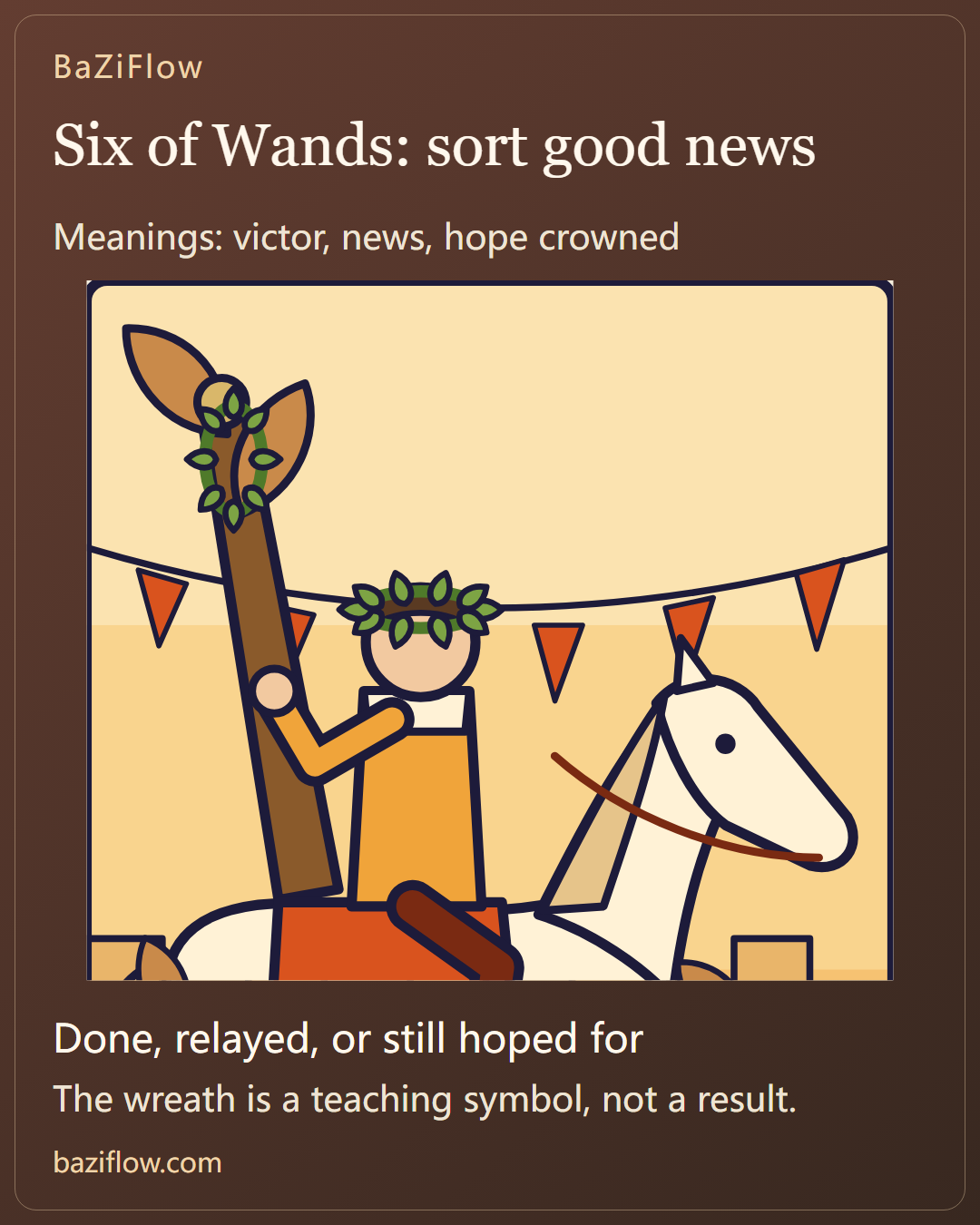
The Six of Wands shows a laurelled rider lifting a wreathed staff past footmen with staves. Separate Waite's three senses (victor, great news, expectation) and sort a shop promotion's "good news" into them.
The short version7 min read
In the Six of Wands only one staff wears a wreath, and the person who lifts it rides while the others walk. Waite says the card was designed to cover several senses, so the first job is to decide which sense your "good news" is.
- Waite's picture: a laurelled horseman bears one staff adorned with a laurel crown, with footmen carrying staves at his side. He opens by saying the card can cover several significations.
- The word list has three layers: a victor triumphing on the surface, great news such as the King's courier might carry in state, and expectation crowned with its own desire. Reversed it turns to fear, treachery and indefinite delay.
- The additional meanings are other readers' words: servants may lose their masters' confidence, a young lady may be betrayed by a friend, and reversed, "fulfilment of deferred hope". Keep them apart from the main entry.
Read first
Start with the picture: one wreathed staff above rider and walkers
Waite describes the Six of Wands in a single sentence: a laurelled horseman bears one staff adorned with a laurel crown, and footmen with staves are at his side.
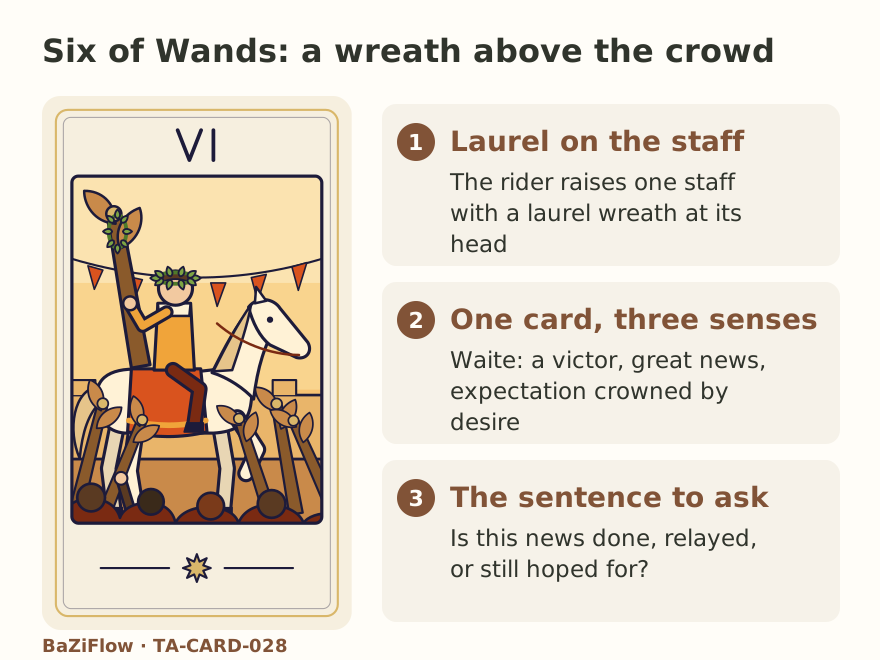
Six of Wands: a wreath held above the crowd
In the Rider-Waite-Smith picture the rider is in profile facing right, in a red cloak on a white horse whose cloth is green with red spots. The staff in his hand carries a laurel wreath at its head with a red ribbon trailing from it. A few faces show at the lower left, and the other staves are held by other people. There are six staves on the card, and only the one in the rider's hand wears a wreath.
Enlarge diagram · scroll sideways to read
What Waite lists: a victor, great news, expectation crowned by desire
Waite starts the divinatory meanings by telling you how the card was written: it can cover several significations. On the surface it is a victor triumphing. It is also great news, of the kind the King's courier might carry in state. And it is expectation crowned with its own desire, the crown of hope.
The card has been so designed that it can cover several significations; on the surface, it is a victor triumphing, but it is also great news, such as might be carried in state by the King's courier; it is expectation crowned with its own desire, the crown of hope, and so forth.
Enlarge diagram · scroll sideways to read
The three layers are written side by side, and none of them is named the correct reading. A reader who takes the whole card as "you won" has kept only the first.
Wreath, courier and footmen: three names and their sources
Three things in the scene deserve separating: the laurel wreath, the King's courier and the men on foot. Waite writes the laurel on the rider and the wreath on the staff, and does not explain the wreath. Laurel woven into a crown for a victor was an ancient Greek and Roman custom, which is general knowledge.
Where the wreath, courier and footmen come from
- Laurel wreath
- Waite writes a "laurelled" horseman and a laurel crown on the staff. He says only that it is there. Crowning victors with laurel is a standard fact of ancient Greek and Roman custom.
- The King's courier
- This is Waite's comparison for the second sense: great news carried "in state". No courier appears in the picture; the figure lives in the word list, not on the card.
- Footmen
- Waite writes "footmen with staves at his side" and says nothing about who they are or what they do. Teaching often reads them as companions, which is a borrowing.
Enlarge diagram · scroll sideways to read
Reading the wreath as "a result someone has credited" and the footmen as "those who walk beside you" is a modern teaching analogy. Its use is that it turns the picture into things you can ask: who credited the result, and are those beside you present? Neither line is in Waite's text.
How to read it: split "it went well" into three kinds
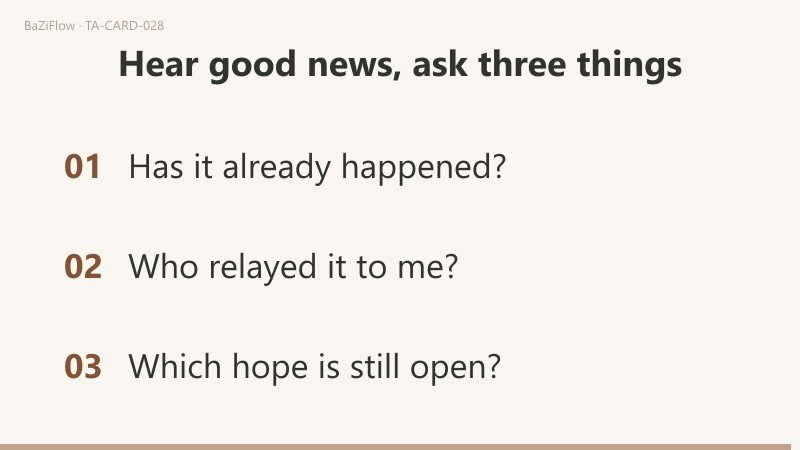
The easiest slip with the Six of Wands is to merge winning, news and hope into one word, "good news". Waite wrote the three layers side by side, which hands you a sorting frame:
Done: can you find the record?
This matches the victor triumphing. It needs a source in the records: a payment log, a shipping slip, a statement. If you cannot find the record, do not put it in this column yet.
Relayed: who said it, through how many hands?
This matches the great news carried by a courier. A courier brings word, which is not the thing itself. Note where the word started and how many people it passed through.
Hoped for: which one thing is it?
This matches expectation crowned with its own desire. Wish-list adds, enquiries and people who say "next time for sure" belong here. They are pleasant to see, and they are not sales yet.
An example: a small web shop is on day three of a launch sale, and the owner writes in the group chat, "the launch is a success". Sort the pieces of information behind that sentence into the three layers:
Enlarge diagram · scroll sideways to read
Once split, "the launch is a success" becomes three sentences of different weight: 62 paid orders is a result, "nearly sold out" is someone else's report, and 300 items in carts is hope. Each calls for a different next move: the first is for reconciling and restocking, the second needs its source checked, and the third is worth asking people why they have not paid yet.
After the three columns, what is left
Placed
- Done items with a record
- Relayed items with a name
Unplaceable
- Verdicts like "a success"
- Numbers with no source
To add
- A source for the verdict
- A question for the hoped-for column
Reversed and neighboring cards: the gate, the delay and "deferred hope"
Waite's reversed reading is drawn like a defense plan seen from the wrong side: apprehension and fear, "as of a victorious enemy at the gate"; treachery and disloyalty, "as of gates being opened to the enemy"; and also indefinite delay. None of these words says "defeat". They are about who stands at the gate and who is inside it.
The additional meanings come from other readers. Upright they read "servants may lose the confidence of their masters; a young lady may be betrayed by a friend", in period wording, and reversed "fulfilment of deferred hope". That runs opposite to the main entry's reversed words, so say which layer you use.
Enlarge diagram · scroll sideways to read
Three cards that speak of winning or celebrating, and where each puts the topic
A garland between the staves, a bridge nearby
Waite describes a great garland hung between four planted staves, two women lifting flowers and a bridge to an old manor. The list is country life, repose, concord and peace: the celebration stays in place and does not move on.
The next card: a figure on a height
One person stands high up while staves point at him from beneath. The list opens with valour and goes on to argument and trade rivalry.
Another victor
Waite's list for the Chariot reads succour, providence, but also war, triumph, presumption, vengeance and trouble. It speaks of triumph as well, and it lists presumption and trouble along with it.
Questions readers ask next
Does the Six of Wands simply mean "you won"?
Not by itself. Victory is only the first layer Waite lists; he then says it is also great news and also a kind of expectation. What has happened, what has been reported and what is still hoped for sit side by side in one card, so ask which of the three you are holding.
What does the Six of Wands mean reversed?
Waite's reversed words are apprehension and fear, as of a victorious enemy at the gate; treachery and disloyalty, as of gates opened to the enemy; and indefinite delay. The additional list reverses to "fulfilment of deferred hope", which points the other way, so name your source before you read.
The Four and Six of Wands both look like celebrations. How do they differ?
The posture of celebration differs. In the Four a great garland hangs between four standing staves while figures hold up flowers; in the Six one staff lifts a wreath while the people move on. Waite gives the Four country life, repose and concord, and the Six a victor, news and expectation.
Was this article helpful?
Sources & references
Continue reading
Four of Wands: four staves hold a garland, meanings "almost on the surface" ↗