

Ghost: two lists and a leap month
Content version · · Sources & references
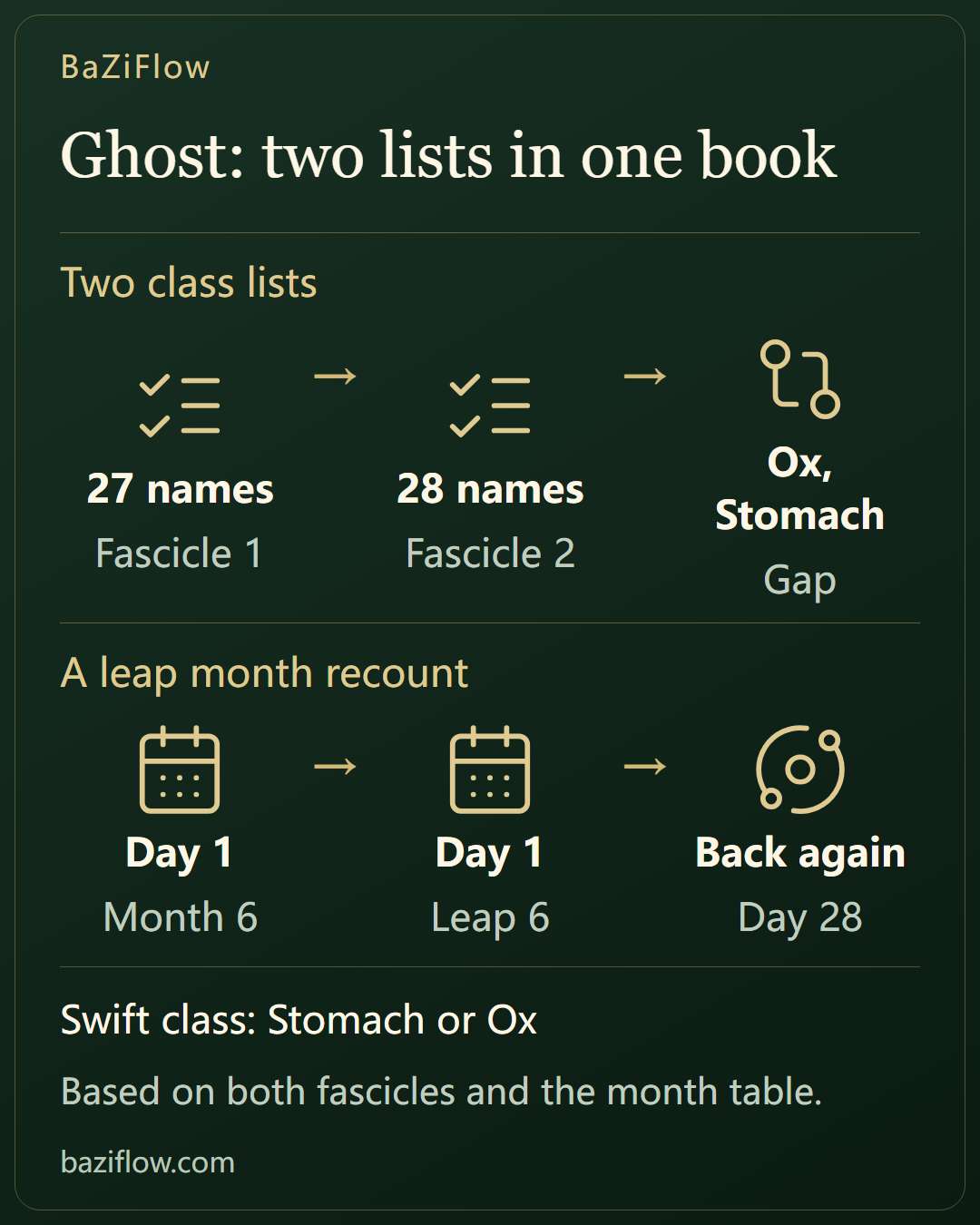
Ghost (鬼) is position 6. The sutra’s class lists total 27 mansions in one fascicle and 28 in the other, differing at Ghost’s "swift" class; then its Crab-house feet, two luminary pairs and a leap-month repeat.
The short version5 min read
Ghost (鬼, Ki in Japanese) is position 6 on the site’s ring, between Well and Willow. When the Sukuyō Sutra sorts mansions into classes its first fascicle lists 27 and its second 28, and the two lists differ exactly in Ghost’s "swift" class.
- The sutra lists its mansion classes twice. The first fascicle’s seven classes total 27 and the second’s total 28; the swift class changes from Ghost, Chariot, Stomach, Bond to Ghost, Chariot, Ox, Bond, and the fierce class gains Stomach.
- All four of Ghost’s feet sit in the Crab house (Well 1, Ghost 4, Willow 4), and Ghost appears twice in the luminary tables, with Jupiter among the Sweet Dew days and with the Moon among the Rakshasa days.
- In the Japanese old calendar (new moon fixed by Tokyo time) month 6 opens on Ghost and a leap month 6 reuses that starting point, so in summer 2025 Ghost falls on 6/1, 6/28, leap 6/1 and leap 6/28.
Read first
What is Sukuyō astrology? How a birth mansion is found ↗
Sukuyō 27 mansions vs the 28 lunar mansions: what is the difference? ↗
One book, two lists
The Sukuyō Sutra’s list of mansion classes actually appears twice, and the two totals differ: the first fascicle’s seven classes add up to 27 mansions and the second fascicle’s to 28. Ghost (鬼, Ki in Japanese) is position 6, after Well (井) and before Willow (柳), and the "swift" class it belongs to is exactly where the two lists part.
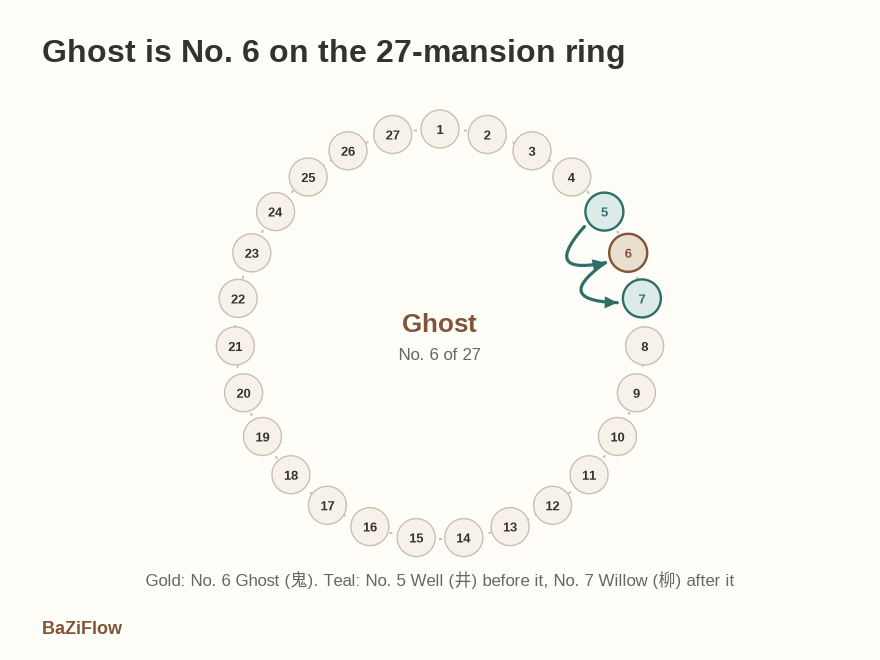
Ghost at position 6 sits between Well and Willow; Well’s last foot plus all four feet of Ghost and of Willow make the Crab house.
The first fascicle, chapter 2, writes:
Ghost, Chariot, Stomach and Bond are the swift mansions.
The class table in the second fascicle writes the same class as:
Swift: Ghost, Chariot, Ox, Bond. These four are the swift mansions.
Put the two lists side by side and only two places differ:
Enlarge diagram · scroll sideways to read
In the first fascicle five classes hold four mansions each, one holds five and the smallest holds two, 27 in all. The second puts Ox into the swift class and Stomach into the fierce class, so the fierce class grows to five and the total to 28. The site’s ring has no Ox, which agrees with the first fascicle’s 27; the second fascicle’s count runs along with the 28-mansion tradition. The same book uses two conventions in turn, so a citation of a class should say which fascicle it comes from.
Ghost’s picture, and four feet in the Crab house
Ghost’s picture begins:
Ghost has three stars shaped like a vase. Its deity is Brihaspati (蘖利诃馺拨底).
Jingfeng’s note says Ghost has five stars in Chinese astronomy, governs the officials and is a southern mansion. Three against five is, like several of the earlier mansions, two numbers from two layers.
In the ledger of the twelve houses, all four of Ghost’s feet are in one house:
Enlarge diagram · scroll sideways to read
The sutra says the house’s deity looks like a crab and that the Moon dwells in it, hence the name. Ghost and Willow put all four feet in, and Well adds only the last one.
One mansion, two luminaries
The sutra has three luminary tables, the Sweet Dew days, the Vajra Peak days and the Rakshasa days, each with seven pairs of one luminary and one mansion. Ghost appears in two:
Willow with Mercury, Ghost with Jupiter, Room with Venus.
That line belongs to the Sweet Dew set, where Ghost pairs with Jupiter. In the Rakshasa set the same Ghost is paired with the Moon.
Enlarge diagram · scroll sideways to read
These are the book’s pairings, each table standing on its own, and neither can be, or needs to be, derived from the other.
A leap month counts Ghost again
The site’s old calendar has leap months, and a leap month reuses the day-1 mansion of the month it repeats before stepping forward by the day number. Old month 6 opens on Ghost, so in summer 2025 Ghost appears four times in two months:
Enlarge diagram · scroll sideways to read
"27 steps" is exactly one lap: day 28 returns to the day-1 mansion, day 29 is the one after it and day 30 the next, so within an old month the starting mansion turns up twice. Across 2025 Ghost falls on 14 Gregorian days: 12 Jan, 8 Feb, 8 Mar, 4 Apr, 2 May, 29 May, 25 Jun, 22 Jul, 25 Jul, 21 Aug, 16 Sep, 13 Oct, 9 Nov and 7 Dec.
The mansion before it is Well and the one after is Willow. For how the 27 and 28 lists came to coexist, see 27 versus 28 mansions.
Questions readers ask next
Why does the Sukuyō Sutra have two class lists?
They are in chapter 2 of the first fascicle and in the class table of the second. The first fascicle’s seven classes add up to 27 mansions with no Ox; the second’s add up to 28, with Ox in the swift class. So the same book uses two lists in turn. The site’s ring has no Ox, which matches the first fascicle.
Why does a leap sixth month count Ghost again from the start?
The site’s rule is that a leap month reuses the day-1 mansion of the month it repeats, then steps forward by the day number. Month 6 opens on Ghost, so leap month 6, day 1 is Ghost too, the same mansion as month 6, day 1. From day 1 to day 28 is 27 steps, a whole lap, so day 28 is back on the starting mansion.
Ghost sits in different places in two luminary tables. Is that a contradiction?
No. The Sweet Dew days and the Rakshasa days are two separate tables of seven luminary-and-mansion pairs. Ghost pairs with Jupiter in the first and with the Moon in the second. The same mansion matched to different luminaries in different tables is how the book works, and neither table is derived from the other.
Was this article helpful?
Sources & references
Continue reading
Well (井): Where the Ring Turns from West to South, and How the Commentator Tags Directions ↗
Willow (柳): Three Luminary Tables, a Picture Missing Its Deity, and Gaps Between Days ↗