

Strike punishment: instrument, branch, palace
Content version · · Sources & references
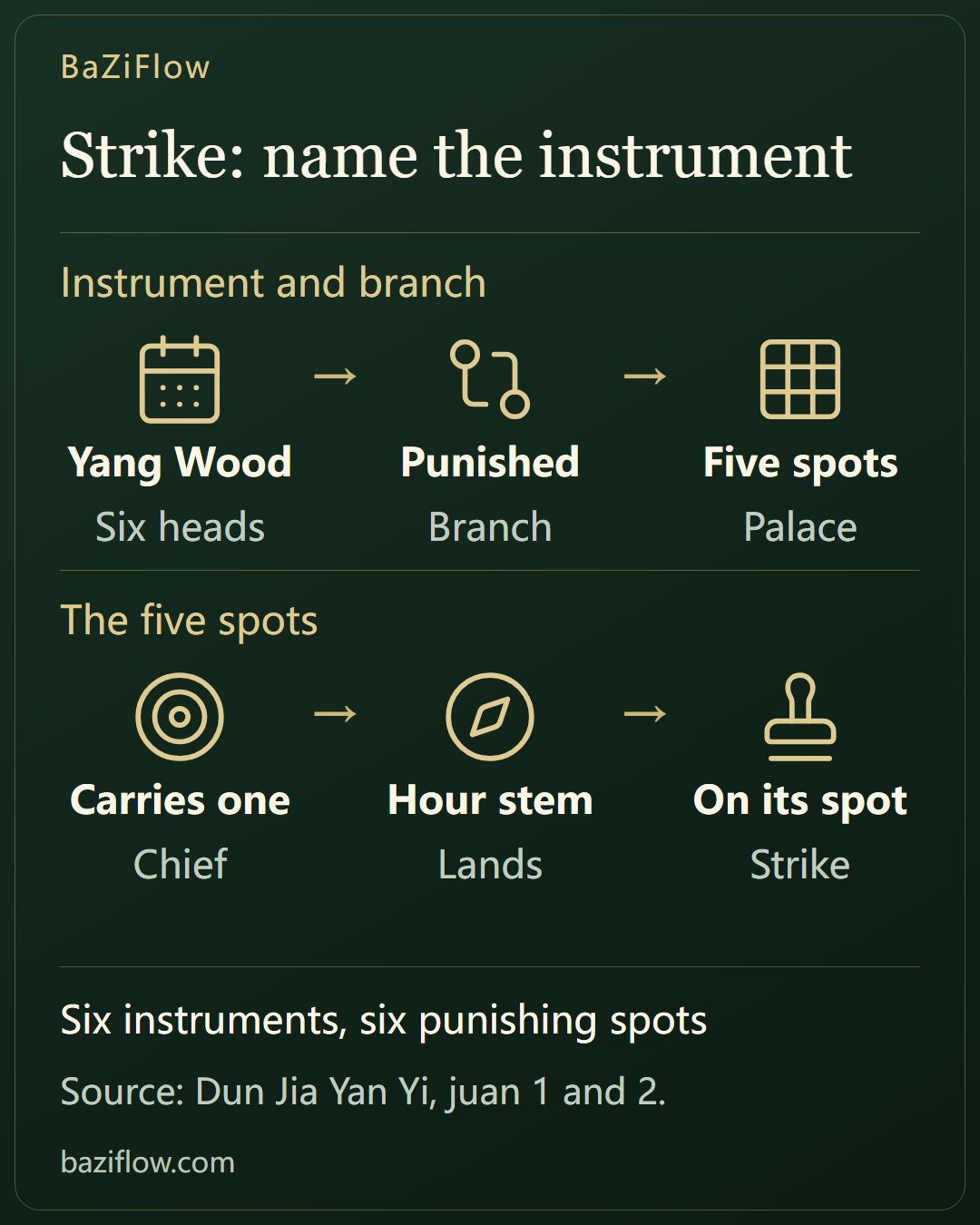
Strike punishment needs three look-ups: the instrument the Chief carries, the punished branch of its decade head, and the palace of that branch. Dun Jia Yan Yi gives six pairs, a worked hour and two board counts.
The short version9 min read
Strike punishment (六仪击刑) means an instrument standing on its own punishing spot: find which instrument the Chief carries, look up the punished branch of its decade head, then the palace of that branch. The book's worked case checks only the Chief's instrument.
- Each instrument pairs with a decade head and a punished branch: Yang Earth, Jia Zi and Rabbit; Yin Earth, Jia Xu and Goat; Yang Metal, Jia Shen and Tiger; Yin Metal, Jia Wu and Horse; Yang Water, Jia Chen and Dragon; Yin Water, Jia Yin and Snake.
- The punished branches land in Zhen Three, Kun Two, Gen Eight and Li Nine, with the two Water instruments sharing Xun Four. Kan One, Qian Six and Dui Seven hold no instrument's punishing spot.
- The scope changes the count. Over 1080 hour charts, checking only the Chief gives 140, and checking all six heaven-plate instruments gives 572.
Read first
Six instruments, each carrying one punishment
Take the term apart: the "punishment" comes from the branches and the "strike" is landing on that spot, so first identify which branch stands behind each of the six instruments.
On a Dun Jia chart the Yang Wood never appears on its own. It hides under one of the six instruments: Yang Earth stands for Jia Zi, Yin Earth for Jia Xu, Yang Metal for Jia Shen, Yin Metal for Jia Wu, Yang Water for Jia Chen and Yin Water for Jia Yin (the overall layout of heaven and earth plates is in the Three Wonders, Six Instruments and the two plates). Each Yang Wood heads a ten-pillar decade and has one branch it punishes. The commentary in juan 2 of Dun Jia Yan Yi (遁甲演义), quoting Ge Hong, defines the strike this way:
The six-instrument strike punishment is when the Chief of a Yang Wood lands on the very ground it punishes.
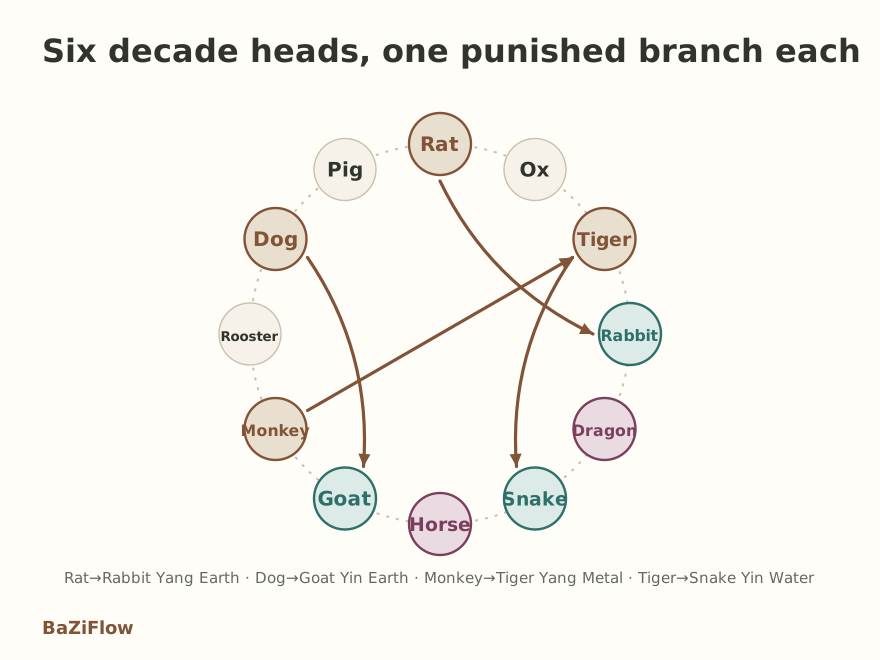
Decade heads and punished branches: mutual and self-punishment come from the note under the six-instrument strike entry in juan 2 of Dun Jia Yan Yi, and the instrument each decade hides is named under the ring.
In the picture beige marks the decade-head branch, teal the punished branch, and the arrow runs from head to punished branch. Dragon and Horse punish themselves, so they carry no arrow. Written out:
| Decade head | Instrument it hides | Punished branch | Kind |
|---|---|---|---|
| Jia Zi | Yang Earth | Rabbit | mutual |
| Jia Xu | Yin Earth | Goat | mutual |
| Jia Shen | Yang Metal | Tiger | mutual |
| Jia Wu | Yin Metal | Horse | self |
| Jia Chen | Yang Water | Dragon | self |
| Jia Yin | Yin Water | Snake | mutual |
Jia Zi with Rabbit, Jia Xu with Goat, Jia Shen with Tiger and Jia Yin with Snake the note calls mutual punishment, two different branches each carrying a punishment toward the other side; Jia Chen with Dragon and Jia Wu with Horse it calls self-punishment, a branch punishing itself.
Two derivations, one table
For these six pairs the juan 2 note gives two ways of deriving them. The first is the mutual and self-punishment above. The second quotes Guo Pu on the punishments of the triple harmonies and goes by direction, in groups:
Hard metal, fierce fire: each punishes its own quarter; water runs east, wood falls back to its root.
Among the six decade heads, Jia Yin, Jia Wu and Jia Xu belong to the Tiger-Horse-Dog fire group, and their punishment falls in the south: Snake, Horse, Goat. Jia Shen, Jia Zi and Jia Chen belong to the Monkey-Rat-Dragon water group, and theirs falls in the east: Tiger, Rabbit, Dragon. Checking the six punished branches one by one, Rabbit, Goat, Tiger, Horse, Dragon and Snake each sit inside the quarter of their own group, so the two derivations never disagree.
Enlarge diagram · scroll sideways to read
How punishment between branches is read in its own right is in whether clash, punishment, harm and destruction settle fortune. Qimen only borrows it to give each of the six instruments one spot.
From punished branch to palace: only five palaces hold a spot
A branch becomes a palace through where the twelve branches sit in the later-heaven trigram arrangement: Rabbit in Zhen, Goat in Kun (Monkey shares it), Tiger in Gen (Ox shares it), Horse in Li, and Dragon and Snake both in Xun. The palace numbers Wang Zhang gives in the note match this mapping one by one: Jia Zi is added to the third palace, Jia Xu to the second, Jia Shen to the eighth, Jia Wu to the ninth, and Jia Chen and Jia Yin both to the fourth.
Enlarge diagram · scroll sideways to read
Xun Four takes two instruments: Dragon is in Xun, Snake is in Xun too, and Yang Water punishes Dragon while Yin Water punishes Snake. Kan One, Qian Six and Dui Seven hold no instrument's spot, and the center has no spot of its own.
One worked hour: Yang-mode ju 1, the ten hours of a Yang Wood or Yin Earth day
The book's worked case is the winter-solstice upper cycle, Yang-mode ju 1, a Yang Wood or Yin Earth day: at the midnight Jia Zi hour the Chief, Tian Peng, carries Yang Earth and stands at its home, Kan One; at the Geng Wu hour the Chief is added onto the hour stem Yang Metal, which sits on the earth plate in Zhen Three, so "the Jia Zi Chief is added to the third palace" and the strike is on. Recomputing the ten hours of this decade one by one on the rotating plate, the Chief Tian Peng travels like this:
| Hour | Hour stem | Where the Chief lands | Zhen Three? |
|---|---|---|---|
| Jia Zi | Yang Earth (stands for Yang Wood) | Kan One | no, the Chief stays |
| Yi Chou | Yin Wood | Li Nine | no |
| Bing Yin | Yang Fire | Gen Eight | no |
| Ding Mao | Yin Fire | Dui Seven | no |
| Wu Chen | Yang Earth | Kan One | no, back at home |
| Ji Si | Yin Earth | Kun Two | no |
| Geng Wu | Yang Metal | Zhen Three | yes |
| Xin Wei | Yin Metal | Xun Four | no |
| Ren Shen | Yang Water | Kun Two | no |
| Gui You | Yin Water | Qian Six | no |
Only the Geng Wu hour puts the Chief in Zhen Three. The first half of the same note also says "at sunrise, the Mao hour"; on the rotating plate the Ding Mao hour puts the Chief in Dui Seven and no strike results, so this walk-through does not use that half-sentence.
Enlarge diagram · scroll sideways to read
How the Chief follows the hour stem is in the duty chief and the duty door.
The scope you draw sets the number
The book's worked case checks only the instrument the Chief carries. Run the same rotating plate over all 1080 charts (nine Yang and nine Yin ju times sixty hours): checking only the Chief, 140 charts qualify; checking each of the six heaven-plate instruments, 572 charts have at least one instrument on its own spot, more than half.
Enlarge diagram · scroll sideways to read
In some ju Yang Earth already sits on Zhen Three on the earth plate (Yang ju 3 and Yin ju 3). There the Jia Zi hour leaves the Chief where it is, so the chart is both Fu Yin and a strike, and the two labels do not exclude each other. Of the 140, forty fall in Kun Two, and twenty of those are hours whose stem sits at Center Five on the earth plate: this site's rotating plate lodges Center Five in Kun Two, so the Chief lands there and the chart is counted; how lodging is counted is also pending on this site.
Three punishing-spot checks
Which instrument does the Jia Wu decade carry, and where is its spot?
The Jia Wu decade carries Yin Metal. Horse punishes Horse, a self-punishment, and Horse sits in Li, so the spot is Li Nine.
The Chief carries Yang Water and lands in Xun Four. Does it hold?
Yang Water is the instrument of Jia Chen, Dragon punishes itself, and Dragon belongs to Xun, so the spot is Xun Four and it holds. A Chief carrying Yin Water in Xun Four holds as well.
The Chief carries Yang Metal and lands in Kan One. Does it hold?
Yang Metal's punished branch is Tiger, Tiger sits in Gen, and the spot is Gen Eight. Kan One is not it, so it does not hold. Kan One is in fact no instrument's spot.
With the instrument spots settled, the next step is the Three Wonders, each with a tomb place of its own, and how to look that place up is in what makes the Three Wonders enter the tomb.
Questions readers ask next
Is the "punishment" here the same as the three punishments in BaZi?
The source is the same: Jia Zi meets Rabbit, Jia Xu meets Goat, Jia Shen meets Tiger and Jia Yin meets Snake as mutual punishments between branches, and Jia Chen with Dragon and Jia Wu with Horse as self-punishments. Qimen only borrows them to give each decade head one spot and then checks whether the Chief lands there.
Why is the punishing spot of the Jia Zi decade in Zhen Three?
Rat punishes Rabbit, and Rabbit belongs to Zhen in the later-heaven arrangement, which is the third palace. The six palace numbers listed by Wang Zhang in the commentary agree with this mapping one by one, though the site's register notes that other editions differ and still need collation.
Only the Chief's instrument counts in the book. What about the others?
The worked case checks just the instrument the Chief carries. Whether the other five heaven-plate instruments are checked too, the text does not say, and this site has not fixed it. The numbers differ widely: of 1080 hour charts, 140 under the Chief-only scope and 572 under all six.
Was this article helpful?
Sources & references
Continue reading
Gate Pressure (门迫): What to Check Before Calling It: Palace, Two Elements, One Arrow ↗
Three Wonders in the Tomb (三奇入墓): Choose the Tomb Table, Then See Where the Wonder Lands ↗