

Robbery Sha: the Severance spot of a group
Content version · · Sources & references
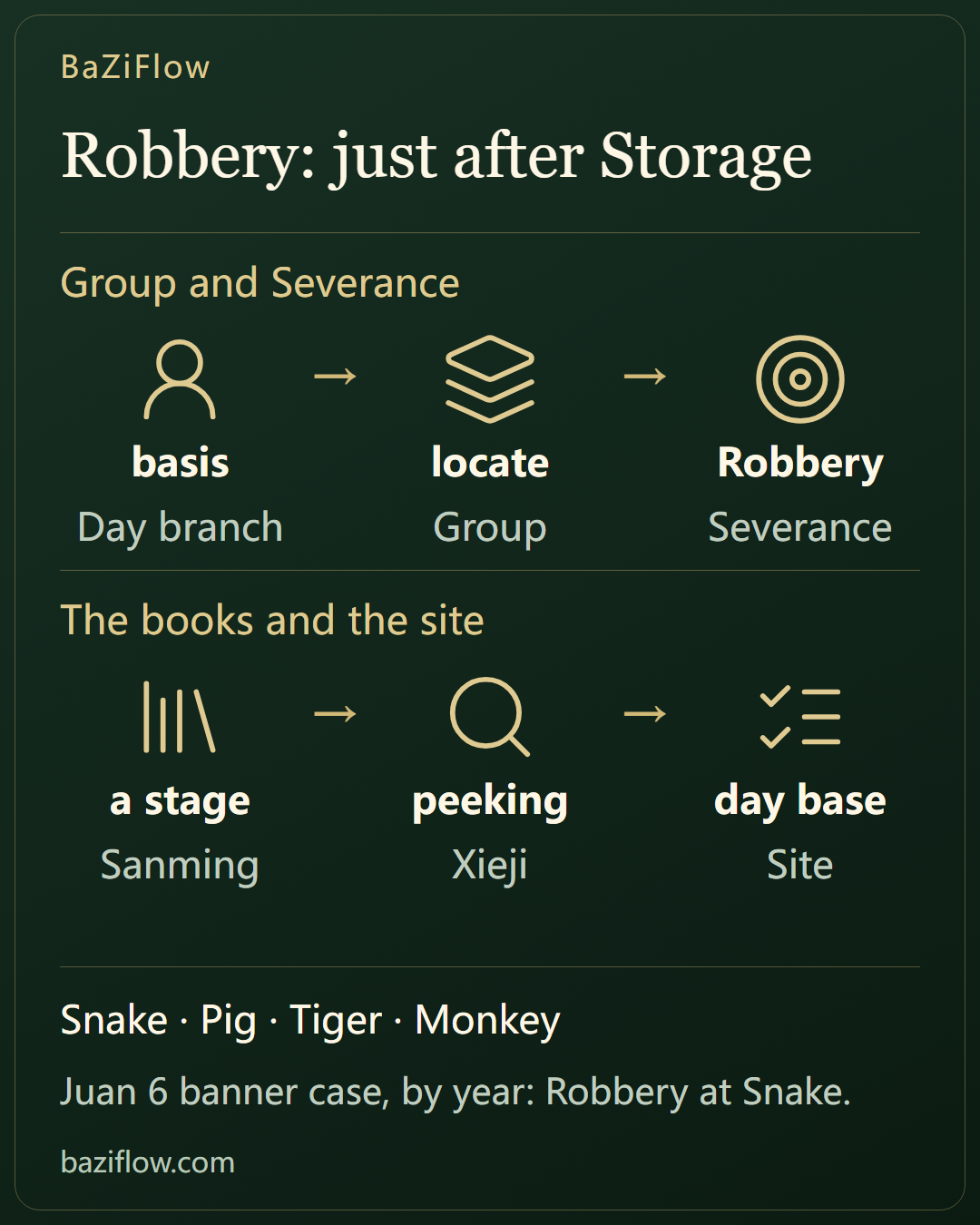
The Robbery Sha starts from the day branch and takes the spot right after Storage in its Three Harmony group, the Severance stage: always Tiger, Monkey, Snake or Pig. A table, two charts, two classical readings.
The short version8 min read
The basis of the Robbery Sha is the day branch: it sits one step past Storage in the Three Harmony group of the day branch, which is that group's Severance spot, always one of Tiger, Monkey, Snake and Pig, and it is looked for in the year, month and hour pillars.
- Monkey-Rat-Dragon gives Snake, Tiger-Horse-Dog gives Pig, Snake-Rooster-Ox gives Tiger, Pig-Rabbit-Goat gives Monkey. The four landing spots are the four Growth branches, and the day pillar's own branch is left out.
- The Sanming Tonghui reads it as the Severance stage and names the hidden stem that "robs" the group's element; the Xieji Bianfang Shu pictures it as the branch pressed against the end of the group, eyeing the place.
- The same four pairs start from the Grand Duke (year branch) in the Xieji Bianfang Shu and from the day branch on this site, so one chart can be hit under one start and missed under the other.
Read first
Symbolic Stars in BaZi: Check the Reference and Rule Before the Meaning ↗
Find the group, then step past Storage
The Robbery Sha (劫煞) is found in two moves. Start with the day branch and name its Three Harmony (三合) group; then go to the last branch of that group, Storage, and step one place further. That place is the Robbery Sha.
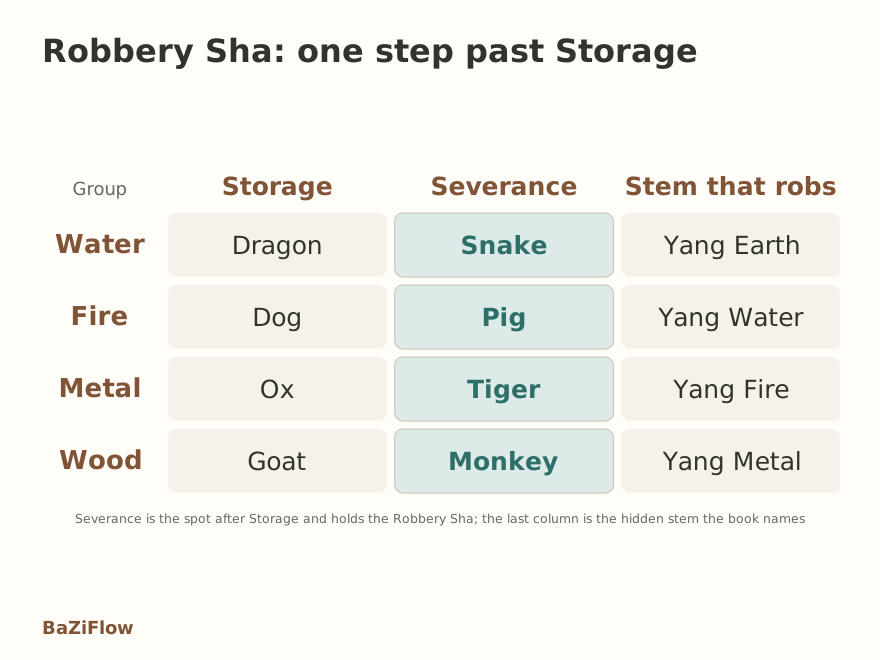
Table: Storage and Severance are checked against the twelve-stage table, the Robbery Sha spots come from the site engine, and the last column is the stem the Sanming Tonghui names, checked against the engine's hidden-stem table.
Each row is a Three Harmony group. Its three branches run Growth, Peak, Storage, and the spot after Storage is called Severance in the twelve life stages table: in the Water group Storage is Dragon and the next spot is Snake; in the Fire group Storage is Dog and the next is Pig; in the Metal group Storage is Ox and the next is Tiger; in the Wood group Storage is Goat and the next is Monkey. All four landing spots are Tiger, Monkey, Snake or Pig. The site's chart reading lists this shensha together with its starting basis, and for this one the basis column says day branch.
The first picture in the books: Severance, and the stem that "robs"
Juan 3 of the Sanming Tonghui (三命通会), a Ming-dynasty compendium, has a section on the Robbery Sha and the Death God. It pins down the landing spots first:
The Robbery lies at the Severance of the five elements, the Loss at their Establishment; both belong to Tiger, Monkey, Snake and Pig.
"Severance" is the spot in the table above. The book then goes group by group, and each time it names the stem inside the landing branch that does the robbing:
Water is cut off at Snake; for Monkey, Rat and Dragon the Robbery Sha is Snake, because the Yang Earth inside the Snake robs Water.
The other three groups are written the same way: Fire is cut off at Pig, and the Yang Water inside the Pig robs Fire; Metal is cut off at Tiger, and the Yang Fire inside the Tiger robs Metal; Wood is cut off at Monkey, and the Yang Metal inside the Monkey robs Wood. The "robber" is the stem, among those hidden in the landing branch, that controls the group's element.
Enlarge diagram · scroll sideways to read
The second picture: just below the end of the group, eyeing the place
The Xieji Bianfang Shu (协纪辨方书), a Qing-dynasty court compendium on choosing dates, groups the Robbery Sha, the Calamity Sha and the Year Sha as the "three shas" in its juan 3. The editors add their own remark on the word "rob", taking the Fire group as the example:
Pig is the Robbery Sha. As for "robbing": the Three Harmony group is Fire, Dog stands at its end and Pig sits just under Dog, glaring in between to take its place, which has the look of theft.
The Fire group of Tiger, Horse and Dog ends at Dog, and Pig is pressed up against it from below, like someone sizing up a seat to slip into. That is where the sense of theft comes from. The two pictures point at the same landing spot: the Sanming Tonghui reaches it through the twelve life stages as the Severance spot, the Xieji Bianfang Shu through its place right beside the end of the group.
Enlarge diagram · scroll sideways to read
Two charts
Both charts use branches only. In chart one the day branch is Rooster, which belongs to Snake-Rooster-Ox, the Metal group; Storage is Ox, the next spot is Tiger, so the Robbery Sha is Tiger. In chart two the day branch is Horse, which belongs to Tiger-Horse-Dog, the Fire group; Storage is Dog, the next spot is Pig, so the Robbery Sha is Pig.
Enlarge diagram · scroll sideways to read
Chart one is hit only in the month pillar. In chart two Pig turns up twice, so the year pillar and the hour pillar are hit once each, and the site marks them separately. Neither chart's day branch appears among its own Robbery Sha, which is the rule from the first section at work.
The same table, started from the year in the old almanac
The Xieji Bianfang Shu quotes Li Dingzuo for the same four pairs:
When the year is Tiger, Horse or Dog, it is at Pig; Pig, Rabbit or Goat, at Monkey; Monkey, Rat or Dragon, at Snake; Snake, Rooster or Ox, at Tiger.
These four pairs match the site's table exactly. What differs is the starting point: here "the year" is the Grand Duke (太岁), the year branch of a particular year. In that book the Robbery Sha is a direction god that moves with the Grand Duke each year, and the direction where it stands is avoided for groundbreaking and building that year; the use is date selection. The site puts it into a natal chart and starts from the day branch. The Sanming Tonghui also reads it from the year: its sixteen kinds weigh the Robbery Sha against the year, and its juan 6 example chart (Yang Metal Dragon, Yang Fire Dog, Yang Metal Horse, Yang Fire Rat) puts the Robbery Sha at Snake, which is what the year branch Dragon gives through the Monkey-Rat-Dragon group; started from the Horse day branch it would be Pig.
Run chart one again and the difference shows:
Enlarge diagram · scroll sideways to read
So before accepting "has a Robbery Sha", look at which basis is printed beside it. The two bases can give opposite answers, and one cannot be used to confirm the other.
What the books say, and where the site puts it
The Sanming Tonghui gives the Robbery Sha no single verdict. It splits it into "sixteen kinds", each with its own alias and its own condition. A few lines side by side:
Three kinds of remark on the Robbery Sha
Opposite lines in one section
One verse says the Robbery Sha is a calamity that cannot be withstood; another says a Robbery God wrapped around an Officer star can "hold military power". Both stand, and the book does not choose.
Each pattern has a condition and an alias
The "Robbery Sha announces its banner" pattern needs a Nobleman to arrive with it and is also called the banner and flag; the "idle Robbery Sha" needs the Lonely stars with it and is also called mist and clouds. Change the condition and the reading changes.
A position and a prompt
The site's line is "a position of being robbed and of sudden events; read the terms carefully when money, contracts or people are involved", a modern prompt built on the word "rob".
For the Ten God that also carries "rob" in its name, see Rob Wealth. The neighbor one spot on is the Calamity Sha, a front-and-back pair with this one; the stage the landing spot belongs to has its own page, Severance; and how much weight any shensha deserves is the subject of where shensha belong in a reading.
Questions readers ask next
If the day branch and the year branch belong to different groups, are there two Robbery Shas?
The site gives one: the day branch fixes the group, so there is a single landing spot. Running the older year-branch method gives a different branch, but that is the result of another start. The two are not added together.
Is the Robbery Sha the same thing as Rob Wealth among the Ten Gods?
No. Rob Wealth is a relation between the Day Master and another stem, so it is looked up on stems. The Robbery Sha is a shensha started from the day branch and landing on a branch. The two tables are unrelated; only the word "rob" is shared.
Is the Robbery Sha always a bad sign?
The old verses go both ways: one line says the Robbery Sha is a calamity that cannot be withstood, another says a Robbery God that meets an Officer star can "hold military power". The book splits it into sixteen patterns and each depends on who stands beside it. The position itself only tells you where it is.
Was this article helpful?
Sources & references
Continue reading
Heavenly Doctor (天医): The Branch Before the Month, and Tables Sharing the Name ↗
Calamity Sha (灾煞): One Spot After the Robbery Sha, Opposite the General Star ↗