

Three of Wands: watching the ships
Content version · · Sources & references
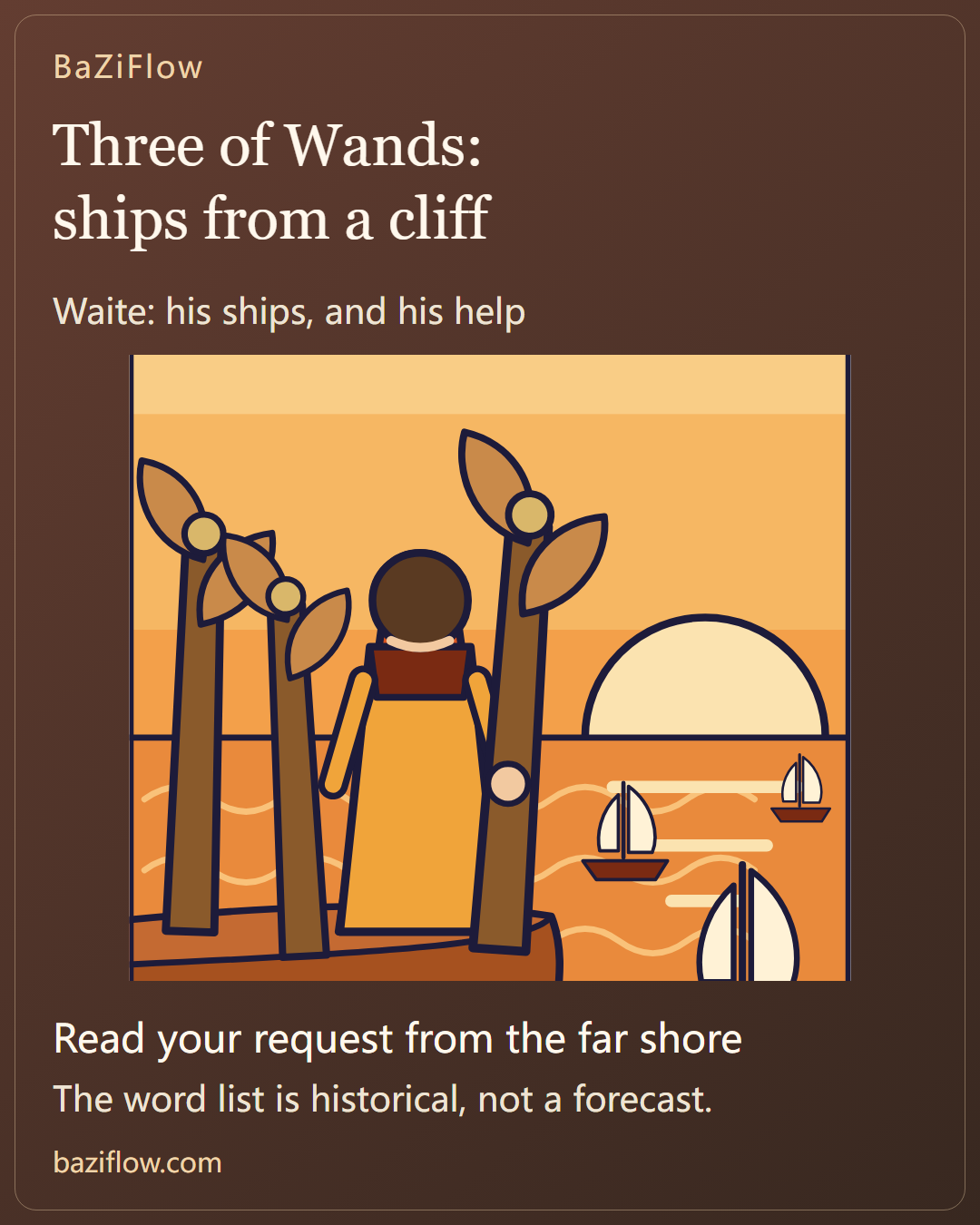
The Three of Wands shows a figure with his back turned at a cliff edge, watching ships, three staves beside him. Separate the picture, the list and the reversed entry, then read a field booking from the far shore.
The short version7 min read
In the Three of Wands a figure with his back turned watches his ships from a cliff. Waite's list holds two viewpoints: his own strength, and his look toward your side as help.
- The card is a back, three staves and ships at sea; Waite calls the figure calm and stately and gives no expression.
- The first half of the list is his own position: established strength, enterprise, effort, trade, commerce, discovery, "his ships". The second half switches viewpoint: a successful merchant prince looks from his side toward yours, to help.
- Reversed, the entry speaks of troubles ending. The extras add one line: a very good card, with collaboration favoring enterprise.
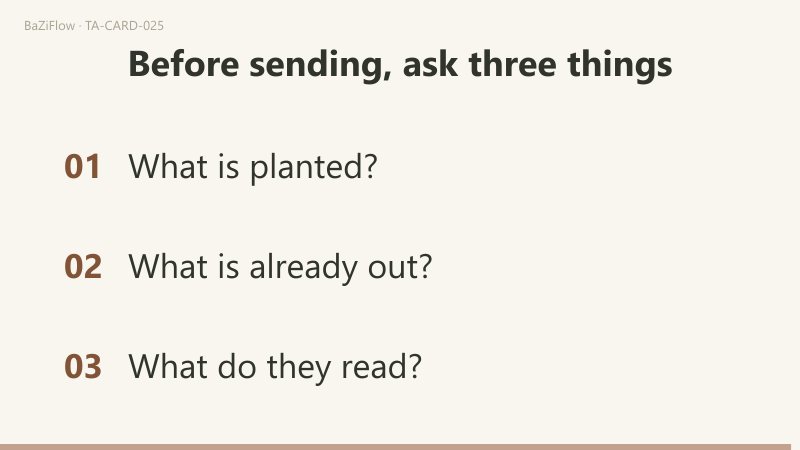
Read first
The back at the cliff: three staves planted, ships far out
Waite draws the scene briefly: a calm, stately personage, with his back turned, looks from a cliff's edge at ships passing over the sea. Three staves are planted in the ground, and he leans slightly on one of them.
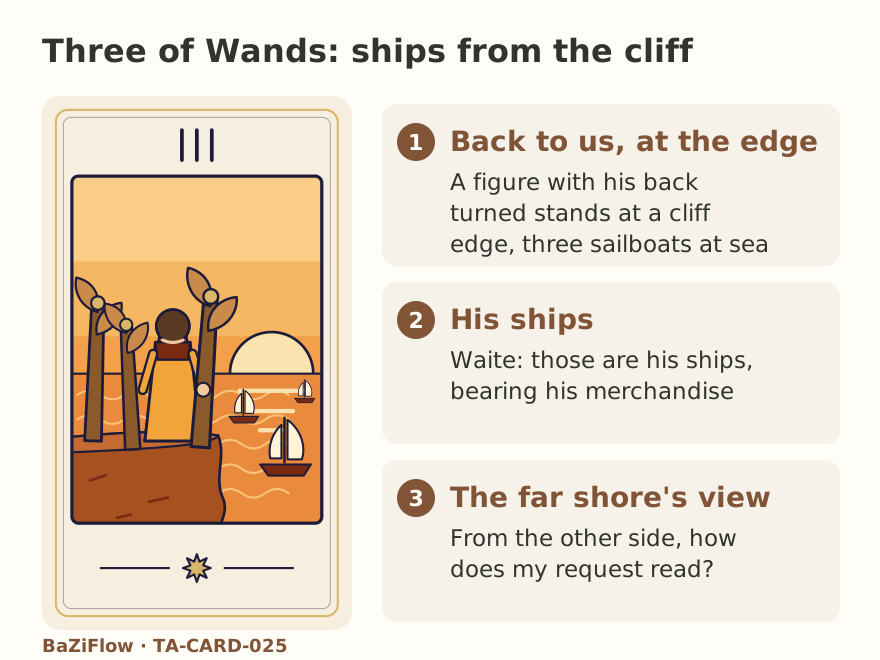
BaZiFlow's own Three of Wands, with three ways in.
On the Rider-Waite-Smith card the figure wears a green cape over a red robe with a pale band around his head, and his back fills the center of the picture. Of the three staves one stands to his left and two to his right; he reaches out to the rightmost, and each staff is topped with small leaves. Under his feet is a rock, ahead a yellow-brown sea, and at the far right small boats can be made out.
Take the picture in three places: underfoot, beside him, far off.
Enlarge diagram · scroll sideways to read
What Waite lists: his ships, and a look "from his side towards yours"
Waite's meanings come in two halves. The first is his own position: established strength, enterprise, effort, trade, commerce, discovery; and then, those are his ships, bearing his merchandise, which are sailing over the sea.
The second half changes viewpoint: the card also signifies able co-operation in business, as if the successful merchant prince were looking from his side towards yours with a view to help you.
He symbolizes established strength, enterprise, effort, trade, commerce, discovery; those are his ships, bearing his merchandise, which are sailing over the sea. The card also signifies able co-operation in business, as if the successful merchant prince were looking from his side towards yours with a view to help you.
Enlarge diagram · scroll sideways to read
In the second half a "yours" appears. It is not an object in the picture; it is the reader's own side: the merchant at one end of the sea, you at the other.
Back, three staves, ships: what Waite wrote and what the picture adds
There is little on this card: a back, three staves, ships. Waite touches each, briefly.
Back, staves, ships: who says how much
- The back
- Waite writes "with his back turned" and gives no face or expression. The Rider-Waite-Smith card shows a cape, a robe and a band around the head; it gives no expression either.
- Three staves
- Waite writes "three staves are planted in the ground, and he leans slightly on one" and does not say what "three" stands for. On the card there is one at left and two at right, with small leaves at the tops.
- Ships
- Waite says "those are his ships, bearing his merchandise". On the card the boats are small and far out; what they carry and where they sail the text does not say.
Enlarge diagram · scroll sideways to read
How to read it: cross to the far shore and read your own request
Three things in the picture can be carried straight over: the three staves planted underfoot, the ships already set out, and the viewpoint in the second half of the list, the merchant looking from his side toward yours. Use them on an everyday matter: an amateur football team wants a school field every Sunday evening and has already sent the caretaker a request. The mapping below is borrowed by teaching.
Enlarge diagram · scroll sideways to read
How many staves are planted?
Waite has three staves in the ground. On paper, write the three things the team has already settled: about twelve players, Sundays from seven to nine, one named contact. If you cannot fill three, the request still lacks a frame.
How many ships are at sea?
Ships are things already sent and not yet in: Monday's booking form, a message asking the price, a call about the deposit. Note the date sent and whom you are waiting on, and the same question will not go out twice.
What does the far shore read?
In the second half of the list the merchant looks from his side toward yours. Move to the caretaker's side and read the request through: who is responsible, how long each session runs, how it is paid, what happens in rain or on cancellation. Can he see those? Whatever he cannot, add.
One request, read by two people, gives two different readings:
One request, two readers
The version written for ourselves
"We'd like to use the field Sunday evenings, ten or so of us, for the long term."
The questions he has to answer
Who is the contact? From what time to what time? What about damage or clearing up? How early must a cancellation be said?
What the revision adds is exactly what only the other side could see.
Reversed and neighboring cards: the end of troubles, not a block
Waite's reversed entry reads: the end of troubles, suspension or cessation of adversity, toil and disappointment.
The end of troubles, suspension or cessation of adversity, toil and disappointment.
This is not the upright "success" turned over into failure; it speaks of something else, trouble stopping. The popular "blocked" and "delayed" belong to other methods and are not in this passage. The additional meanings are one line: a very good card, collaboration will favor enterprise.
Enlarge diagram · scroll sideways to read
Three cards, and where each puts the distance
The card before: a globe in the hand
He also looks out from a height, but the globe is still in his hand and Waite mentions no ships. That list is two readings that cannot merge; the man of the Three already has ships of his own.
The same number, a different craft
Waite writes a sculptor at work in a monastery. The list: métier, trade, skilled labour, though usually regarded as a card of nobility, renown, glory. The trade of the Three of Wands is across the sea; here it leans toward craft.
The next card: back on shore
Four staves stand in the foreground with a garland strung between them and two women lifting bouquets. The list leans toward settled country living and rest.
Questions readers ask next
Is the Three of Wands "the waiting card"?
Waite does not use the word waiting. The figure watches the ships, the list speaks of established strength and enterprise, and the ships are "his ships", already at sea. Reading it as "waiting for a reply" is a later teaching borrowing; use it if you name the source.
Does the Three of Wands reversed mean "blocked"?
Waite's reversed entry is the end of troubles: adversity, toil and disappointment suspended or ceasing, which leans toward easing. "Blocked" and "delayed" are phrases from other methods, so say where yours come from.
Who is the "he" in the Three of Wands?
Waite writes "as if the successful merchant prince were looking", a figure of speech. He does not say it is the true identity of the man in the picture, nor that such a person will turn up in real life.
Was this article helpful?
Sources & references
Continue reading
Two of Wands: a globe in hand, and two readings Waite says cannot be married ↗