

Understanding yourself
Content version · · Sources & references
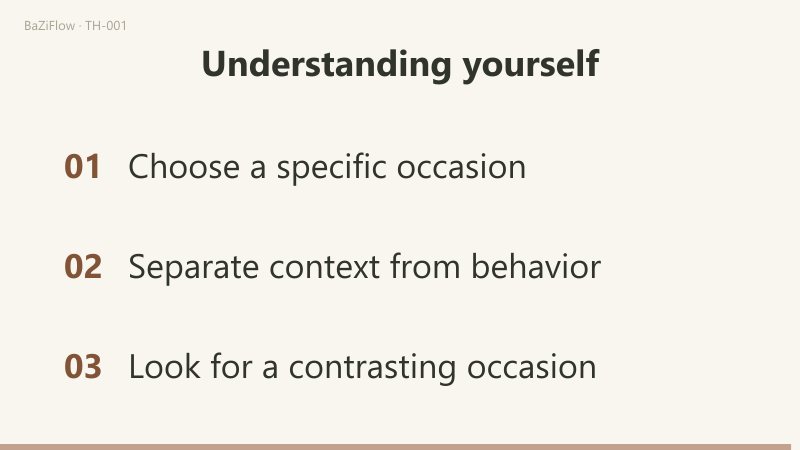
Begin with a question you can observe, then choose a route through the four pillars, Sun–Moon–rising symbolism or the evidence behind a personal reading. Keep the person larger than any label.
The short version6 min read
“I am indecisive” combines many experiences into one claim. Choose an actual decision and ask what was missing, what you did and what happened next. The reading can then become a question you can investigate.
- A Day Master, Sun or Moon is a particular chart component, not a complete person.
- A behavior becomes more informative when its situation and constraints are recorded.
- An exception can refine a description instead of being discarded to protect it.
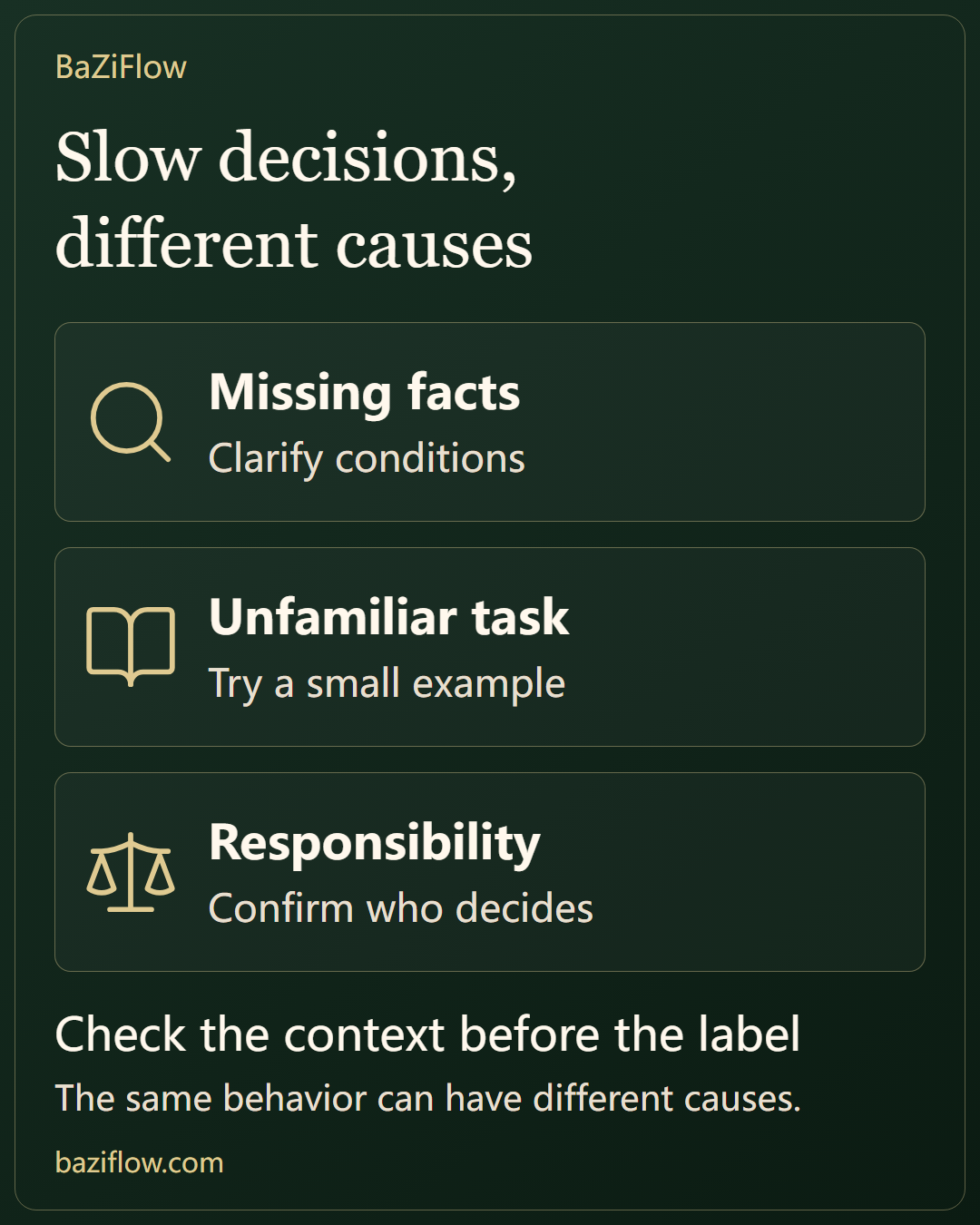
A description feels accurate. What exactly did it describe?
Perhaps a reading calls you slow to decide. Before adopting the label, identify a situation. Were you unfamiliar with the task, missing information or responsible for an important consequence? You may act quickly in well-practiced work and cautiously elsewhere. Those differences are useful information, not inconvenient exceptions to remove.
A broad question such as “What kind of person am I?” can absorb many plausible descriptions. A smaller question gives the reading a clearer role: how do I begin an unfamiliar task, or how do I respond when someone disagrees with me? Keep the context in the question so that later reflection has something specific to examine.
An identity label
- Generalizes across occasions
One slow decision
- Has a context to investigate
A slow decision can have more than one explanation
- Situation
- The task, available information and responsibility surrounding a particular action.
- Exception
- An occasion on which the same person behaves differently under different conditions.
Pick the kind of understanding you need first
You might want to identify the symbols in a chart, distinguish different interpretive roles, or inspect why a paragraph claims to describe you. These are different learning tasks. You do not need to study every system at once, and you do not need a final identity label before beginning.
| Your immediate question | A useful starting route |
|---|---|
| Where does this symbol sit? | Four-pillar structure and the Day Master |
| Why do these factors have different roles? | Sun, Moon and rising in a stated astrological approach |
| What makes this explanation personal? | Input-specific evidence and the limits of inference |
The routes are options for learning a symbolic language. They are not three tests that collectively determine who you are. It remains possible to understand a tradition clearly without accepting every personal application made in its name.
Learn Four Pillars
- Identify positions and relations
Learn Sun–Moon–rising
- Distinguish bodies and an angle
Read the structure before turning it into adjectives
For BaZi, begin with the four pillars and Day Master. Locate the year, month, day and hour positions and the reference point used for relationships within the chart. A zodiac animal or a single element name cannot stand in for that whole structure.
Volume two of San Ming Tong Hui discusses the four time positions and reading with the day as a reference while considering the others. This is historical support for an internal method. It is not validation of a modern personality instrument, and the Day Master should not be treated as a ranking of human worth or a complete description of a person.
For astrology, Sun, Moon and rising offers a first distinction among factors. A planetary position and an angle are different kinds of chart objects. Do not turn their names into three disconnected personality stickers or let the Sun sign replace the rest of the chart.
Carole Taylor's introductory material organizes the subject through planets, signs, houses and their relationships, with different symbolic roles for the Sun and Moon. That supports an account of a teaching tradition, not an established psychological measurement. Swiss Ephemeris documentation concerns calculation conditions; the move from calculated position to personal meaning remains an additional interpretive step.
If the birth time is uncertain, retain the uncertainty around time- and place-dependent factors. A passage feeling familiar does not establish that an uncertain time must be correct. Recognition and input verification need different forms of support.
Four Pillars
- A positional structure
Day Master
- The day-stem reference
Ten Gods
- Relations to that reference
Bring the question back to an actual situation
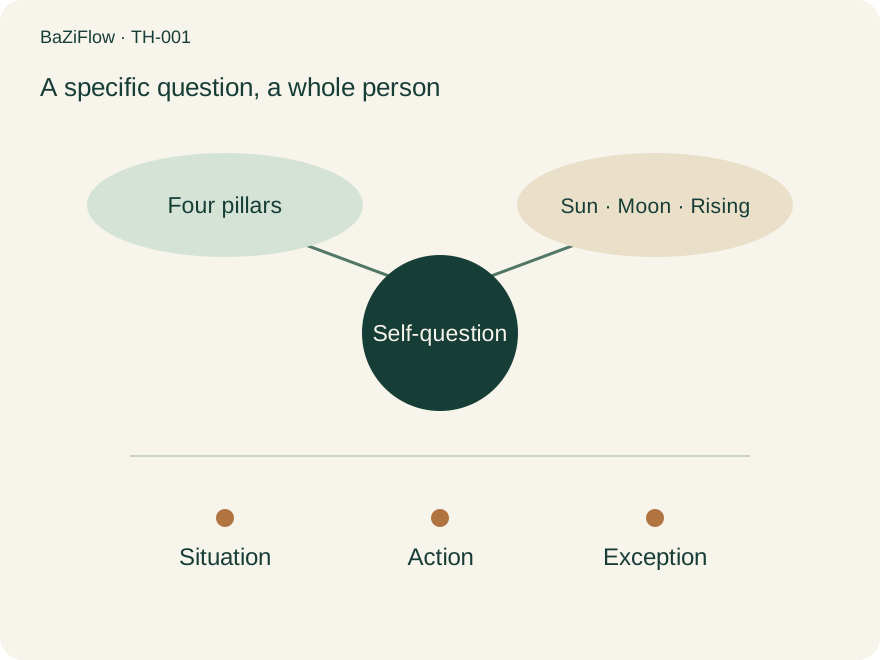
Original BaZiFlow self-reading route map. Connections show learning options, not a causal determination of personality.
The diagram keeps the learning routes above a separate set of observations: situation, action and exception. The connecting lines offer places to begin reading. They do not show a symbol causing a fixed personality.
Return to the example of slow decisions. Record what happened and what you did, not only the adjective you used afterwards. Include a case where your behavior differed. You may discover that the question concerns missing information, unfamiliar responsibility or a particular interaction, rather than a permanent quality that explains everything.
This does not require rejecting your experience of feeling understood. It asks what kind of statement that experience supports. The guide to evidence-based personal readings helps distinguish a personally resonant sentence from an explanation grounded in the particular input.
If the paragraph could describe many people after changing only the name, ask which details make the interpretation specific. Do not manufacture a connection where the material does not supply one. A question left open is more informative than a confident label with no visible basis.
Waiting for quotes
- What is missing?
- Relevant information
- What could be observed next?
- A decision after all quotes arrive
First attempt at a task
- What is missing?
- Practical familiarity
- What could be observed next?
- A choice after a small trial
Routine work
- What is missing?
- Conditions are already clear
- What could be observed next?
- Whether the same delay occurs
Leave room to revise the account of yourself
A symbolic description may draw attention to a habit worth observing. It should not become a reason to stop trying, a ceiling on your abilities or a verdict on your character. Experience, learning and circumstances can alter how you act, and no short chart description contains all of that context.
After some time, revisit the original question. What supported your first idea? What made you change it? Which situations are still missing from the record? If only matching examples survive, look for the occasions you left out. If the answer remains unclear, another system need not be added merely to force certainty.
The useful outcome of this route is a more precise account of a symbol, an interpretation and an experience. You can state what each contributes without requiring any one of them to define your whole identity.
- Describe an occasion
- Find a contrast
- Refine the scope
- Observe again
This is a revision cycle, not a personality score.
Locate the delay
For example, the person waits because some quotations have not arrived, rather than hesitating over every decision.
Compare familiar work
A quick routine decision would narrow the explanation to the current information or responsibility.
Observe the changed condition
Check what happens after the quotations arrive; that result may support or revise the initial explanation.
Questions readers ask next
Is the Day Master a personality category?
It is first a reference based on the day stem. Understanding its relation to the rest of the chart is different from assigning a complete personality from that one field.
What follows a description that feels accurate?
Attach it to an actual occasion, then compare a contrasting one. Ask which conditions differ before turning the sentence into a general account of yourself.
Can I study with an uncertain birth time?
You can learn general structures. Personal conclusions that depend on an Ascendant, houses or an hour pillar should retain the uncertainty in the input.
Was this article helpful?
Start reading
Reading a BaZi chart for the first time: the four pillars and the Day Master ↗ · BaZi
Sun, Moon and Rising: Two Luminaries and One Intersection ↗ · Western astrology
Personalization Needs a Reason That Changes with the Input ↗ · Cross-system studies
Sources & references
Continue reading
Reading a BaZi chart for the first time: the four pillars and the Day Master ↗
Sun, Moon and Rising: Two Luminaries and One Intersection ↗
Personalization Needs a Reason That Changes with the Input ↗