

Six of Pentacles: weighed, then given
Content version · · Sources & references
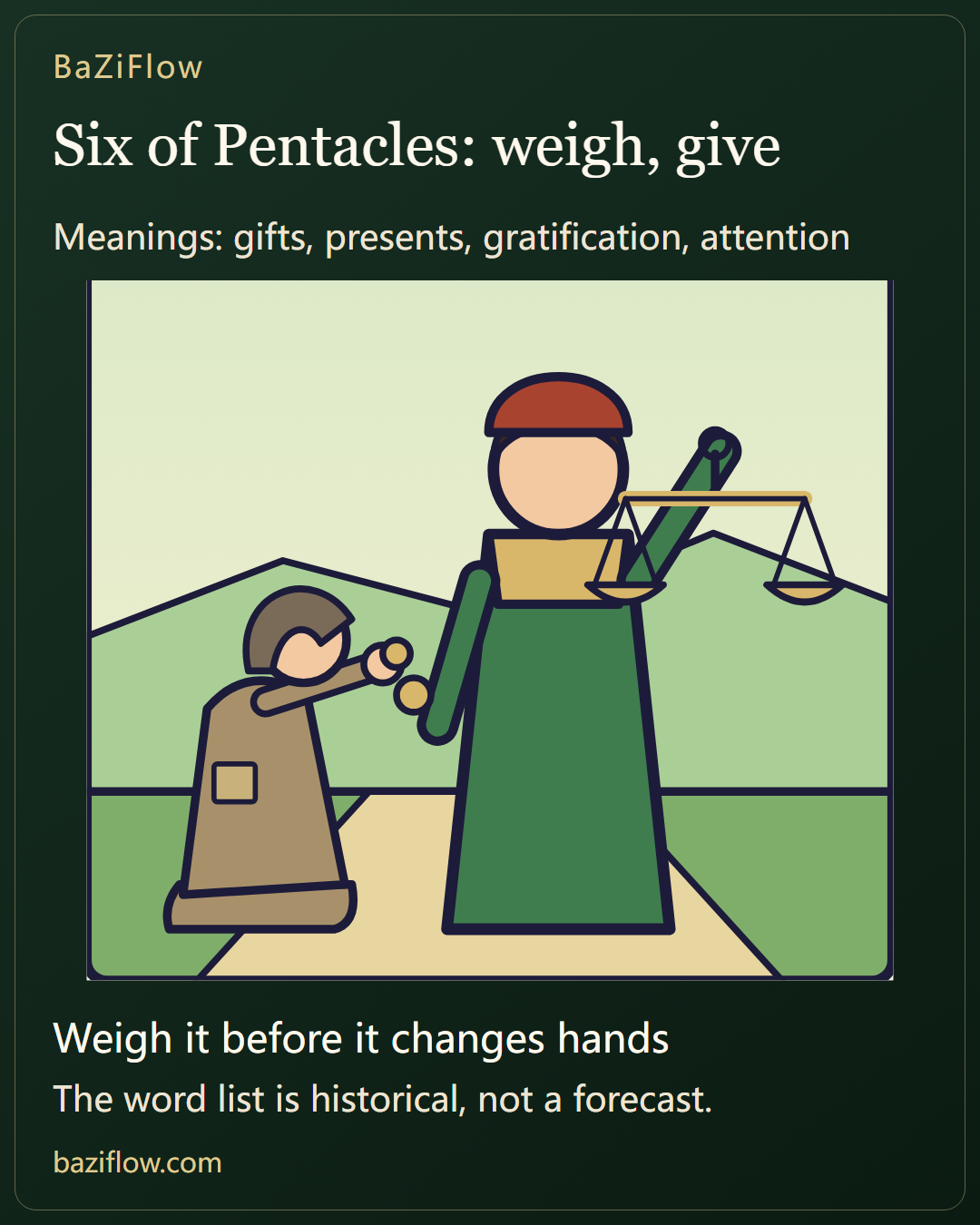
The Six of Pentacles shows a merchant holding scales while coins fall toward a hand held out from below. Read the picture, Waite's words and the extras apart, then split a second-hand handover into weigh, give, receive.
The short version7 min read
The Six of Pentacles puts three things in one picture: a pair of scales, falling coins and a reaching hand. It is about how a giving is measured, handed over and received.
- Waite's description: a figure in the guise of a merchant weighs money in scales and distributes it to the needy, as testimony to his success and his goodness of heart. Words: presents, gifts, gratification; another account, attention and vigilance.
- The reversed list is a run of feelings: desire, cupidity, envy, jealousy, illusion. The additional meanings say the present must not be relied on, and reversed, a check on ambition.
- In a question it points at the standard that was weighed, what was handed over and how it was received, not at who deserves to give or to receive.
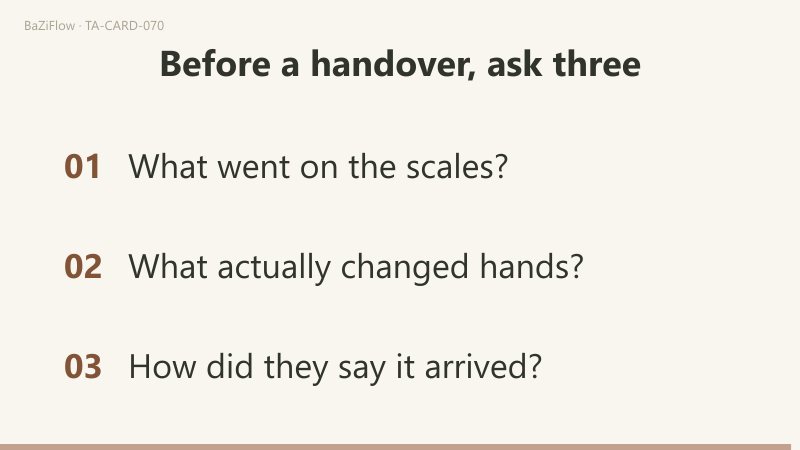
Read first
Start with the picture: scales in one hand, coins from the other
Waite describes the Six of Pentacles in two sentences. A person in the guise of a merchant weighs money in a pair of scales and distributes it to the needy and distressed. It is a testimony to his own success in life, as well as to his goodness of heart.
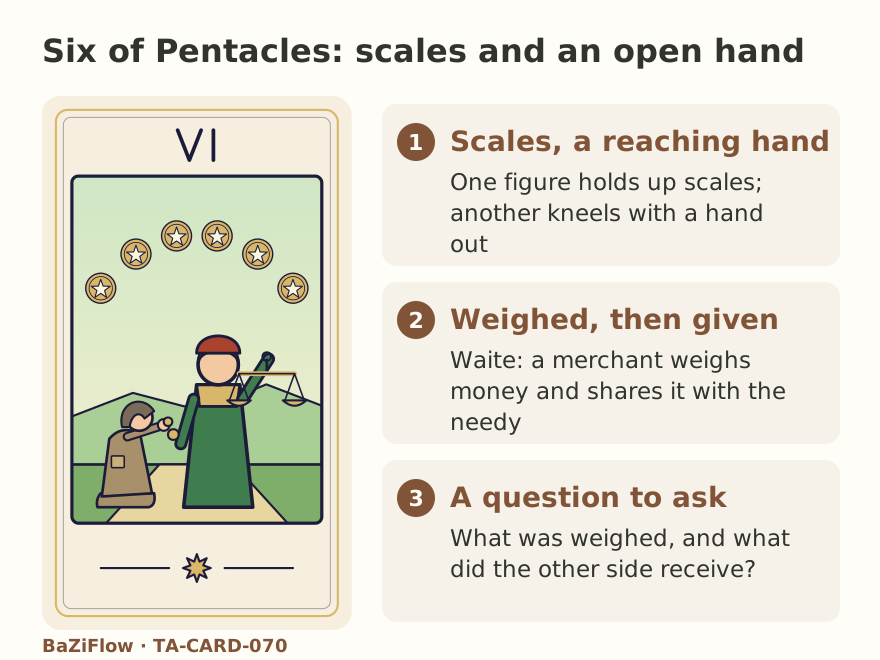
BaZiFlow original Six of Pentacles: scales, a reaching hand
The RWS original has the merchant at the center in a red robe. One hand holds the scales, the other lets a few coins drop toward a palm held up from the lower left; a cloaked figure kneels on either side of him, and six pentacles hang overhead. The BaZiFlow drawing is simpler: one figure stands with raised scales, one kneels with a hand out, and the coins form an arc. Both pictures share one feature. The standing figure has an instrument for measuring; the kneeling side has no instrument, only open hands.
Enlarge diagram · scroll sideways to read
What Waite lists: gifts, vigilance, and "now is the accepted time"
The list of meanings opens with presents, gifts and gratification. Another account gives attention and vigilance, then adds: now is the accepted time, present prosperity. The reversed entry is a run of feelings: desire, cupidity, envy, jealousy, illusion.
Presents, gifts, gratification; another account says attention, vigilance; now is the accepted time, present prosperity... Reversed: Desire, cupidity, envy, jealousy, illusion.
Enlarge diagram · scroll sideways to read
The word to read side by side is "present". The other account in the main entry says now is the accepted time, present prosperity. The additional meanings, from other readers, say the present must not be relied on. The two point opposite ways and Waite sets them next to each other without reconciling them. So the card does not promise that today's ease will last; it carries two attitudes toward "now" at once.
Scales, coins, the one below: who said what
The picture has few symbols, and three deserve separating: the scales, the falling coins and the figure reaching up from below. For the first two Waite gives only an action and not a symbolism.
Three symbols, three sources
- Scales
- Waite writes "a pair of scales" in which the money is weighed. He does not say what they stand for; in Western imagery scales commonly go with measuring and fairness, which is traditional common knowledge.
- Falling coins
- Waite writes "distributes", an action. The text gives no number of coins or amount; in the RWS picture you can see a few coins dropping toward the open hand.
- The one below
- Waite calls them the needy and distressed, and judges the scene "a testimony to his own success in life, as well as to his goodness of heart". The comment stands on the giver's side; how the receiver sees it is in neither the picture nor the text.
Enlarge diagram · scroll sideways to read
Later teachers like to call the scales "the standard" and the low figure "the request": you need a standard before you can weigh, and a request before anyone reaches out. The frame is handy, though borrowed, so say so when you use it instead of attributing it to Waite.
How to read it: split a handover into weigh, give, receive
The card carries three actions of its own: the scales weigh, the coins fall, the hand takes. Moved to a small everyday matter, they become three steps. Suppose you are passing a treadmill you have used for two years to a neighbor in the same building:
Weigh: what goes on the scales?
What gets weighed is what you can say aloud: how long it was used, where it is worn, whether the accessories are included. The scales are in the giver's hand, so this is the step most easily done by feel. Write each item down first.
Give: which thing is handed over?
A coin falling from a hand is a concrete act: a price or free, which day the pickup is, who carries it down. If one of those three is unsaid, the handing over is not finished.
Receive: what lands in the other hand?
The open hand in the picture stands for what the other person actually gets. Ask them to repeat it in their own words, and see whether what they think they are getting is what you think you are giving.
Enlarge diagram · scroll sideways to read
One handover, three states
Already clear
- Condition and extras listed one by one
- Price and pickup day in a line each
Still vague
- "Like new" with nothing behind it
- "Come any time" with no date
Step to add
- Photograph the wear
- Ask them to confirm in one line
Reversed and neighboring cards: a run of feelings, and a present you cannot lean on
The reversed word list of the Six of Pentacles is almost all feeling: desire, cupidity, envy, jealousy, illusion. Any of them could turn up on either side of a handover, but Waite does not say which; reading it as "comparisons bend an exchange out of shape" is a teaching choice. In the additional meanings the reversed entry is a check on the Querent's ambition, a line from other readers.
Neighboring cards, and which side each stands on
Two beggars pass a lit window
The Five of Pentacles pictures the side where nothing has been handed over; Waite opens with material trouble.
Clasping what he owns
The figure in the Four keeps a firm grip on what he owns; against the Six, the hands are closed and nothing is passed on.
Looking at his own coins
A young man leans on his staff and looks at seven pentacles: looking and counting, with no weighing and no giving yet.
Enlarge diagram · scroll sideways to read
Questions readers ask next
Does the Six of Pentacles mean money will come to me?
The word list does start with presents, gifts and gratification, but the picture is about weighing and distributing: one figure stands holding the scales, another reaches from below. Waite also lists attention, vigilance and "now is the accepted time", so the card is not reduced to a single promise.
What does the Six of Pentacles mean reversed?
Waite's reversed entry is a string of words: desire, cupidity, envy, jealousy, illusion. The additional meanings add a check on the Querent's ambition. These words name feelings and attitudes, and he does not say whether they belong to the giver or the receiver.
Can the "needy" in the card be matched to a real person?
That would be a stretch. "The needy and distressed" is 1910 wording, written from the giver's point of view. Modern teaching more often reads it as a side that needs support on one particular matter, a situation and not a kind of person.
Was this article helpful?
Sources & references
Continue reading
Five of Pentacles: a lit window in the snow, and two readings Waite cannot harmonize ↗
Seven of Pentacles: leaning over seven coins, with a word list that argues with itself ↗