

Comparing luck-pillar transitions
Content version · · Sources & references
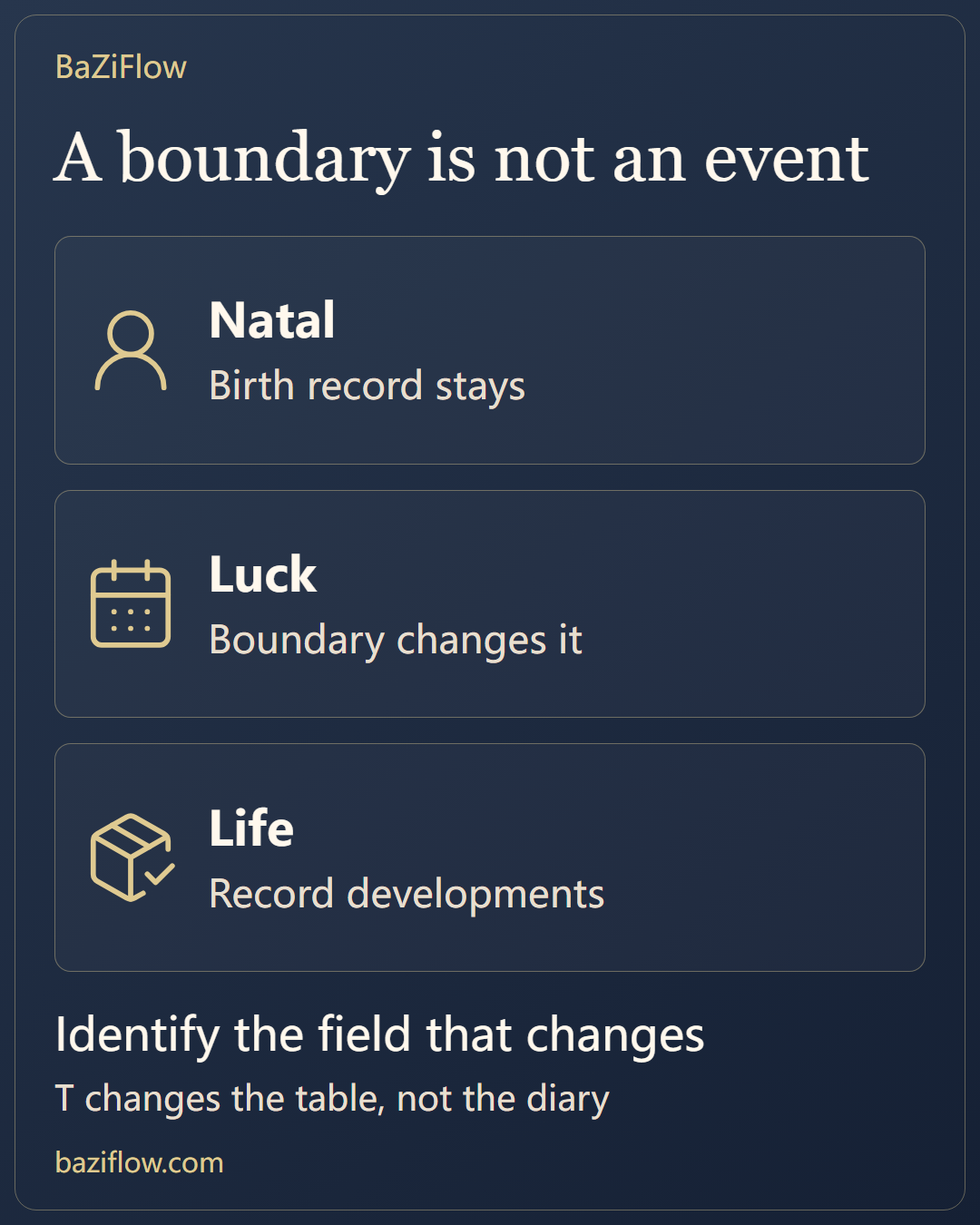
A calculated boundary changes the selected luck pillar, not the natal record or reality by itself. Compare before-and-after snapshots and keep life events as separate evidence.
The short version5 min read
A transition changes a field in the luck table. Keep the natal record, the changing pillar and the independent life record separate before comparing them.
- A transition is a calculated table boundary, not a guaranteed change in work, relationships or income.
- Before-and-after snapshots must track annual and monthly inputs separately rather than assigning every difference to the luck pillar.
- Set a recording interval beforehand and keep uneventful observations as well as apparent matches.
Read first
How luck pillars are derived: separate the sequence from its starting time ↗
Natal, Luck, Annual and Monthly Layers: How to Read Them Together ↗
What would count as no change?
Imagine keeping a record around a luck-pillar transition. Before looking for a striking match, decide how you will record an ordinary week in which nothing noticeable happens. If both a dramatic event and the absence of an event are automatically called confirmation, the exercise cannot distinguish outcomes.
Choose a recording interval in advance if you want to observe one. That is a practical choice for your notes, not a claim that a traditional influence lasts exactly that long. Keep existing plans, developments that actually occur and expectations that do not occur in separate entries. Preserve the original wording so that later knowledge does not quietly become an earlier prediction.
Consider a hypothetical job change: preparation, applications, interviews, acceptance and the first working day are different stages. Selecting whichever date happens to fall nearest a chart boundary does not show that the boundary caused the process. The coincidence can be recorded, but the explanation also needs information about choices, opportunities and work already underway.
The same problem occurs if an initially short observation window is expanded after an event appears. Some traditions discuss residual influence or gradual transitions, but their scope and reasoning differ. A particular claim needs its source and limits. This article supplies no universal effective window, and a note-taking interval should not be relabelled as one after the fact.
Luck-pillar transitions
- Calculated boundary
- The table selects the previous pillar before T and the next after T.
- Life event
- A separate record of actions, timing and circumstances; not an automatic table output.
A date label may not be a timestamp
Before using T in a comparison, establish what the displayed date means. An integer age, a different age-counting convention and a date retaining hours and minutes are not automatically contradictory timestamps. Check the birth input, time basis, sectional-term endpoint, starting-age ratio and calendar arithmetic used by the tools.
The luck-pillar section of Xing Xue Da Cheng, volume three, discusses interval conversion and subsequent ten-year changes. It documents a traditional calculation; a modern program still needs to explain how converted units are added to a civil date. The phrase “ancient method” cannot fill that implementation gap.
How luck pillars are derived separates the sequence from the first starting-time calculation. Later pillars commonly continue in ten-year units under the selected method. Remainders and calendar units must be handled consistently. An unknown birth minute or an unresolved birth time near a sectional-term boundary may justify a range, not a claim of second-level precision.
Display
Integer age
- Check
- Find the calendar date
Timestamp
- Check
- Align zone and units
Range
- Check
- Retain birth uncertainty
Now identify what the calculation actually changes
A luck-pillar transition ordinarily means the calculated move from one pillar to the next. For teaching, call an assumed verified boundary T and let the sequence move from Ding-Mao to Wu-Chen. The birth chart remains the same on either side. The new pair changes the comparison material; it does not generate an entry in a life diary.
| Field | Before T | After T |
|---|---|---|
| Natal pillars | Verified birth record | The same birth record |
| Luck pillar | Teaching example: Ding-Mao | Teaching example: Wu-Chen |
| Annual/monthly layers | Values for the selected time | Change only at their own boundaries |
| Life record | Existing plans and facts | New developments recorded separately |
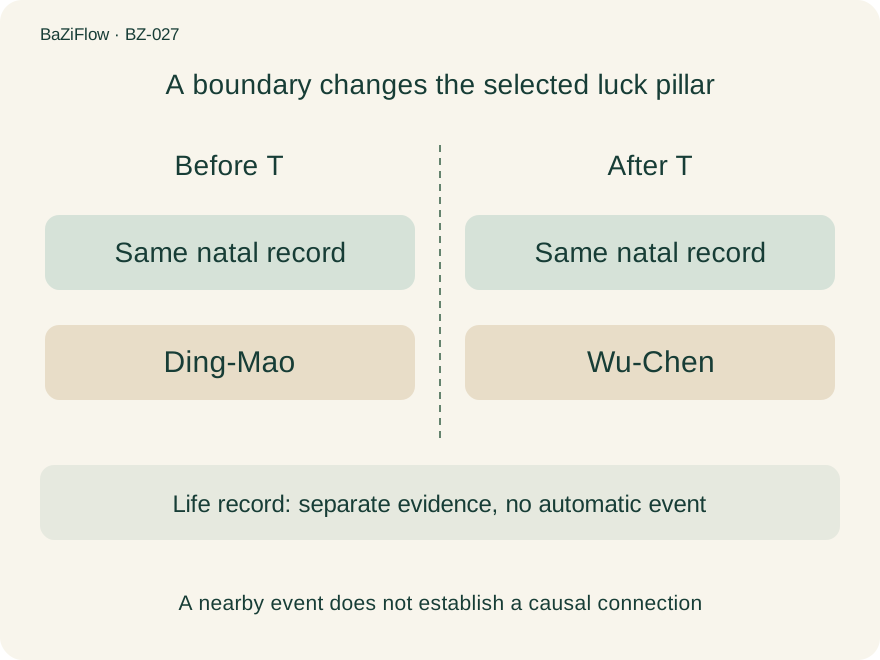
Original BaZiFlow comparison. T is an assumed verified boundary, not a date calculated for a person.
If the selected moments also cross a year or month boundary, mark those changes separately. If they do not, leave those values unchanged. Attributing every before-and-after difference to the luck pillar would hide concurrent inputs. The snapshots make this distinction visible without assuming that either side is better.
Formation and transformation are conditional terms
The chapter on luck bringing formation or transformation in Zi Ping Zhen Quan is not a promise of automatic improvement. It describes how added conditions relate to a configuration, then explicitly includes formation that is not favorable and transformation that is not unfavorable. Reading only the chapter title would lose those qualifications.
Ding-Mao and Wu-Chen change both stem and branch. A substantive traditional argument would identify which natal placement the new pair relates to and what further conditions matter. Without the natal record, one can introduce the two pairs' attributes but cannot invent a person's biography to demonstrate them.
Keeping birth facts unchanged does not require every interpretation to remain unchanged: the comparison inputs differ. Conversely, changed inputs do not prove that work, relationships or feelings must change at the same instant. The calculation and the claim about life therefore require different evidence.
Formation is conditional
Read the conditions, including formation that is not favorable, rather than turning a chapter title into a promise.
Nearness is not causation
An action prepared earlier may span T. Timing alone does not eliminate alternative causes.
Return to the record you made beforehand
A useful review asks whether the earlier explanation identified anything specific, whether its conditions were present, and whether contrary observations were retained. A statement allowing change in any area at any time has little ability to distinguish one transition from another. Adding a new explanation afterward should be labelled as a new explanation.
A calculated date should not be the sole reason to delay care, resign abruptly, invest or make a relationship decision. Those choices need their own real-world information. Natal, luck, annual and monthly layers develops the time framework. Keeping that framework separate from the life record allows a proposed connection to be examined instead of built into the record from the start.
Beforehand
- Existing plans
- Stated expectation
- Start and end
Afterward
- What happened
- What did not
- New explanation
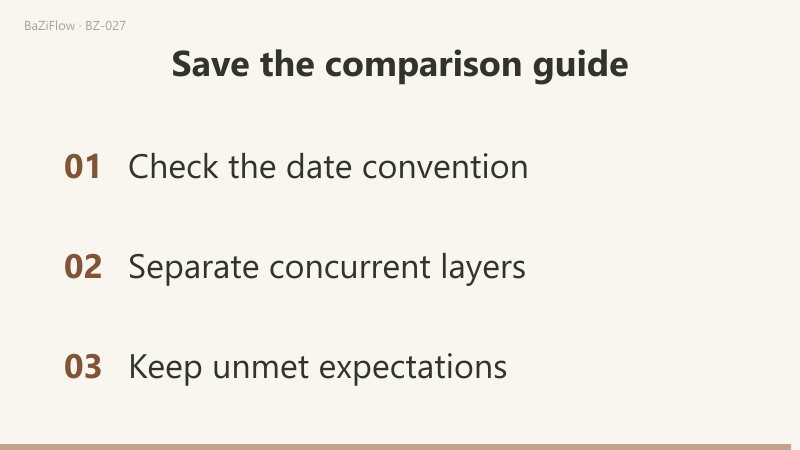
Keep the settings
Save the birth record, time basis, derivation method and displayed precision used to produce T.
Mark concurrent boundaries
List natal, luck, annual and monthly fields side by side; mark which actually cross a boundary.
Consult the diary
Keep plans, developments and unmet expectations in a separate record, preserving the original wording.
Questions readers ask next
Does feeling no change mean the transition date is wrong?
No. Check the birth input, derivation and calendar arithmetic. The absence of an event is not evidence of a computational error.
How should I compare tools that differ by several days?
First align time zones, sectional-term endpoints, calendar arithmetic and displayed precision. A difference is interpretable only after those settings agree.
Does a new luck pillar alter the natal chart?
The birth pillars do not change. The added comparison pillar changes, while annual and monthly inputs follow their own boundaries.
Was this article helpful?
Sources & references
Continue reading
Bazi pattern formation: follow the conditions and assistance ↗
Compatibility beyond animal signs: keep chart fields and relationship evidence distinct ↗