

Xun: doubled wind and two “beneath the bed” lines
Content version · · Sources & references
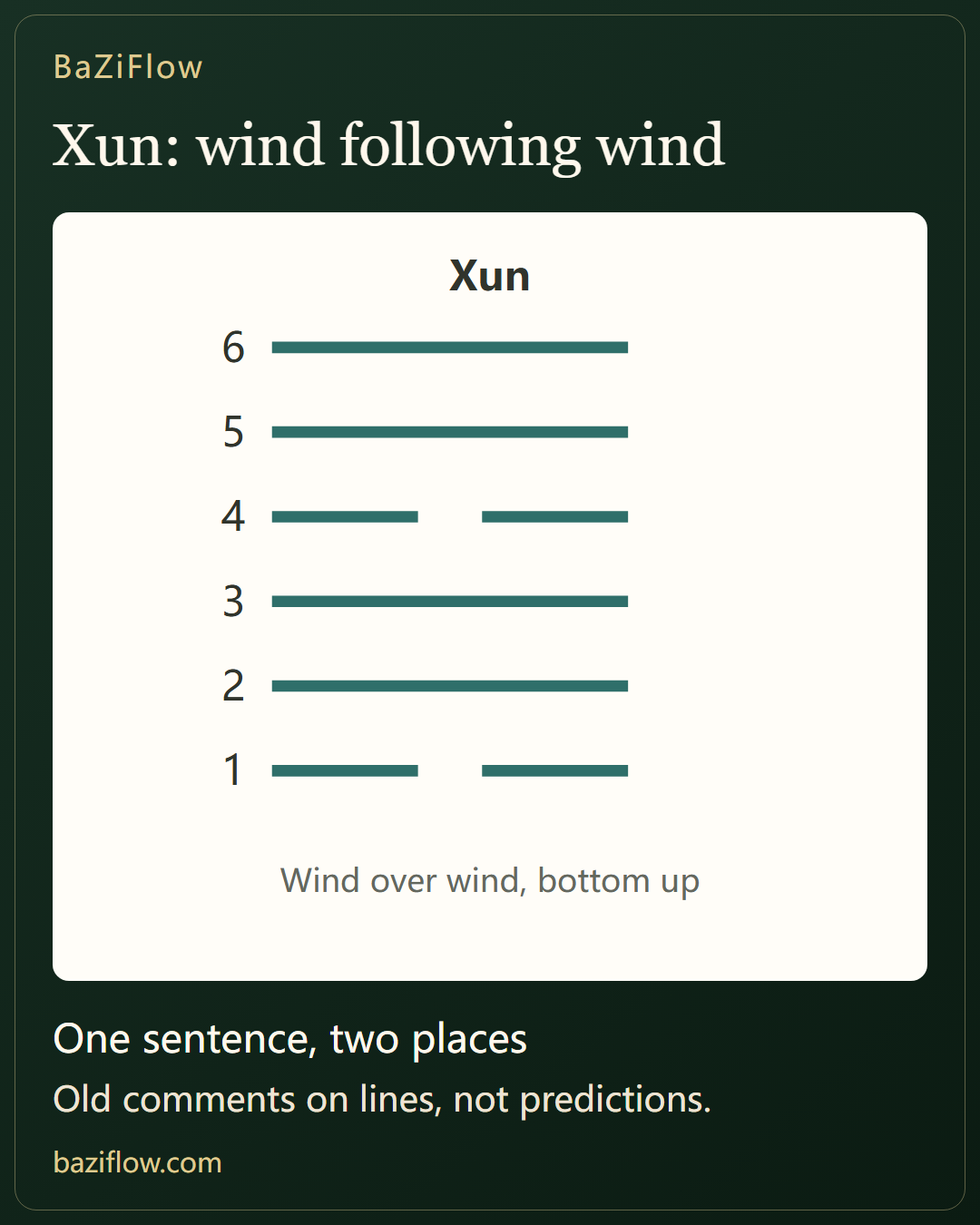
Xun (巽) is the 57th hexagram, wind over wind. Read “with Xun doubled, orders are repeated”, the Great Image on repeating orders, and one sentence, “beneath the bed”, on line 2 and line 6 with opposite results.
The short version8 min read
In Xun the idea of doubling keeps returning: two Xun stacked, orders repeated, “repeated yielding”, and one sentence, “beneath the bed”, written on line 2 and again on line 6 with opposite results.
- Xun stacks two Xun (wind). Each is one yin line under two yang lines. The Shuo Gua gives the trigram the word “entering”, and the judgment has three short sentences that open with “small success”.
- The Commentary on the Judgments says “with Xun doubled, orders are repeated” and the Great Image says the noble person “repeats his orders and carries out his tasks”: the same phrase twice, meaning say it again, then do it.
- “Yielding beneath the bed” stands on lines 2 and 6. Line 2 has good fortune and no blame, with “he has found the middle”. Line 6 loses the funds and ax, with “at the top he has run out of room”.
Read first
The Sixty-Four Hexagrams: How Upper and Lower Trigrams Form One Figure ↗
Judgment and Line Statements: Whole Hexagram or Single Line? ↗
Wind over wind: two Xun, each with a yin line at the foot
Xun (巽) is one trigram stacked on a copy of itself, so it is read as Xun above Xun. Each trigram is a yin line under two yang lines: from the bottom, yin, yang, yang, and then yin, yang, yang again. The Shuo Gua says “Xun is entering”, takes wood and wind as its images, and also links it with “advancing and retreating” and with not being decisive.
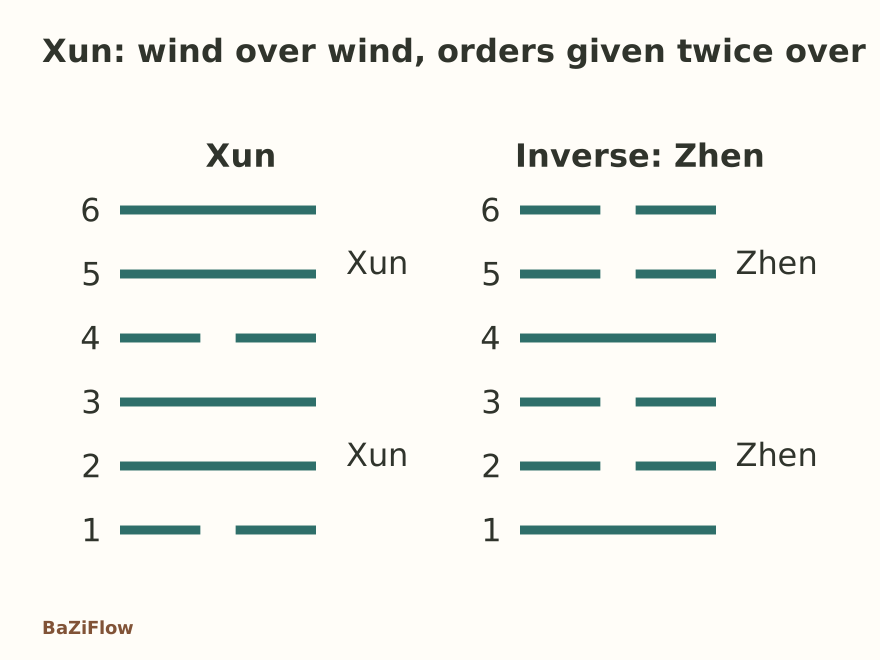
Xun and its inverse Zhen: in the Shuo Gua wind and thunder come as a pair, thunder to stir things and wind to scatter them.
Enlarge diagram · scroll sideways to read
Three words before reading
- Xun
- The Shuo Gua: “Xun is entering”, and also wood and wind. Entering suggests going in, and going in by yielding.
- Doubled Xun
- Both the upper and the lower trigram are Xun, so the figure is called doubled Xun. The Commentary on the Judgments opens with it.
- Repeat
- The Commentary and the Great Image both have “repeat the orders”. To repeat is to say a thing again and again; to repeat orders is to give them twice over.
The judgment and the Commentary: doubled Xun, repeated orders
The judgment of Xun has three short sentences: small success; fitting to have somewhere to go; fitting to see a great person. The Commentary on the Judgments explains “doubled Xun” first and then says where the three sentences come from.
With Xun doubled, orders are repeated. The firm yields at the center, in the right place, and its purpose is carried out. The yielding lines all comply with the firm; this is why there is small success, why it is fitting to have somewhere to go, and fitting to see a great person.
Enlarge diagram · scroll sideways to read
These can be checked on the figure. “Doubled Xun” is simply two Xun. Line 5 is yang and sits in the fifth place, which is a yang place, and it is also the middle line of the upper trigram. That is why the text says “center, in the right place”, and the Small Image agrees: “its place is right and central”. For “the yielding lines all comply with the firm”, look at the yin lines: line 1 has line 2 directly above it, and line 4 has line 5 directly above it, so every yin line has a yang line right on top. The “small” of “small success” gets no separate comment in the Commentary; it simply follows on from “comply with the firm”.
The Great Image: following wind, repeat the orders and act
The Great Image of Xun reads:
Following wind: Xun. The noble person repeats his orders and carries out his tasks.
“Following wind” is one gust coming after another. From it the noble person takes two actions: repeat the orders, and carry out the tasks. Tradition usually reads it like this: as gust follows gust, an order is made clear by being given again and again, and once it is clear the work is done.
Enlarge diagram · scroll sideways to read
The phrase “repeat the orders” has already occurred once in the Commentary: “with Xun doubled, orders are repeated”. The Great Image writes it a second time, so the same words appear twice in one hexagram, which can be read alongside the Commentary’s opening “doubled Xun”.
Six lines: “beneath the bed” written twice
Here are the six line statements of Xun with their Small Image (小象) comments. Within the lines, the word Xun is read as a verb, to yield or bow.
Enlarge diagram · scroll sideways to read
Line 1 is at the bottom: “advancing, retreating; fitting for the steadfastness of a warrior”. The Small Image works in two layers: “the will is in doubt”, then “the will is put in order”. In the Shuo Gua, Xun stands for “advancing and retreating”, and line 1 is exactly that. Line 3 reads “repeated yielding: cause for shame”; tradition reads the word for “repeated” either as again and again or as frowning, and the Small Image says “his aim is spent”. Line 4 reads: regret vanishes; in the hunt he takes three kinds of game, which the Small Image calls “merit”.
The statement of line 5 is the longest: steadfastness brings good fortune, regret vanishes, nothing is unfavorable; no beginning but an end; three days before the geng day and three days after it. Tradition usually reads “geng” as “change”, so it means three days before the change and three days after. Gu (蠱) has the same pattern with the jia day; see Gu.
What stands out in the whole hexagram is lines 2 and 6: the same sentence, “yielding beneath the bed”, appears twice, word for word.
Enlarge diagram · scroll sideways to read
After “beneath the bed”, line 2 goes on: “he employs scribes and shamans in great numbers”. Scribes are those who keep records and speak the words of prayer, shamans are the ritual specialists, and “in great numbers” is read by tradition as many of them put to use. The result is good fortune and no blame, and the Small Image says “he has found the middle”. Line 6 goes on: “he loses his funds and ax”, steadfastness brings misfortune, and the Small Image says “at the top he has run out of room”. One is in the middle and one at the end. The posture is the same, and the reason the Small Image gives is position in both cases.
Dui, Zhen and Kui: neighbors of Xun and its place after Lü
Turn Xun upside down and you get Dui (兌), so Dui is its reversed hexagram (综卦). The inverse hexagram (错卦) is Zhen, shown in the figure above. The nuclear hexagram (互卦) is Kui (睽): lines 2 to 4 of Xun are yang, yang, yin (Dui), and lines 3 to 5 are yang, yin, yang (Li), with Dui below and Li above.
Enlarge diagram · scroll sideways to read
The two yin lines of Xun are the bottom lines of their trigrams; the two yin lines of Dui are the top lines of theirs, one holding up from below, the other covering from above. The Xu Gua puts Xun after Lü (旅):
A traveler who is taken in nowhere: so what follows is Xun, and Xun means entering.
The traveler who has nowhere to stay is followed by the word “entering”. One more link joins the two hexagrams. Line 4 of Lü says the traveler gets his funds and ax, and the top line of Xun says he loses them, one in each of two neighboring hexagrams. The inverse hexagram Zhen is also paired with Xun in the Shuo Gua: thunder is used to stir things, wind to scatter them.
Questions readers ask next
What does “beneath the bed” mean?
Literally under the bed; tradition usually reads it as a posture of lowering oneself as far as one can. The text never explains the act. It writes the sentence on line 2 and again on line 6, each followed by a different outcome, so what matters is which line it stands on.
Why does the judgment say only “small success”?
The Commentary answers from the figure: first line 5, central and in its proper place, whose purpose is carried out; then the two yin lines, each complying with the yang line above. Only after both does it say “this is why” there is small success, somewhere to go and a great person to see. It gives no separate reason for the word “small”.
How are Xun and Dui related?
They are each other’s reversed hexagram: turn Xun upside down and you have Dui (兌). Xun’s two yin lines are the bottom lines of its trigrams, and Dui’s are the top lines. The Xu Gua joins them as entering and then delight.
Was this article helpful?
Sources & references
Continue reading
Lü (旅): fire on a mountain, from “petty and fussy” to the burned nest ↗
Dui: lake over lake, from “harmonious delight” to “delight that draws” ↗
The Sixty-Four Hexagrams: How Upper and Lower Trigrams Form One Figure ↗
Judgment and Line Statements: Whole Hexagram or Single Line? ↗