

Zodiac Animals and Branches: What a Year Label Leaves Out
Content version · · Sources & references
Five different Monkey year pillars share one animal label. Use that example to distinguish a zodiac sign from a complete BaZi chart, and a Year Branch from the same symbol in another pillar.
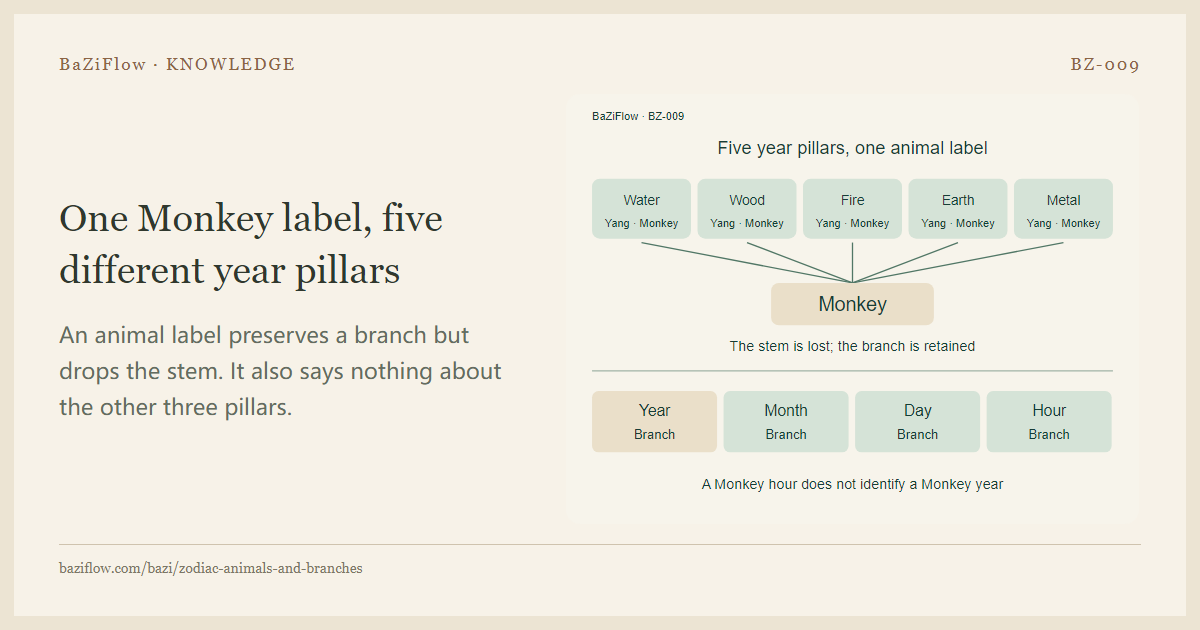
An animal label preserves a branch but drops the stem. It also says nothing about the other three pillars.
Read first
Try the two-card test
Someone hands you a card reading “Hour Branch: Monkey” and asks you to name the year animal. There is no valid answer yet. You have an hour field, not a year field. This small failure to answer is useful: it exposes exactly where a familiar animal name can make us assume more information than we possess.
For a simple exercise, put two statements on separate cards: “Year Branch: Rabbit” and “Month Branch: Monkey.” There is no conflict between the cards. If the animal label is being recorded from the Year Branch, it is Rabbit; the Monkey entry stays in the month field. The exercise provides no date, no person and no complete chart. It tests only whether information is being kept in its correct place.
This distinction also matters when deriving stems. The month-stem procedure depends on the year stem, while the hour-stem procedure depends on the day stem. These are described separately in the month-and-hour derivation section of San Ming Tong Hui, volume 2, and tabulated in the Observatory's stems-and-branches material. Four pillars are not four interchangeable stickers. The introduction to stems and branches explains their different roles in more detail.
A twelve-step return that is not a full return
The branch cycle has twelve positions; the stem cycle has ten. Advancing both sequences together returns a branch to its starting point after twelve steps, but the stem has moved two positions beyond a complete ten-step circuit. Only after sixty steps do both return to the original pair.
This can be checked without memorising all sixty names. In the Observatory's sixty-pair table, the Monkey branch occupies positions 9, 21, 33, 45 and 57. The gaps are twelve. The corresponding stems are Yang Water, Yang Wood, Yang Fire, Yang Earth and Yang Metal. After another twelve steps, the next cycle reaches the initial pairing again. Five repetitions of twelve equal sixty, which is also six repetitions of ten.
Consequently, one sixty-pair cycle contains five Monkey entries but only one Yang Water Monkey entry. The calculation says something exact about a symbolic sequence. It says nothing about two people twelve years apart repeating one another's experiences. The second claim would require evidence that the cycle calculation does not supply.
There is a separate boundary issue near the start of a year. Popular zodiac usage often follows Lunar New Year, whereas a common Zi Ping convention changes the Year Pillar at the Beginning of Spring solar term. Those boundaries need not coincide. When comparing two outputs, record which convention and time basis each uses before treating a difference as an error. A folk-calendar label and a pillar computed under a stated solar-term rule can answer different questions.
Now shorten five records to one label
Keep that distinction in mind while editing a catalogue with five entries: Yang Water Monkey, Yang Wood Monkey, Yang Fire Monkey, Yang Earth Monkey and Yang Metal Monkey. If every entry is shortened to “Monkey year,” the catalogue becomes easier to scan. It also loses the distinction between five Heavenly Stems. Nothing about the shared animal can recover the information that was removed.
This is the relationship between a familiar Chinese zodiac label and a year pillar. In ordinary conversation, a person's animal usually refers to the Earthly Branch assigned to their birth year. A BaZi chart has four pillars, for year, month, day and hour; each pillar has both a stem and a branch. An animal label is therefore a partial description of just one pillar, rather than a compact substitute for all four.
The Hong Kong Observatory gives the five Monkey combinations above as its example of how animals recur in the sixty-pair cycle. Its material establishes a calendrical correspondence. It does not validate a claim that everyone carrying that label has a common personality or future.
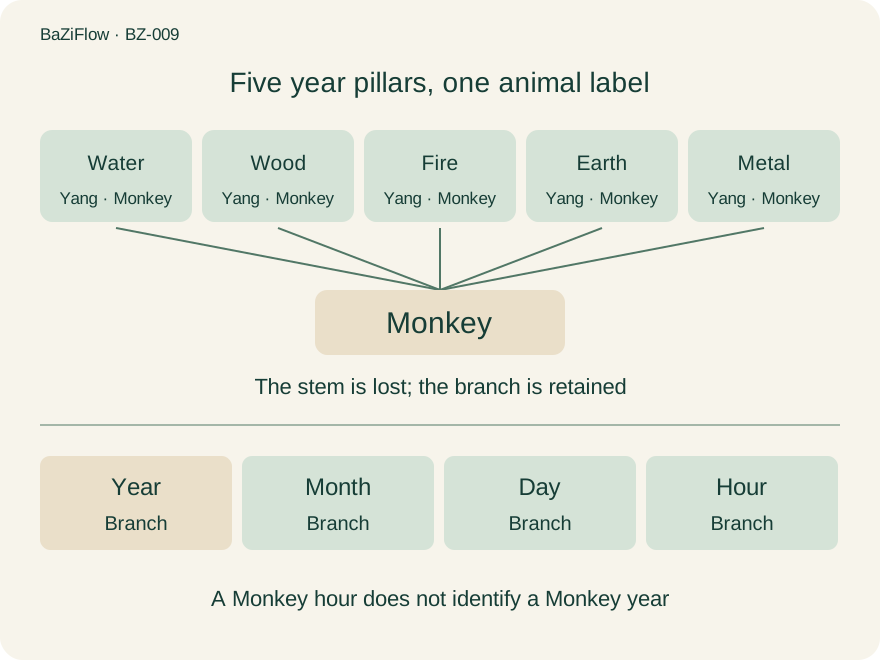
Original BaZiFlow teaching diagram: information lost in a label and the separate scopes of the four pillars; not a personal chart.
Reading a cultural correspondence responsibly
The animal names are paired with the twelve Earthly Branches. The section on branch animals in San Ming Tong Hui, volume 2, documents this traditional mapping. The same correspondence appears in modern calendar education. Historical explanations of animal symbolism should be distinguished from the mapping itself: an old explanation is evidence of an interpretive tradition, not an experiment demonstrating personality differences.
| Branch order | Animal label | Branch order | Animal label |
|---|---|---|---|
| 1 | Rat | 7 | Horse |
| 2 | Ox | 8 | Goat |
| 3 | Tiger | 9 | Monkey |
| 4 | Rabbit | 10 | Rooster |
| 5 | Dragon | 11 | Dog |
| 6 | Snake | 12 | Pig |
The two halves of this table are a layout choice, not a compatibility chart. Reading the left half first and then the right gives the complete branch order. Each position occurs exactly once. Regional animal vocabulary and translation choices can differ, so a comparison across traditions should identify the underlying branch rather than rely on whether two illustrations look alike.
An animal label can help someone learn branch order, recognise calendar traditions or give a short answer in conversation. On its own, it does not disclose the Day Master, the Month Pillar, hidden-stem arrangements or the interactions across two complete charts. Seeing two animal names is not enough to identify which pillars are being compared, much less to establish a relationship outcome.
A useful reading habit is to compare the detail of a claim with the detail of the input. If a text receives only one animal label, it should not present omitted chart information as if it had been supplied. Giving everyone in the same category nearly identical substantive advice does not become individual analysis merely by changing a name or an adjective.
Keep the animal label where it is helpful and leave the missing fields visibly unknown. Before using it to compare two people, read why compatibility cannot rest on zodiac animals alone. That comparison begins by preserving differences rather than allowing a shared label to erase them.