

Compare San He and Flying Star operations
Content version · · Sources & references
A four-position set and a palace-stem transformation arrow encode different information. Learn how to compare these reading frameworks without inventing uniform school rules or accuracy rankings.
The short version6 min read
Two checkable operations clarify different reading emphases. Surrounding-palace selection identifies where to look together; a palace-stem transformation traces a source to a mark on a star. One produces a set of positions, the other a directed relation. Their labels alone supply neither uniform lineage rules nor an accuracy ranking.
- A Monkey focus selects Monkey, Rat, Dragon and Tiger; changing the focus to Rooster requires Rooster, Ox, Snake and Rabbit instead.
- With Yin Wood at palace A and Tian Ji in B, the cited table gives Lu from A to Tian Ji in B; the star does not relocate.
- Changing only the source stem from Yin Wood to Yang Wood selects Lian Zhen for Lu; its unknown location cannot be replaced with the old B destination.
Read first
Three sides, four directions: the four palaces read together ↗
What would count as a fair comparison?
Two readers can disagree while using different inputs, different time layers or different transformation tables. Calling one “San He” and the other “Flying Stars” does not identify which difference produced the result. Before comparing conclusions, ask whether the records could be reconstructed by someone else.
This article uses two operations documented in the cited modern reference: selecting a focus palace and its surrounding positions, and tracing a palace stem to a transformation on a star. They help explain contrasting reading emphases. They are not a complete history of schools, nor a claim that every teacher under either label follows one uniform procedure.
To compare predictive performance would require a separate exercise: questions and evaluation criteria fixed in advance, consistently recorded outcomes, and unsuccessful cases retained. A worked chart operation demonstrates how a convention is applied. It does not supply an accuracy rate.
Position selection
- Focus position
Stem transformation
- Source stem and table
Reconstruct the positional set
For a Monkey (申) focus, Rat (子) and Dragon (辰) are the other two trine positions, and Tiger (寅) is opposite. Include Monkey itself and there are four locations to inspect. This selection uses branch relationships; it does not begin by choosing a stem that activates a transformation.
The palace names occupying those locations depend on the chart and layer. Monkey is not permanently the same life topic for everyone. If the focus changes, the surrounding set must be selected again. A memorized list of four branches is useful only when its focus and purpose remain attached.
After selecting the locations, a reader may examine their actual stars and other specified conditions. That second stage should remain visible. The set alone contains neither a personality description nor a predicted event. For the role of combined star conditions, see reading star combinations.
Change only the spatial focus from Monkey to Rooster (酉). Rooster’s trines are Ox (丑) and Snake (巳), and Rabbit (卯) is opposite, so the new set is Rooster, Ox, Snake and Rabbit. Monkey, Rat, Dragon and Tiger no longer describe this query. The separate symbolic exercise still states Yin Wood at A and Tian Ji in B. Changing the spatial focus has not changed either of those inputs, so the Yin Wood–Tian Ji–Lu record remains as it was.
Rooster focus
- Rat
- Ox
- Tiger
- Rabbit
- Dragon
- Snake
- Horse
- Goat
- Monkey
- Rooster
- Dog
- Pig
Follow the arrow without moving the star
Now take the independent symbolic example: palace A has the stem Yin Wood, and Tian Ji is already in palace B. In the cited transformation table, Yin Wood maps Hua Lu to Tian Ji. The resulting record connects A's stem to that mark on the star in B.
Tian Ji has not traveled from A to B. The arrow carries a source relationship, not a relocation. If the note is shortened to “B has Lu,” the distinctive information about the activating source is lost. A later reader could then confuse it with a birth-year mark or a different time layer.
Keep the source palace, source stem, table, star and destination together. Palace-stem versus birth-year transformations explains why identical-looking labels can originate in different fields. Reversing the arrow or silently replacing the source creates a different claim, even if the destination still looks familiar.
The documented operation does not establish how every lineage interprets the relation. A named author may add further rules; those should be attributed and checked rather than inferred from the presence of an arrow.
Now make the opposite kind of change: keep the spatial focus at Monkey, but replace the symbolic exercise’s source stem Yin Wood with Yang Wood. In the same table Yin Wood selects Tian Ji for Lu, while Yang Wood selects Lian Zhen. The selected star has changed. Since Lian Zhen’s location has not been supplied, leave the destination unverified instead of reusing B. The spatial set remains Monkey, Rat, Dragon and Tiger.
Changing one input at a time exposes which result should change and which should remain. Treating a stem change as movement of a star, or a focus change as a new transformation table, confuses the dependencies of two different operations.
Start with two records that answer different questions
| Operation | Input | Output | Add for reading |
|---|---|---|---|
| Select positions | Monkey focus | Monkey / Rat / Dragon / Tiger | Names, stars, scope |
| Trace a mark | A: Yin Wood; B: Tian Ji | A → B: Tian Ji–Lu | Table and context |
The first output is a set. The second is a directed relation. There is no reason for their shapes to match: one answers where to look together, while the other records where a transformation comes from and which star receives it. Treating the two outputs as contradictory conclusions would skip the interpretive work that has not yet been done.
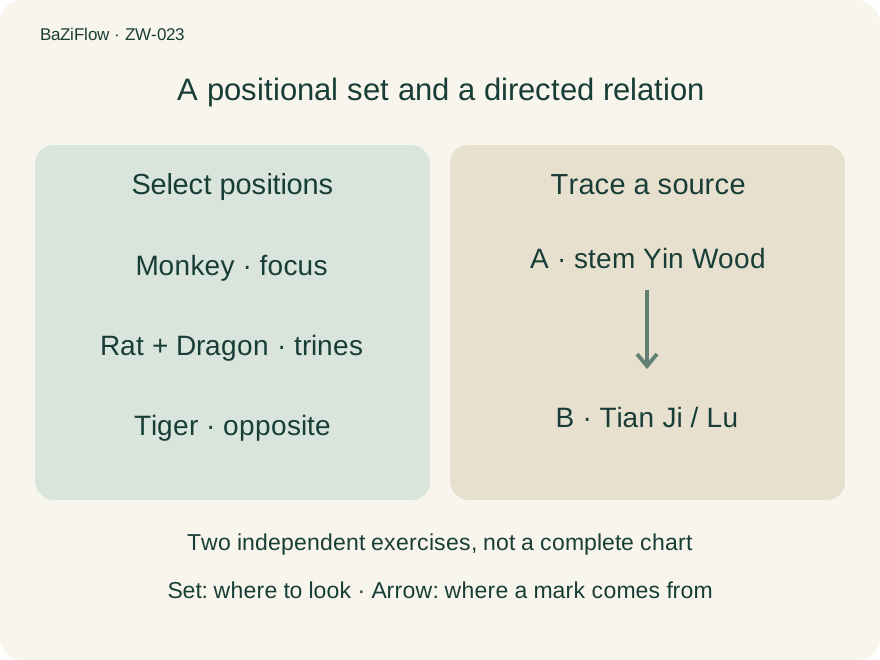
Original BaZiFlow comparison of two operations: positional selection and a directed transformation relation. Neither panel is a complete personal chart.
The panels are deliberately separate exercises. They do not share invented birth data, and A and B have no assigned branch or palace name. Keeping them separate prevents a teaching diagram from pretending to be a valid full chart.
Position set
- Four places to inspect
Directed relation
- Source, star, destination
Use school names as starting points for questions
A reader may use star combinations, surrounding positions and transformations within one explanation. The appearance of a transformation does not automatically prove that the reader has switched schools. Conversely, a shared term does not ensure that two authors give it the same role or priority.
When comparing notes, first align the birth information and calculation settings. Then compare the layer, the table version and the actual operations. Only after those checks is it useful to locate the interpretive disagreement. A mismatch caused by different inputs should not be advertised as evidence that one school defeated another.
Write a short method record: which source was followed, what the focus was, which positions were selected, which stem activated which star, and what hypothesis the author proposed. Leave an unknown rule unknown. Borrowing a missing step from another source can create a hybrid that neither author actually taught.
This approach allows disagreement to become more specific. The error may be a misplaced palace, a lost transformation source, or a different interpretation of correctly recorded structure. Those are different problems, and a broad school label cannot resolve them on its own.
Questions readers ask next
Which aspects of San He and Flying Stars are compared here?
The article compares selecting four surrounding positions with tracing a palace stem to a transformation star and its destination. These are different record operations, not uniform rules attributed to all lineages or a test of predictive accuracy.
What changes when the positional focus moves from Monkey to Rooster?
Rooster’s trines are Ox and Snake, with Rabbit opposite. These replace the old surrounding set. The separate symbolic exercise still has Yin Wood at A and Tian Ji in B, so changing only the spatial focus does not change that transformation record.
Can the old Tian Ji–Lu destination be kept after Yin Wood changes to Yang Wood?
Not as the result of the new query. In the cited table Yin Wood selects Tian Ji for Lu, whereas Yang Wood selects Lian Zhen. Select the new star and check its actual location. If that location is not supplied, the destination remains unverified rather than defaulting to B.
Was this article helpful?