

The Lovers: angel, two people, two trees
Content version · · Sources & references
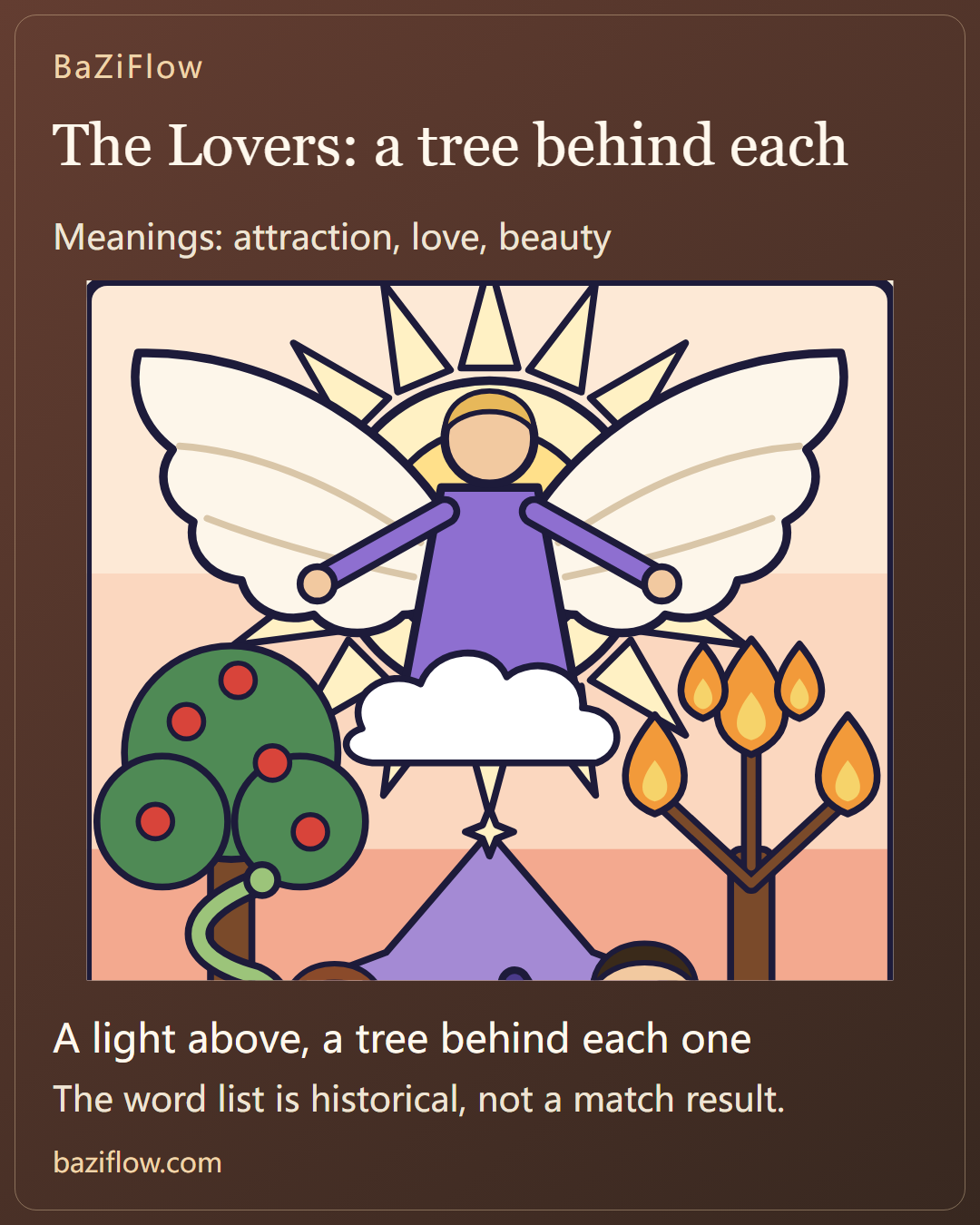
The Lovers shows two people beneath an angel, with a tree behind each. Separate Waite's picture, his word list and the origin of the "choice" reading, then use the trees to plan a talk before sharing a flat.
The short version7 min read
The Lovers shows two people under one light, each with a tree behind. Waite's list says attraction, love and beauty, and has no word for "choice".
- The picture has three tiers: a winged figure before the sun above, a man and a woman between, and two trees behind them, one with a serpent and one bearing twelve fruits.
- The list is a single line: attraction, love, beauty, trials overcome. The popular "pick one of two" reading belongs to the older picture that Waite says he replaced.
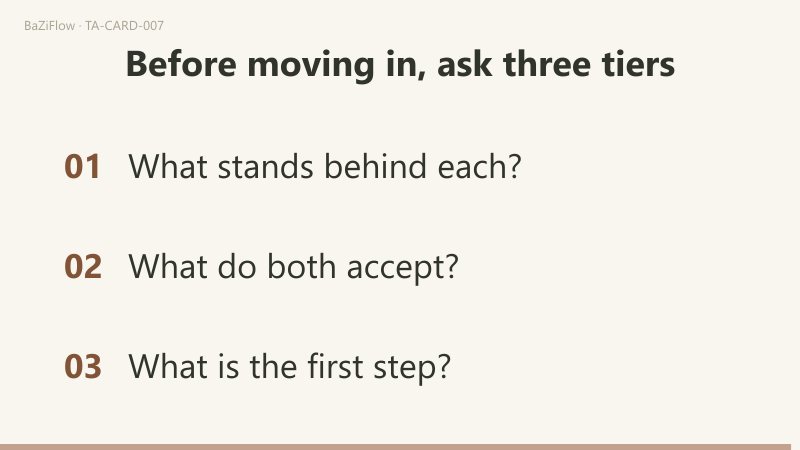
- Use it before sharing a flat: each writes their own "cannot give", then you lay out the rules you both accept, then you set the first step.
Read first
Start with the picture: light above, two between, a tree behind each
In Part II, where he describes each trump's picture and inner symbolism, Waite writes that the sun shines in the zenith, and beneath it is "a great winged figure with arms extended, pouring down influences". In the foreground are two human figures, male and female, "unveiled before each other", as it were Adam and Eve in the first days of the earthly paradise. Behind the man is the Tree of Life, bearing twelve fruits; the Tree of the Knowledge of Good and Evil is behind the woman, with the serpent twining round it.
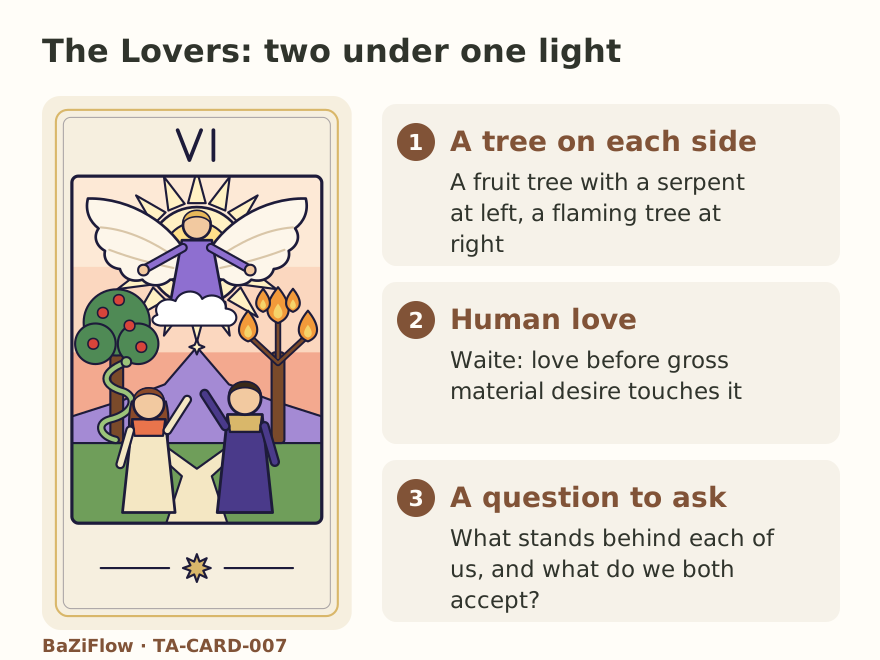
The Lovers: two people under one light, a tree behind each.
The Rider-Waite-Smith picture shows a few things Waite does not mention. The numeral VI is at the top and the sun sends out rays. The angel wears a gray-violet robe with red wings and hair like flame, and a cloud sits beneath. At left the woman stands before a tree with red fruit and a serpent coiled on its trunk; at right the man stands before a tree whose branches carry flame-shaped leaves. The man's face is turned toward the woman, and she looks up. A red mountain rises in the distance between them.
Break the picture into three tiers: above, the light and the angel; between, the two people; behind, two trees, one for each. Each tier stands by itself, and the picture falls apart if one is taken away.
Enlarge diagram · scroll sideways to read
What Waite lists: attraction, love, beauty and trials overcome
Waite's divinatory meanings are a single line: attraction, love, beauty, trials overcome. Reversed: failure, foolish designs. He adds another account, which speaks of marriage frustrated and contrarieties of all kinds.
Attraction, love, beauty, trials overcome. Reversed: Failure, foolish designs.
Enlarge diagram · scroll sideways to read
Attraction comes first in the list, love second, beauty third; the last phrase speaks of a process, trials that have already been overcome. Part II adds a summing-up: in all simplicity this is the card of human love, here exhibited as part of "the way, the truth and the life". The two figures, he says, suggest youth and innocence, and love before it is contaminated by gross material desire.
The angel, two trees and the serpent: who said what
The card carries many symbols, and Waite says most about the trees and the woman. The angel gets one line: a great winged figure pouring down influences.
Three symbols, each with its source
- Winged figure
- Waite places it below the sun, arms extended, pouring down influences. He gives it no name and does not say what the "influences" are.
- Two trees
- The Tree of Life with twelve fruits behind the man; the Tree of the Knowledge of Good and Evil behind the woman, with the serpent twined round it. The names come from the garden story, and Waite compares the two people to Adam and Eve at their first occupation of paradise.
- The woman
- Waite calls her an "attraction towards the sensitive life" that carries the idea of the Fall, then adds that she is the working of a secret law of Providence rather than a willing and conscious temptress; man completes himself "only by her".
Enlarge diagram · scroll sideways to read
Reading the trees as "each person's own ground" is how modern teaching handles them: Waite says which tree stands behind whom and does not say the trees stand for the two people's backgrounds. The borrowing is handy and the next section uses it; label it as borrowed when you do.
How to read it: tree, light and ground before sharing a flat
The Lovers carries three tiers of its own: the tree behind each person, the light above them both, and the ground between them (a path in BaZiFlow's drawing, a mountain in the RWS original). Carry them to an everyday matter: two people talking about renting a flat together.
The tree behind: what can each not give up?
Each person has a tree of their own: how long the commute may be, the rent ceiling, the length of the lease. These conditions existed before they met. Write your own, and do not write the other person's.
The light above: which rule do you both accept?
The angel stands over both and on neither side. In teaching it corresponds to the rules both accept: how the rent is split, who signs the contract, who holds the deposit.
The ground between: what is the first step?
Between the two there is one stretch of ground, and one goes before another. Write the next step as one action and one day: view the flat together this Saturday.
An example: A and B plan to share a two-bedroom flat, and both say "sure". Lay out the "sure":
Enlarge diagram · scroll sideways to read
Before sharing, what the card can help with
Can be laid out
- Each side's limits, apart
- How many rules you both accept
Cannot settle
- Whether the two get along
- Whether to take this flat
Still yours to do
- Write the shared rules down
- Put a date on the first step
Reversed and neighboring cards: from feeling to plans and outcomes
Waite's reversed words are failure and foolish designs; another account says marriage frustrated and contrarieties of all kinds. The upright words (attraction, love, beauty) are about feeling; the reversed words sit on plans and outcomes. That is a difference you can see by reading the list, not an explanation Waite gives.
Three cards, three ways of holding "two people"
Marriage, set inside an institution
Waite's list opens with marriage, alliance, captivity, servitude, and by another account mercy and goodness. Both cards touch marriage; the Hierophant places it in institution and constraint, and the Lovers' list begins with attraction and love.
Two cups, nothing above or behind
The picture is two people pledging one another, and the list is love, passion, friendship, union. The Lovers adds a light above and a tree behind each.
Again a man and a woman, now chained
Waite says the two figures are like Adam and Eve after the Fall, chained to a ring. The two of the Lovers carry no chain, and their list does not open with ravage or violence.
Enlarge diagram · scroll sideways to read
Questions readers ask next
Is the Lovers a card about choosing between two people?
The word "choice" is nowhere in Waite's list. He says this card replaced the older pictures that showed a man standing between vice and virtue, and drew two people face to face instead. The choice reading came later, from the old picture.
What does the Lovers mean reversed?
Waite gives failure and foolish designs, and a second account adds a frustrated marriage and contrarieties of every kind. Where the upright words name what is felt, these name how things turn out.
Do the serpent and the trees point to one of the two as the problem?
Waite ties the trees to the Tree of Life and the Tree of Knowledge from the garden story, and goes out of his way to say the woman is no willing tempress. Reading the trees as each person's own ground is a modern borrowing, not a verdict on either side.
Was this article helpful?
Sources & references
Continue reading
Relationship readings without speaking for the other person ↗