

Separate birth and daily mansions
Content version · · Sources & references
Use two assumed birth labels and one target to distinguish a calendar entry from a personalised relative position, without presenting the exercise as a forecast.
The short version6 min read
A birth mansion belongs to a person’s birth data and chosen rule; a daily mansion belongs to the queried calendar date. A personal position label compares the two. The same Jing target is position four, An, from Bi, but position three, Shuai, from Zui. The reference changes while the day target stays fixed.
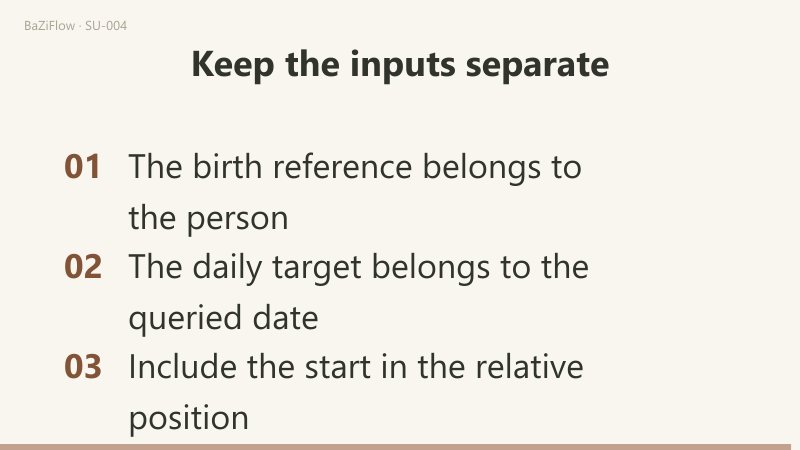
- Birth and daily mansions belong to different inputs: advancing the calendar does not edit the person’s birth reference.
- The inclusive three-nine count puts Bi to Jing at position four, An, despite only three moves; Zui to Jing is position three.
- An identical reference and target is position one, Ming: zero moves does not mean position zero when the start is included.
Read first
What are Sukuyō astrology and the birth mansion? ↗
Why Sukuyō Natal Mansion Methods Differ: Tell Lookup from Zoning, Then Check the Rule ↗
What changed when the calendar advanced?
Consider a saved profile whose birth mansion is Bi (畢). You open a calendar, move to a different date, and see the word An replaced by Wei. Before treating this as a change in the person, ask which value the screen changed. A date label, a birth label and a comparison between them have different owners.
Try two operations separately. Keep the profile selected and change the date: the calendar's target may change. Return to the original date and select another profile: the reference may change. Either operation can change a relative-position label. Neither operation, by itself, edits the first person's birth information.
This is a way to inspect a calendar, not a claim about a particular application's implementation. A changed birth label needs its own explanation: corrected input, revised calendar conversion or a different calculation convention. The passage of another day is not such an explanation.
Birth mansion
- Birth input and rule
Daily mansion
- Queried date and rule
Read the two source passages for different purposes
The three-nine chapter of the CBETA 2023.Q4 T1299 (T21 p. 391a28–b13) sets out three groups of nine positions, beginning from the birth mansion. A later passage (p. 397c19–24) applies that ordering when examining the day's mansion relative to one's birth reference. The first passage supplies an ordering; the second identifies two inputs to a comparison. Their different purposes are worth preserving when a modern interface compresses the result into one word.
The second passage also shows why reading a position name as a plain-language forecast is unreliable. Its traditional activity prescriptions are not reducible to the everyday emotional meaning of a word such as Wei. This article does not reconcile those prescriptions into a modern risk rule. It uses the stated positions, with the historical interpretation kept separate.
NAOJ's calendar account supplies another kind of information: a month-start allocation and subsequent day counting. That helps explain how a date-table label can be obtained. It does not establish which edition or leap-month policy an unidentified calendar uses. A familiar mansion name does not make two lookup methods interchangeable; see calculation-method differences.
Birth reference
Date target
Personal relative position
Test ownership with one target and two references
Use invented inputs, without assigning any actual birth date or civil day. Person A's birth label is Bi, person B's is Zui, and the target label is Jing. Follow the 27-name sequence without Niu and include the starting position as position 1.
| Reference held by the profile | Inclusive run to the same Jing | Position | Sequence label |
|---|---|---|---|
| A: Bi | Bi, Zui, Shen, Jing | 4 | An |
| B: Zui | Zui, Shen, Jing | 3 | Shuai |
Jing stays unchanged in both rows. The difference is the reference, not a second version of the day. In the three-nine ordering of the first passage, positions 4 and 3 carry An and Shuai respectively. This calculation verifies the lookup under the declared ordering; it does not demonstrate that A will have a better day than B.
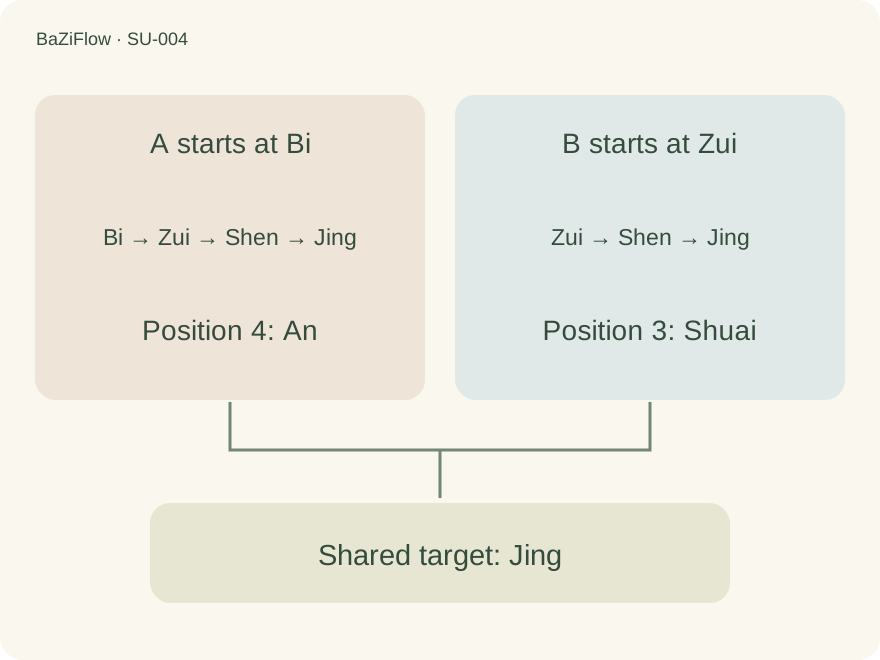
Original inclusive-count diagram using invented inputs. Position labels are not predictions.
Now hold A at Bi and substitute Gui as a hypothetical target. Bi, Zui, Shen, Jing, Gui has five positions, reaching Wei (危). Only the target changed. We have not calculated a real succession of civil dates: a monthly reset or another calendar convention still matters when actual dates are supplied.
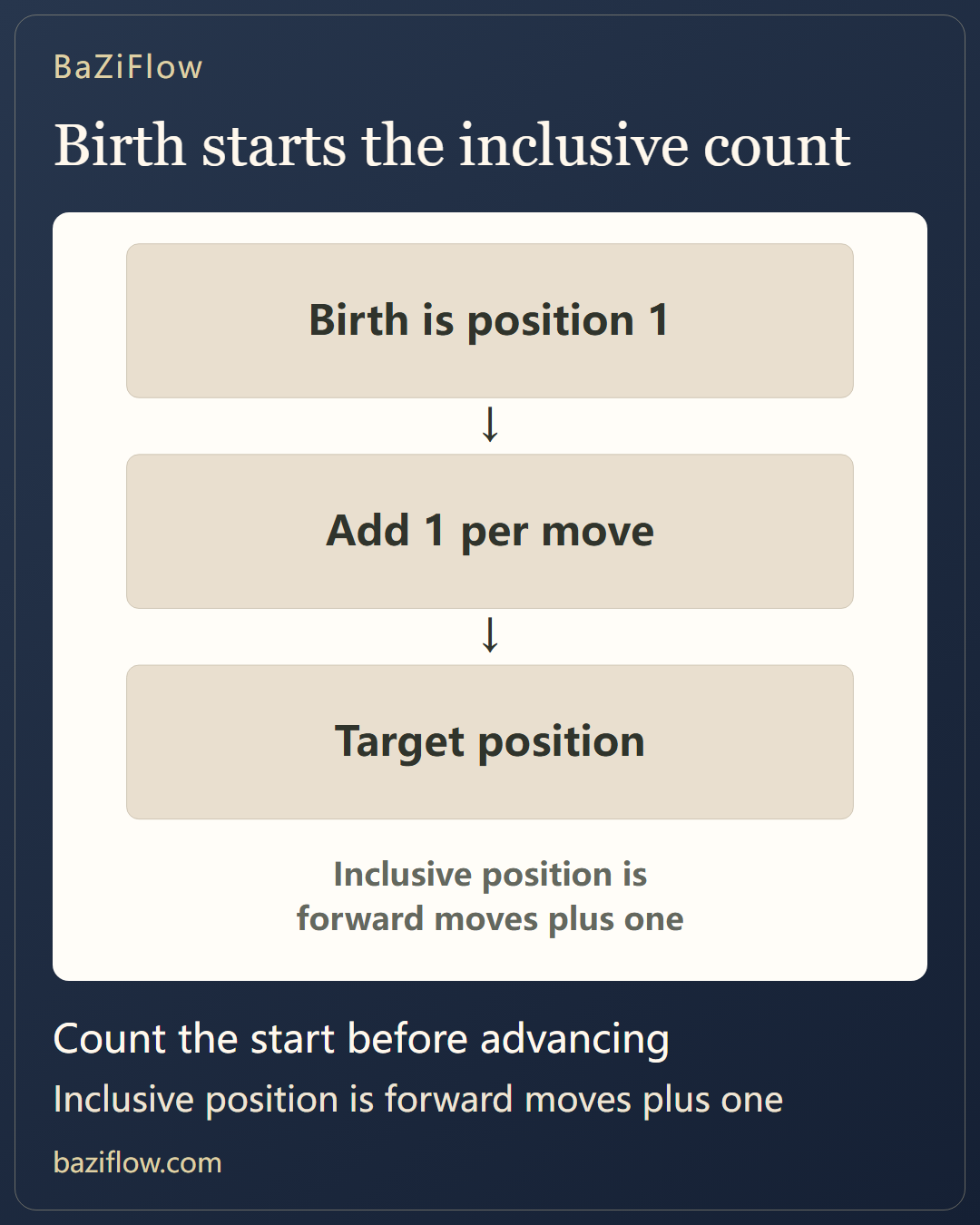
Check the counting boundary with an identical input pair: birth reference Bi and target Bi. No move has occurred, yet Bi itself is already position one, Ming. Reaching Jing from Bi takes three moves but includes four positions—Bi, Zui, Shen and Jing—so the result is position four rather than three.
For this short run, keep forward moves and inclusive position in separate columns: zero moves gives position one; three moves gives position four. Dropping the initial position shifts every answer down by one and would mislabel this An result as Shuai. That arithmetic check verifies the stated convention, not a judgement about the day’s events.
Moves
- Bi
- 0 moves
- Zui
- 1 move
- Shen
- 2 moves
- Jing
- 3 moves
Position
- Bi
- 1 Ming
- Zui
- 2 Rong
- Shen
- 3 Shuai
- Jing
- 4 An
What a cropped screenshot loses
A card showing only An may have discarded the reference that made An the answer. Calling it a label shared by everyone would then change the meaning of the calculation. If the card is intended for public sharing, do not restore private birth details merely to make it reproducible. Explain that it refers to an individual comparison, and keep the underlying personal record privately.
For an internal check, retain the selected date, the reference profile, the rule version and the resulting target. If a screen keeps A's relative label after switching to B, compare those inputs before adding interpretation. A longer explanation cannot repair a result that still belongs to the previous profile.
Also distinguish a calendar assignment from the Moon's live longitude. A date table and an astronomical coordinate calculation are different methods. Neither becomes the other because both display a mansion name.
Change date
- New daily target
Change person
- New birth reference
Finish with a bounded record
The practice entry is small: assumed Bi reference, assumed Jing target, start included, position 4, label An. There is no actual date assignment and no forecast to score. For a real calendar, add its documented lookup and date conversion rather than silently treating these assumptions as calculated facts.
Observed events belong in a separate entry. Keeping an inconvenient event does not invalidate an inclusive count; keeping a pleasant event does not validate a traditional prediction. The calculation and the observation answer different questions. Reading a Sukuyō calendar extends the same care to the other columns on a calendar page.
0 moves = position 1, Ming
Questions readers ask next
How do a birth mansion, daily mansion and position label differ?
The birth mansion belongs to the person’s birth input, the daily mansion to the queried date, and the position label to the comparison from the first to the second. Displaying them together does not make the fields interchangeable.
Why are three moves from Bi to Jing counted as position four?
The cited three-nine convention counts Bi itself as position one. The sequence is Bi 1, Zui 2, Shen 3 and Jing 4. Three intervals connect four counted positions; the number of moves is not the inclusive position number.
Which position applies when reference and target are identical?
Position one, Ming, under this article’s inclusive convention. No move is required, but the starting position is already counted. That identifies the relative position; it does not establish an event that will occur on the day.
Was this article helpful?