
The twelve Zi Wei palaces: a map of questions
Content version · · Sources & references
Learn the twelve palace names, their scope and how to turn a broad life question into a disciplined chart-reading exercise.
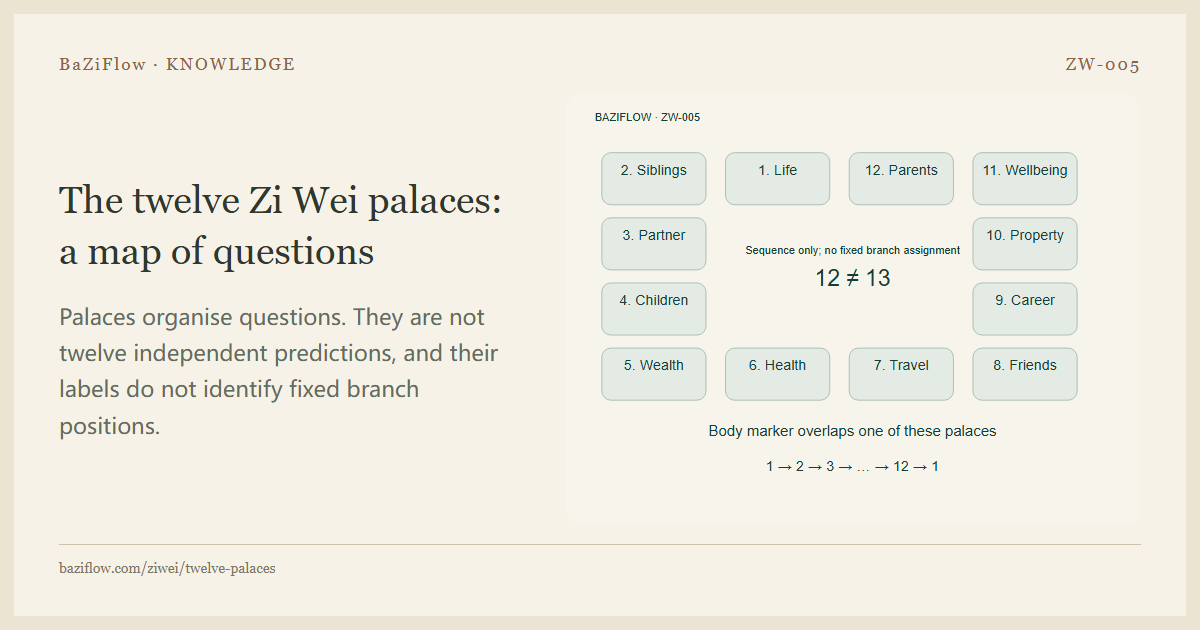
Palaces organise questions. They are not twelve independent predictions, and their labels do not identify fixed branch positions.
Translate the labels before reading the chart
English translations of Zi Wei palace names can sound more literal than intended. “Career” does not mean only government office; “Property” is not a promised house count; “Travel” includes engagement with an unfamiliar environment. A palace marks a topic in a traditional interpretive system. Its name alone does not supply a prediction.
The historical list in volume two of Zi Wei Dou Shu Quan Shu includes labels commonly rendered as wives or concubines and servants. Contemporary usage generally prefers Partner and Friends. Knowing the older terms helps identify a passage without endorsing its social hierarchy.
A working glossary of all twelve
- Life: a central reference for self-expression and the chart's overall orientation.
- Siblings: siblings and peer ties, with broader extensions depending on the method.
- Partner: partnership dynamics, not a complete chart of another person.
- Children: children and younger-generation relationships, not a fertility test.
- Wealth: ways of obtaining and handling resources, not a bank balance.
- Health: traditional bodily and condition-related symbolism, not a diagnosis.
- Travel: external settings, movement and life beyond familiar surroundings.
- Friends: friends, collaborators and group relationships.
- Career: responsibilities, work and public activity, not only a job title.
- Property: home, residence and property-related circumstances.
- Wellbeing, often called Fortune or Happiness: inner experience, rest and satisfaction, not moral merit.
- Parents: parental and related support relationships; further extensions should name their school.
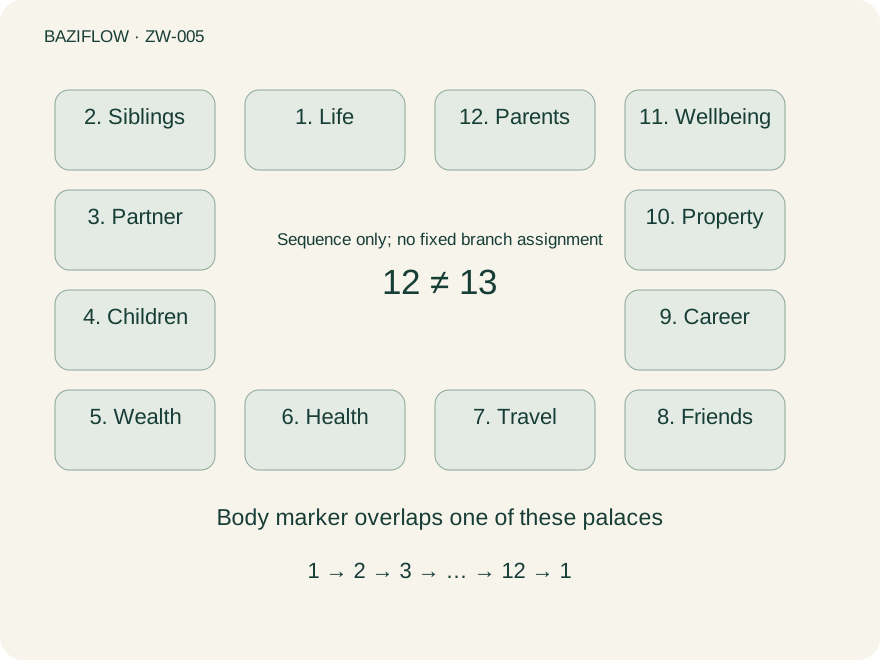
A conceptual guide, not a personal chart or a strength score.
Three coordinates that must stay separate
A chart has twelve branch positions, twelve palace labels assigned according to its rules, and sometimes a Body marker. The Life palace does not always occupy the same branch. The Body marker lies within one of the twelve palaces; it is not an extra thirteenth house. Our diagram gives a teaching sequence, not a universal natal placement.
Software may overlay annual or decade palace labels on the natal chart. If several names appear in one box, identify their timing layer before copying them into a notebook. A change in the annual label does not rewrite the original natal position.
Practise with questions, not outcomes
Take three distinct questions: changing a job, moving home, and forming a business partnership. For the first, separate responsibilities from pay and workplace location. For the second, separate the dwelling from the wider environment. For the third, distinguish the symbolic cooperation topic from the real agreement, contributions and track record of the other person.
You now have a reason to consult Career, Wealth, Travel, Property or Friends, rather than collecting reassuring sentences from every box. This is a way to organise study, not an automatic palace-combination rule. The actual interpretive links must still follow a stated method and the chart's displayed placements.
What an empty palace does not establish
“Empty” usually means none of the fourteen major stars is resident. Other stars and relationships can remain relevant. It does not mean the corresponding experience is missing from life. Similarly, the existence of a Partner palace cannot establish a particular partner's character or future behaviour.
Return to the Zi Wei introduction if palace placement and star placement are still getting mixed together. BaZi and Zi Wei reading methods explains why a familiar translation such as Wealth must not be treated as an exact cross-system equivalent.
Sources & references
Continue reading
What is Zi Wei Dou Shu? A first guide to palaces and stars ↗