

Shock Gate: the Metal of Dui Seven, third in Yin ju 9
Content version · · Sources & references
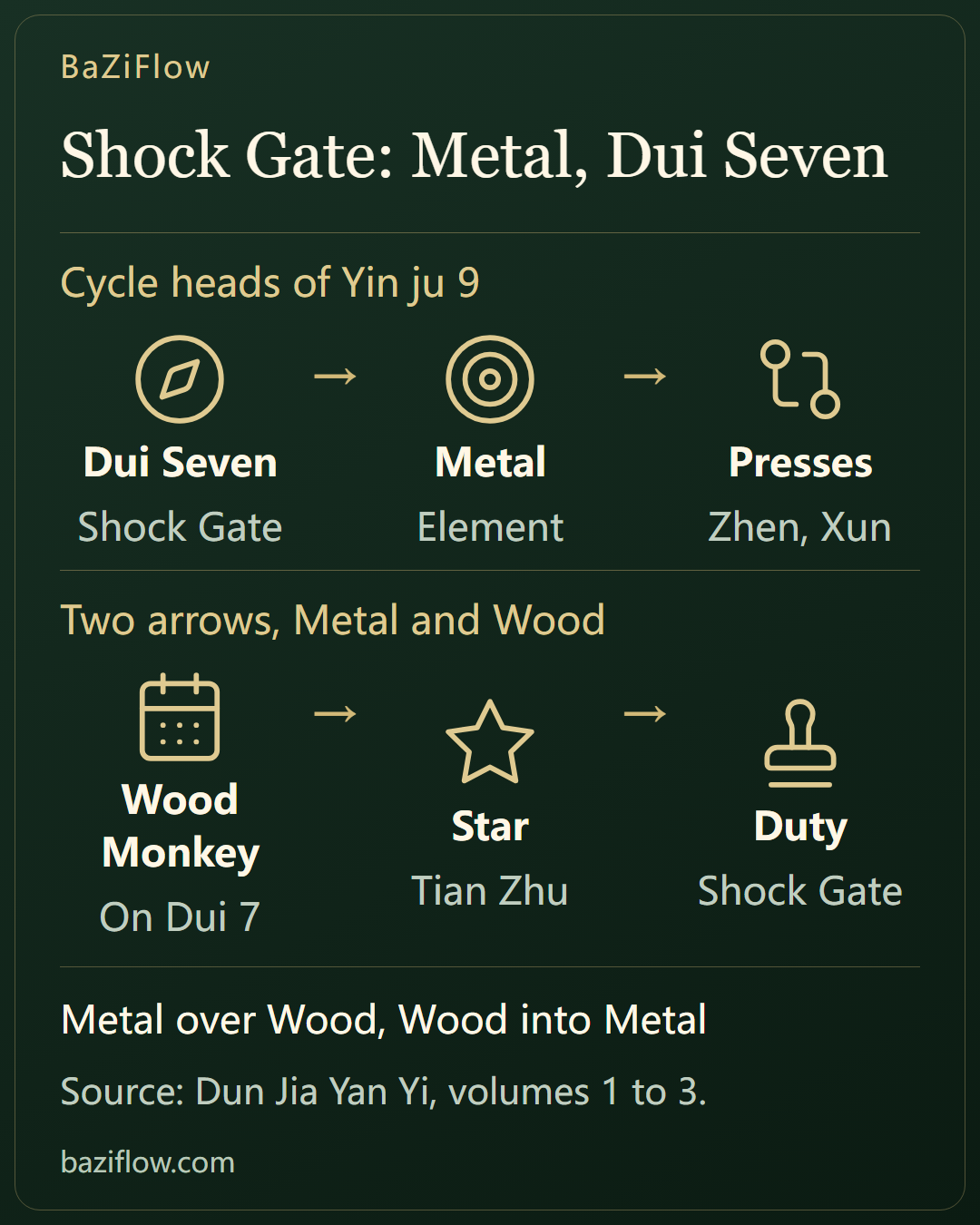
The Shock Gate starts in Dui Seven and belongs to Metal. We read the six cycle heads of Yin-mode ju 9, the verse line on it, Human Feint, and the two passages where Metal meets Wood.
The short version8 min read
In Yin-mode ju 9 the Yang Metal of the Yang Wood Monkey cycle falls on Dui Seven, so the gate on duty is the one at home there, the Shock Gate. The book mentions this Metal gate in three more places: a line of the verse, the Human Feint among the five feints, and two passages where Metal meets Wood.
- The six cycle heads of Yin-mode ju 9 fall on Li Nine, Gen Eight, Dui Seven, Qian Six, the center and Xun Four; the Yang Wood Monkey head sits on Dui Seven, with Tian Zhu as duty star and the Shock Gate as duty gate.
- The verse gives the gate one line, about seizing and lawsuits; among the five feints it joins Six Harmony and lies on Nine Heaven as Human Feint, which the book puts to catching fugitives.
- Metal meets Wood with two different arrows: the gate on Zhen Three or Xun Four is a gate restraining its palace, an ominous gate pressed; the Yin Wood wonder on the gate in Qian Six is “Wood entering Metal’s land”, a wonder under restraint.
Read first
Dui Seven, due west: the Shock Gate sets out from the autumn position
Dui Seven (兑七) lies due west in the nine palaces and belongs to Metal; it is the home of the Shock Gate (惊门).
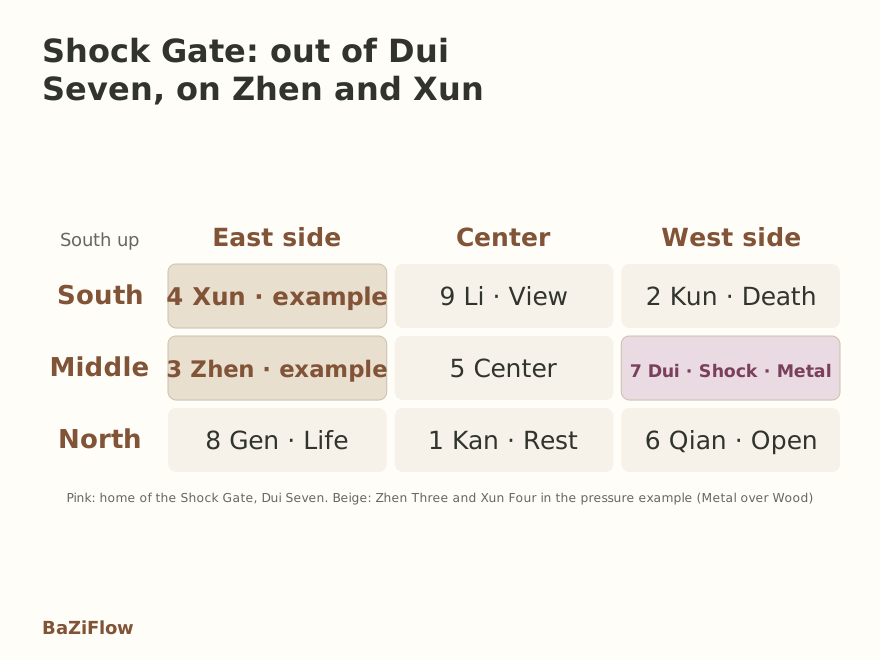
Nine-palace base grid with south at the top and east on the left; directions and elements follow the usual assignments. Pink marks the Shock Gate’s home, Dui Seven, and beige marks Zhen Three and Xun Four, where the pressure example puts it. They are three different boxes.
On the south-up, east-left grid, Dui Seven is the rightmost box of the middle row, facing Zhen Three across the center, and 7 + 3 = 10. The Shuo Gua (说卦), chapter 5, describes Dui through a season:
Dui is the true autumn, that in which all things rejoice.
“True autumn” fits due west and fits Metal, and the word translated “rejoice” is the one that also means “delight”. What the gate carries away from this box is its direction and its Metal. The word for “shock” in the gate’s name is left unexplained by the book.
Yin-mode ju 9: six cycle heads, and the Shock Gate is third
A cycle head is the first of each run of ten double-hours. Yin-mode ju 9 puts the Yang Earth instrument on Li Nine and lays the six instruments out backward: 9, 8, 7, 6, 5, 4 for Yang Earth, Yin Earth, Yang Metal, Yin Metal, Yang Water and Yin Water. Wherever a cycle head’s instrument lands, the home star and home gate of that palace become the duty star and duty gate. Volume 1 of Dun Jia Yan Yi, a text from the Ming, writes out all six heads of this ju; the third reads:
Yang Wood Monkey is at Dui; Tian Zhu is duty star and the Shock Gate is duty gate, governing ten double-hours.
Enlarge diagram · scroll sideways to read
The instrument of the Yang Wood Monkey cycle is Yang Metal, it lands on Dui Seven, and Dui Seven’s home star is Tian Zhu and home gate the Shock Gate, so those two take this cycle. The Shock Gate is third only because the heads run Yang Wood Rat, Yang Wood Dog, Yang Wood Monkey; the count is by position and has nothing to do with the gate’s name. In another ju the instrument falls elsewhere and so does the duty: in Yang-mode ju 1 Yang Metal is on Zhen Three, and the Yang Wood Monkey cycle goes to Tian Chong and the Harm Gate. The whole duty calculation is in duty chief and duty door.
One line from the verse: “seize, lawsuits, a name”
The Yan Bo Diao Sou fu gives each gate a line or two, and the Shock Gate’s has seven characters:
The Shock Gate can seize; lawsuits have a name.
The original has no punctuation; read literally, the gate suits seizing people, and in a lawsuit a reputation is made. Seizing means arrest, a lawsuit means a legal case, and “a name” means a reputation that goes abroad.
Enlarge diagram · scroll sideways to read
The line names kinds of business only. It does not say who seizes whom or who sues whom.
Human Feint among the five feints: gate, god and palace come from two layers
Of the five feints that volume 2 sets beside its three ruses, the gate takes the one called Human Feint:
If the Shock Gate joins Six Harmony and lies on the Nine Heaven palace, it is called Human Feint, and suits catching fugitives.
Enlarge diagram · scroll sideways to read
The three conditions come from two layers: the Shock Gate sits in the gate layer, Six Harmony (六合) and Nine Heaven (九天) in the god layer. What “joins” and “lies on” each mean the text leaves open, and only the literal wording is given here.
Where the same book speaks of Six Harmony, the volume 3 commentary says “beneath Six Harmony one may escape”, while Human Feint says “suits catching fugitives”: one speaks for the side that flees and the other for the side that catches, and both revolve around fugitives. For the positions of Six Harmony and Nine Heaven, see Six Harmony; the matching jia hung on the View Gate is described in View Gate.
Metal meets Wood: a gate pressing, and Wood entering Metal’s land
The Shock Gate is Metal, and the book puts it up against Wood twice, with the arrow pointing in different directions.
The first is in the pressure section of volume 2: the Shock Gate placed in the third and fourth palaces is listed among the ominous gates that are pressed. Zhen Three and Xun Four are both Wood, and Metal restrains Wood: the gate acts on its palace.
Enlarge diagram · scroll sideways to read
The second is in the volume 2 passage on wonders under restraint, which cites a remark of Wang Zhang:
The Yin Wood wonder on Qian with the Shock Gate, with Yang Metal and Yin Metal imprisoned and dead, is Wood entering Metal’s land. … This is called a wonder under restraint; nothing may be started.
The Yin Wood wonder (乙) is Wood, Qian Six is a Metal palace and the Shock Gate stands there as well: Wood has entered the place of Metal, called “Wood entering Metal’s land”, and the book names this a wonder under restraint.
Enlarge diagram · scroll sideways to read
With the same two elements, one passage has the gate (Metal) pressing a Wood palace and the other has a wonder (Wood) entering a Metal palace. The arrow differs and so does the name of the passage, and swapping one for the other changes the question.
Writing the Shock Gate in a note
What the book states
- Home Dui Seven, element Metal
- Duty gate of the Yang Wood Monkey cycle in Yin ju 9
- Verse, Human Feint and the examples each have a source
What the name cannot give
- That someone was frightened
- That a lawsuit has begun
- That someone is on the run
Still to look up
- The element arrow of gate and palace
- Whether wonders, stars and gods share the palace
- The ju number and cycle head
Going around the gates’ homes, the next one after the Shock Gate is the Open Gate.
Questions readers ask next
How does the gate on Zhen Three and Xun Four differ from the Yin Wood wonder on Qian Six?
In the first, the actor is the gate, which presses on the palace; in the second the actor is the Yin Wood wonder, which enters a Metal palace. Both involve Metal and Wood, but the thing acted on differs and so do the names of the passages; neither stands in for the other.
Does “shock” mean someone will be frightened?
The book never reads the name as a forecast for a person: the verse speaks of seizing, lawsuits and reputation, Human Feint of catching fugitives. The word for “shock” itself gets no explanation in the text, and none is added here.
Is the Shock Gate also duty gate of the Yang Wood Monkey cycle in other ju?
Not necessarily. The duty gate follows wherever the cycle head’s instrument falls: in Yin ju 9 Yang Metal falls on Dui Seven, so it is the Shock Gate; in Yang ju 1 it falls on Zhen Three and the Harm Gate takes the duty instead.
Was this article helpful?
Sources & references
Continue reading
Death Gate: the Earth of Kun Two and How Dun Jia Yan Yi Limits What It Governs ↗
Open Gate: Yin Wood on Yin Earth, Yang Fire Tiger in Two Ju, and the Book’s Other “Open” ↗