

Poem, allusion and commentary
Content version · · Sources & references
Use a named Guanyin lot page to separate the poem, story heading, and remarks, while keeping editorial choices and personal interpretations visible.
The short version6 min read
A heading invites research, a poem supplies wording and a gloss adds a labeled reading aid. Keep these functions visible before bringing in a story or relating a phrase to a present concern.
- The title of a story is not the developed narrative or its application to this poem.
- Twenty-eight poem characters and sixteen gloss characters remain two blocks, even when copied together.
- A substituted character can preserve the count; new dates and occupations also need an identified source.
Read first
What are oracle lots? Numbers, poems, and narrative references ↗
Why the same oracle-lot number can have different versions ↗
A story heading is not a biography supplied by the page
The heading “Zhongli attaining the Dao” may invite a reader to tell a long story. On the Chinese Temples Committee's Guanyin lot-one page, however, the allusion field supplies a short title rather than a developed narrative. Episodes added from memory are additional material, even when they sound familiar.
That distinction is the starting point of this article. A lot page can contain an identifier, a grade, a story heading, a poem, and a commentary. These elements guide reading in different ways. They should not merge with the reader's own associations into one supposedly original statement.
We use this named page as a limited textual exercise, not as a reading drawn for you or as a template for every lot collection. If your paper differs, first check same-number edition differences. A shared number does not establish shared wording.
Heading
- Research lead
Poem
- Displayed wording
Gloss
- Separate remarks
A heading, poem and gloss have different roles
- Source wording
- Visible words in an identified field of the named page.
- Interpretive layer
- An added explanation with its author and supporting reasons retained.
Count the text blocks before interpreting them
The poem on this page has four lines of seven Chinese characters: 4 × 7 = 28, excluding punctuation and line breaks. The separately labeled explanatory remarks (解曰) has four units of four characters: 4 × 4 = 16. These counts describe the displayed material; they do not give either number a divinatory meaning.
| Field | What can be checked here | What the field does not supply |
|---|---|---|
| Allusion heading | Zhongli attaining the Dao | A full biography or a cast of people in your life |
| Poem | Four seven-character lines, 28 characters | A specified occupation, month, or relationship outcome |
| Explanatory remarks | Four four-character units, 16 characters | A guaranteed schedule for an event |
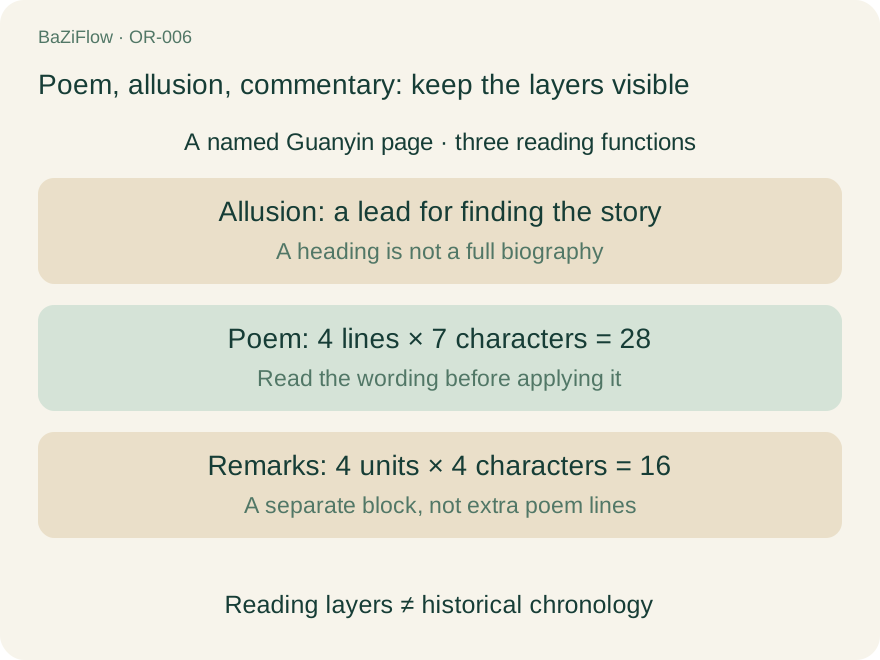
Original BaZiFlow text-layer diagram. Character counts check this page's structure; they are not fortune numbers.
A count can reveal a missing line, but an equal total cannot prove an accurate transcription. One character could have been substituted for another. Return to the actual wording after checking the block lengths. If poem and remarks are copied together without their labels, a later reader may mistake them for one longer poem.
Poem
- Units
- 4
- Characters each
- 7
- Total
- 28
Gloss
- Units
- 4
- Characters each
- 4
- Total
- 16
Let the poem make its own claims
The opening line, roughly “heaven opens and earth breaks ground, making a good bond”, brings together imagery of heaven and earth opening and a favorable connection. Before applying it to a personal concern, identify the imagery and the relationship between the words. A broad expression of affinity does not, without argument, become a promise of marriage.
Nor does an image of a beginning automatically guarantee that a business venture will succeed. If a modern explanation introduces a particular month, amount of money, or job title, ask where that detail entered the interpretation. It may come from the current situation or an interpreter's hypothesis; it should not be presented as a literal translation of words that do not contain it.
This does not prohibit personal reflection. A person considering collaboration might find the language of connection useful. The honest formulation is that the reader is making that connection in relation to a stated concern. It does not establish another person's unexpressed willingness to collaborate.
Favorable connection
- Words being read
Explore collaboration
- A present interpretation
Consent received
- Needs real confirmation
Use the allusion as a research lead, not a casting instruction
The short heading can help locate a story elsewhere. Once a source is found, distinguish two tasks: establishing what that source says, and explaining how its story relates to the poem in this edition. The first task does not automatically complete the second.
Do not import every episode from a text merely because the protagonist has the same name. Still less should every supporting character be assigned to a colleague, partner, or relative in the reader's life. Such a mapping would need an argument that the heading alone cannot provide.
This article does not reconstruct Zhongli's life or date the attachment of the heading. Its position above the poem establishes a layout, not historical priority. Checking allusion sources addresses the further work of identifying a book, passage, and version.
Commentary helps reading without becoming the poem
The explanatory block begins with the compact expression, roughly “swift yet not swift”, involving speed and its qualification. The page's favorable grade should not erase wording that requires careful interpretation. Conversely, a remark involving pace need not immediately be declared inconsistent with a broad favorable label.
There is no need here to force the expression into an exact number of days or months. A short traditional phrase can require explanation while remaining distinct from a modern forecast. Label the latter as an interpretation if you offer one, rather than letting it inherit the status of the quoted text.
The Committee's introduction says its editorial work considered differences in grades, allusions, poems, and remarks, and presents the result as a reference supplement rather than a unification of all versions. This supports citing a specific edited presentation. It does not establish that every field was written by one author at one time, or that the current page preserves a unique earliest form.
Keep your own explanatory layer visible
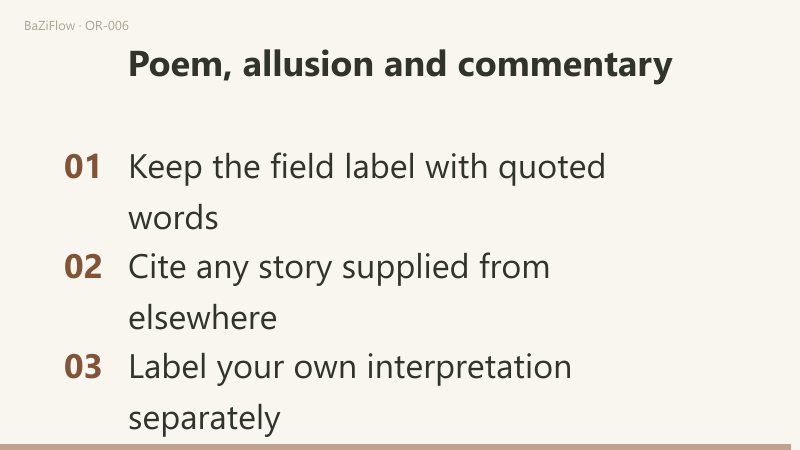
In a reading note, place a short original phrase beside its field label, then add any external commentary with its source. Put your own interpretation in a separate paragraph. An absent commentary source can remain absent; a plausible anonymous explanation should not be invented to fill the space.
For example, treating favorable connection as a reason to explore a possible collaboration is an interpretive move. Deciding what information to request from the other party is a further practical move, dependent on actual circumstances. Neither should be described as an instruction already printed in the poem.
Save the edition and the page context, not just its grade. Recording a lot's version and source makes the text recoverable for later comparison. Clear layers do not prove predictive validity. They do let a reader ask a more answerable question: which words, from which source, support this particular explanation?
28 characters
- What is checked
- Matching length
- Not established
- Every character correct
Page arrangement
- What is checked
- Separate fields
- Not established
- Their historical dates
Count two blocks
The poem is 4×7 = 28 and the gloss 4×4 = 16. Keep their field labels.
Test one omitted line
Three poem lines would give 3×7 = 21. The seven-character gap prompts a return to the source, not an invented replacement.
Test one substituted character
Replacing one character can leave the total at 28. Compare the actual wording to locate that different error.
Questions readers ask next
Why preserve the poem and gloss labels?
Without them, copied remarks may appear to be part of the poem rather than a separate text block.
Can an allusion heading assign real-life roles?
It supplies neither a complete narrative nor an argument mapping its characters to people in the present concern.
Does a total of 28 establish an accurate transcription?
Only its length matches this example. A substitution or a changed order can preserve the same total; compare the actual words with the source.
Was this article helpful?
Part of a learning path
Sources & references
Continue reading
Recording an oracle-lot source: identifiers, dates, and gaps ↗
Upper and lower oracle lots are labels, not event outcomes ↗
Check an oracle-lot allusion against the passage, not a title ↗