

Equalizing Things: perspectives meeting
Content version · · Sources & references
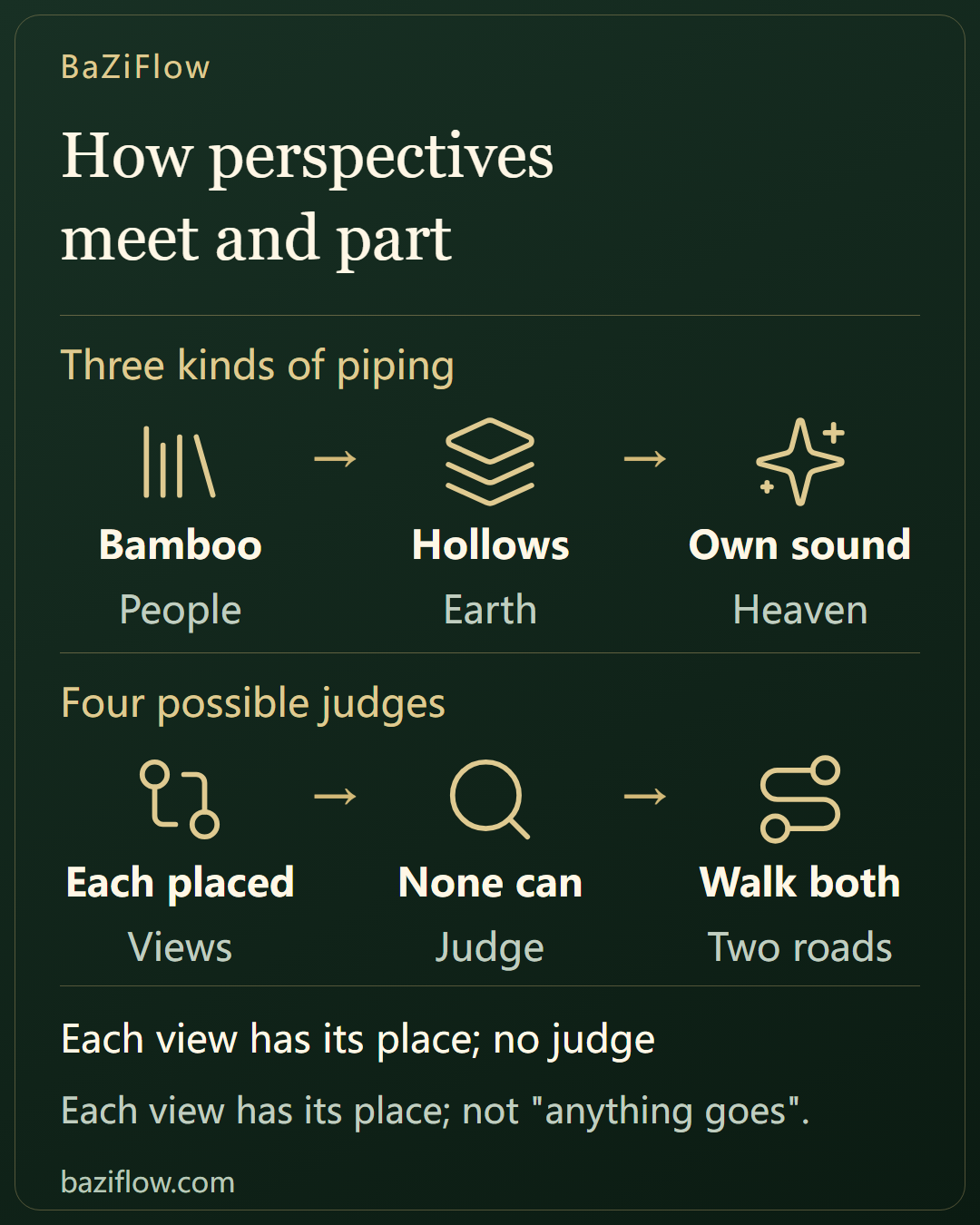
Three kinds of piping, Wang Ni's three questions, "that" and "this", who can judge, three in the morning and the butterfly: where words and judgments reach their limit, and why that is not "anything goes".
The short version10 min read
With the pipes that blow "on the myriad things, each differently", the creatures' different "right" dwelling, taste and beauty, and the saying that "that" and "this" are born together, "Equalizing Things" asks where each view stands and why a dispute has no judge; it never says that every judgment is the same.
- In dwelling, food and beauty, humans, loaches, apes, deer, fish and birds each have their own "right", so the question of whose standard counts has no ready, common answer.
- "That" and "this" lean on each other, and each side calls its own side "this"; the text answers with "nothing like clear illumination" and asks us to stand in the "center of the ring" of the pivot of the Way.
- Whoever is brought in to settle a dispute, a friend of either side, a stranger to both or someone who agrees with both, is disqualified by the text, one candidate after another.
Read first
The Zhuangzi: Inner, Outer and Miscellaneous Chapters, Mapped ↗
Free and Easy Wandering: What the Great Bird and the Small Birds Argue About ↗
"I have lost myself": starting from three kinds of piping
"Equalizing Things" begins with Nanguo Ziqi sitting propped on his armrest, looking up at the sky and exhaling slowly, as if he had "lost his counterpart". His pupil Yan Cheng Ziyou asks what has happened, and he answers: "Today I have lost myself." Then he speaks of three kinds of piping, three kinds of sound.
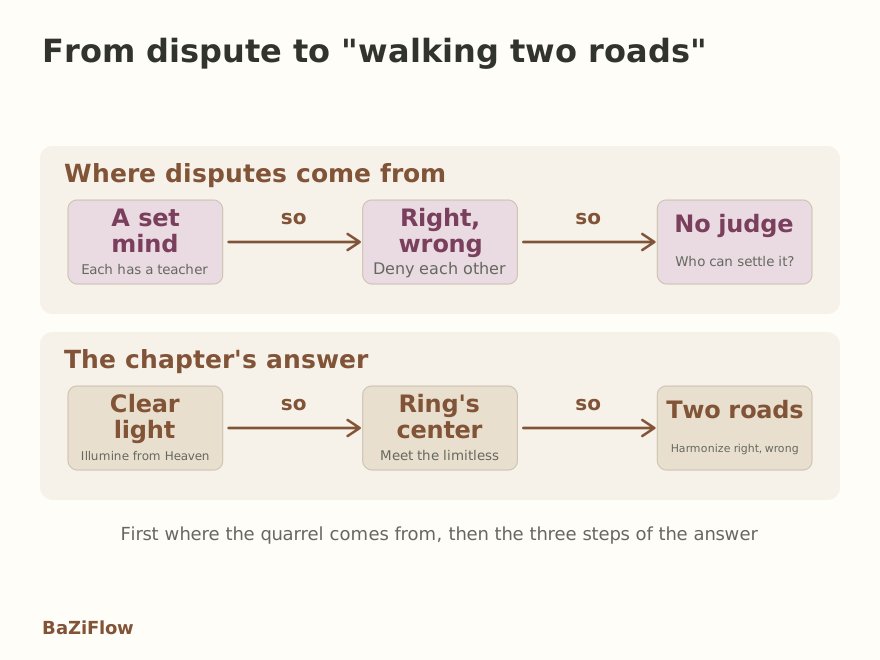
Relation sketch: the top row is how disputes arise, the bottom row the three steps of the answer, each of which can be checked against a line of the text.
The diagram above is the whole chapter in relation form. Start with the three kinds of piping, the first picture the text draws:
Enlarge diagram · scroll sideways to read
People's piping is "pipes of bamboo set side by side", played by people. Earth's piping is the "many hollows": when the wind rises, the hollows of a forest sound together, some like a nose, some like a mouth, some like an ear, each with its own sound, "roaring, scolding, sucking, crying". As for Heaven's piping, Ziqi gives no definition and only asks:
It blows on the myriad things, each differently, and lets each be itself; each takes what it takes for itself. Who, then, is the one that makes them roar?
Each hollow gives out its own sound, and the wind chooses none of them. "I have lost myself" is often explained as letting go of the "I" that clings to itself, which is the commoner traditional reading; the text moves straight on to the three kinds of piping without elaborating.
Whose standard is "right": Wang Ni's three questions
Nie Que asks Wang Ni: "Do you know what all things agree is right?" Three times Wang Ni answers "how would I know?" Then he asks three questions about everyday things.
Enlarge diagram · scroll sideways to read
The three questions each have more than one side answering: in the damp a person aches while a loach does not; at table people, deer, the centipede (it relishes snakes, so the traditional commentaries read the text) and owls each have their taste; in beauty, people find Mao Qiang and Li Ji lovely while fish, birds and deer flee from them.
Seen from where I stand, the beginnings of benevolence and righteousness and the paths of right and wrong are all jumbled and confused. How could I know how to tell them apart?
The phrase for "jumbled and confused" pictures things crossing in every direction. Wang Ni's point is that with no standard that everyone accepts, he cannot use one to sort this tangle of right and wrong. The same thing is called "right" by a different standard from a different place.
"That" and "this": a different place, a different name
"Nothing is not 'that', nothing is not 'this'. From 'that' it is not seen; from knowing oneself it is known." From the side of "that" you cannot see what is on the side of "this", and from your own side you can. The Confucians and the Mohists are the ready example: each "calls right what the other calls wrong and wrong what the other calls right".
Enlarge diagram · scroll sideways to read
"That" and "this" are a pair of pointing words that appear together: only when there is this side is there that side. "Just born is just dying" and "just fit is just unfit" are the same reasoning put another way. Disputants always think they stand at "this" and the other at "that", but swap places and the names swap too.
When "that" and "this" find no counterpart, this is called the pivot of the Way. Once the pivot finds the center of its ring, it can answer the limitless.
The pivot is a door hinge, and the "center of the ring" is the middle of the socket it turns in. Tradition uses the image to say that a hinge set in the middle of its socket lets the door swing either way, so only one who leans to neither side can answer the endless changes of "this" and "that". That is what "nothing like clear illumination" means: to light things with clarity, not to crush the other side with one's own "this".
The limits of words and argument: who can judge
"Words are not wind blowing; a speaker has something to say, but what he says is simply not fixed." Words are not like wind through a hollow: the speaker has something in mind, but what he says is "not yet fixed". Later in the chapter Zhangwuzi asks the question no one can avoid: when two people argue, who decides?
Enlarge diagram · scroll sideways to read
Zhangwuzi rules out all four: each is already on one side or off both, and none is entitled to say who is right.
If someone who agrees with me is to settle it, he already agrees with me, so how can he settle it? If someone who differs from both you and me is to settle it, he already differs from both of us, so how can he settle it?
So Zhangwuzi concludes that "you and I and everyone cannot know one another". The way out he calls "harmonizing with the heavenly dividing": traditionally taken as answering along the natural divisions of things, without insisting on one common right and wrong.
The text also gives another grading of speech:
How the sage speaks of three kinds of matter
Keeps it, does not discuss
Grants that it exists, but passes no comment.
States it, does not weigh it
Can set out an account but does not judge who is right.
Weighs it, does not argue
Can judge, but does not argue it out to the end.
Three in the morning: names unchanged, joy and anger put to use
Today the Chinese idiom "three in the morning, four at night" usually means fickleness, but in "Equalizing Things" it is about something else. Before the story the text first gives a definition: "To wear out the mind making things one without knowing they are already the same is called 'three in the morning'."
Enlarge diagram · scroll sideways to read
A monkey keeper handing out nuts says "three in the morning and four at night", and the monkeys are all furious. He says "then four in the morning and three at night", and they are all pleased. The daily number is the same; only the wording was changed.
The names and the facts were not diminished, yet joy and anger came into play; this too is going along with "this". So the sage harmonizes with right and wrong and rests in the even balance of Heaven. This is called "walking two roads".
"Names and facts not diminished": neither name nor fact lost anything; "joy and anger put to use": yet joy and anger took effect. Traditionally "walking two roads" is read as both sides passing: the sage grants each side its "right and wrong" and himself rests on the "heavenly balance", tied to neither side. That does not say the two sides are the same; it says not choosing one side to overpower the other.
The penumbra and the shadow, and Zhuang Zhou's butterfly: even the self is changing
Near the end come two short stories that turn "perspective" back on oneself.
Enlarge diagram · scroll sideways to read
The penumbra (the faint outer shadow) asks the shadow: a moment ago you walked, now you stop; a moment ago you sat, now you rise; why so little steadiness? The shadow answers: "Do I move depending on something? And what I depend on, does that too depend on something?" A shadow leans on a body, and the body leans on other things. The word "depend" here is the one in "depending on something" in Free and Easy Wandering, worth looking back to.
The last story is the butterfly:
He did not know whether Zhou had dreamed he was a butterfly, or the butterfly dreamed it was Zhou. Between Zhou and the butterfly there must be a distinction. This is called the transformation of things.
Note the words "there must be a distinction": Zhou is Zhou and the butterfly is a butterfly, and the difference stays; what changes is the passing from one to the other. "Transformation of things" is traditionally taken as the changing of things into one another. Zhangwuzi has already spoken of one "who dreams of drinking wine and weeps at dawn" and of "a great awakening, after which we know this is a great dream"; the butterfly closes the same theme.
To see the chapter within the book, read on:
- The structure of the Zhuangzi: where this chapter sits among the inner chapters.
- Free and Easy Wandering: where "depending on something" first appears.
- Cook Ding carves the ox: the story in "Nurturing Life", the very next chapter.
Questions readers ask next
Does "Equalizing Things" say every view is right and anything goes?
It cannot be read that way. The text still separates grades of speech, saying "to stop at what one does not know is the utmost", and says to "harmonize with right and wrong". What it speaks of is that a dispute has no final judge and that words have limits; it does not remove all distinctions.
Did "three in the morning" originally mean a person who keeps changing his mind?
Not in the text. A keeper offers three nuts in the morning and four at night and the monkeys are angry; he offers four in the morning and three at night and they are pleased. The total did not change, only the way it was put. Its use for fickleness came later, as a new sense of the Chinese idiom.
Does the butterfly dream settle which is real and which is false?
No. Zhuang Zhou wakes still himself, yet cannot tell whether he dreamed the butterfly or the butterfly dreams him; the ending stresses that between Zhou and the butterfly "there must be a distinction", and names such change the "transformation of things", without declaring either one false.
Was this article helpful?
Part of a learning path
Sources & references
Continue reading
The Zhuangzi: Inner, Outer and Miscellaneous Chapters, Mapped ↗
Free and Easy Wandering: What the Great Bird and the Small Birds Argue About ↗
Cook Ding Carves the Ox: Skill, Attention and Nourishing Life ↗